6
understands and follows these safety instructions as well.
REMEMBER! Welding by nature produces sparks, hot
spatter, molten metal drops, hot slag, and hot metal parts
that can start fires, burn skin, and damage eyes.
FLASH HAZARDS
WARNING
ARC RAYS CAN INJURE EYES AND BURN SKIN! To
reduce risk of injury from arc rays, read, understand, and
follow the following safety instructions. In addition, make
certain that anyone else that uses this welding equipment, or
is a bystander in the welding area, understands and follows
these safety instructions as well.
FUME HAZARDS
WARNING
FUMES, GASSES, AND VAPORS CAN CAUSE
DISCOMFORT, ILLNESS, AND DEATH! To reduce risk of
discomfort, illness, or death, read, understand, and follow
the following safety instructions. In addition, make certain
that anyone else that uses this welding equipment or is a
bystander in the welding area, understands and follows
these safety instructions as well.
COMPRESSED GASSES AND EQUIPMENT HAZARDS
WARNING
IMPROPER HANDLING AND MAINTENANCE OF
COMPRESSED GAS CYLINDERS AND REGULATORS
CAN RESULT IN SERIOUS INJURY OR DEATH! To
reduce risk of injury or death from compressed gasses and
equipment hazards, read understand and follow the following
safety instructions. In addition, make certain that anyone
else who uses this welding equipment or a bystander in the
welding area understands and follows these safety
instructions as well.
Do not use flammable gasses with MIG welders. Only inert
or nonflammable gasses are suitable for MIG welding.
Examples are Carbon Dioxide, Argon, Helium, etc. or
mixtures of more than one of these gasses.
BURN HAZARDS
WARNING
Hot slag can cause fires and serious injury from burns.
To reduce the risk of discomfort or serious injury due to
burns always wear heavy protective clothing, eye and face
protection, and gloves designed for welding. To prevent the
risk of fires starting, use a metal plate or some other material
with a high flash point to catch and shield combustibles from
the hot slag.
ADDITIONAL SAFETY INFORMATION
For additional information concerning welding safety, refer to the
following standards and comply with them as applicable.
• ANSI Standard Z49.1 — SAFETY IN WELDING AND
CUTTING — obtainable from the American Welding Society,
550 NW Le Jeune Road, Miami, FL 33126 Telephone (800)
443-9353, Fax (305) 443-7559 — www.amweld.org or
www.aws.org
• ANSI Standard Z87.1 — SAFE PRACTICE FOR
OCCUPATION AND EDUCATIONAL EYE AND FACE
PROTECTION — obtainable from the American National
Standards Institute, 11 West 42nd St., New York, NY 10036
Telephone (212) 642-4900, Fax (212) 398-0023 —
www.ansi.org
• NFPA Standard 51B — CUTTING AND WELDING PROCESS
— obtainable from the National Fire Protection Association, 1
Batterymarch Park, P.O. Box 9101, Quincy, MA 02269-9101
Telephone (617) 770-3000, Fax (617) 770-0700 —
www.nfpa.org
• CGA Pamphlet P-I — SAFE HANDLING OF COMPRESSED
GASSES IN CYLINDERS — obtainable from the Compressed
Gas Association, 1725 Jefferson Davis Highway, Suite 1004,
Arlington, VA 22202-4102 Telephone (703) 412-0900 Fax
(703) 412-0128 — www.cagnet.com
• OSHA Standard 29 CFR, Part 1910, Subpart Q., WELDING,
CUTTING AND BRAZING — obtainable from your state
OSHA office or U. S. Dept. of Labor OSHA, Office of Public
Affairs, Room N3647, 200 Constitution Ave. Washington, DC
20210 — www.osha.gov
• CSA Standard W117.2 — Code for SAFETY IN WELDING
AND CUTTING. — obtainable from Canadian Standards
Association, 178 Rexdale Blvd. Etobicoke, Ontario M9W 1R3
— www.csa.ca
• American Welding Society Standard A6.0. WELDING AND
CUTTING CONTAINERS WHICH HAVE HELD
COMBUSTIBLES. — obtainable from the American Welding
Society, 550 NW Le Jeune Road, Miami, FL 33126 Telephone
(800) 443-9353, Fax (305) 443-7559 — www.amweld.org or
www.aws.org
WELDER
SPECIFICATIONS
DESCRIPTION
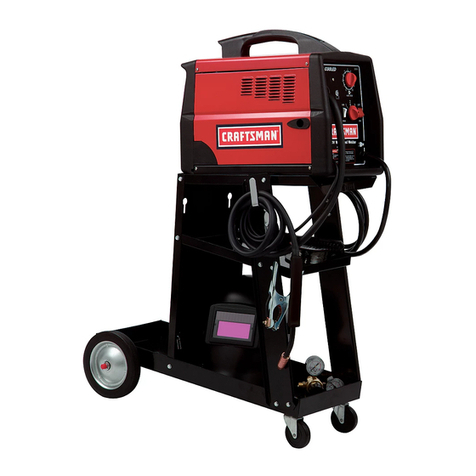
Your new wire feed welder is designed for maintenance and
sheet metal fabrication. The welder consists of a single-phase
power transformer, stabilizer, rectifier, and a unique built-in
control/feeder.
Now you can weld sheet metal from 26 gauge up to 3/16 inch
thick with a single pass. You can weld thicker steel with
beveling and multiple pass techniques. Table 1 lists your MIG
welder specifications.
Table 1. Welder Specifications
Primary (input ) volts 120 Vac
Primary (inputs) Amps 20
Phase Single
Frequency 60 Hz
Secondary (output) volts 18.5
Secondary (UL output) amps 90
Open Circuit Volts (Max.) 28 Vdc
Duty Cycle Rating @ 90 amps 20%