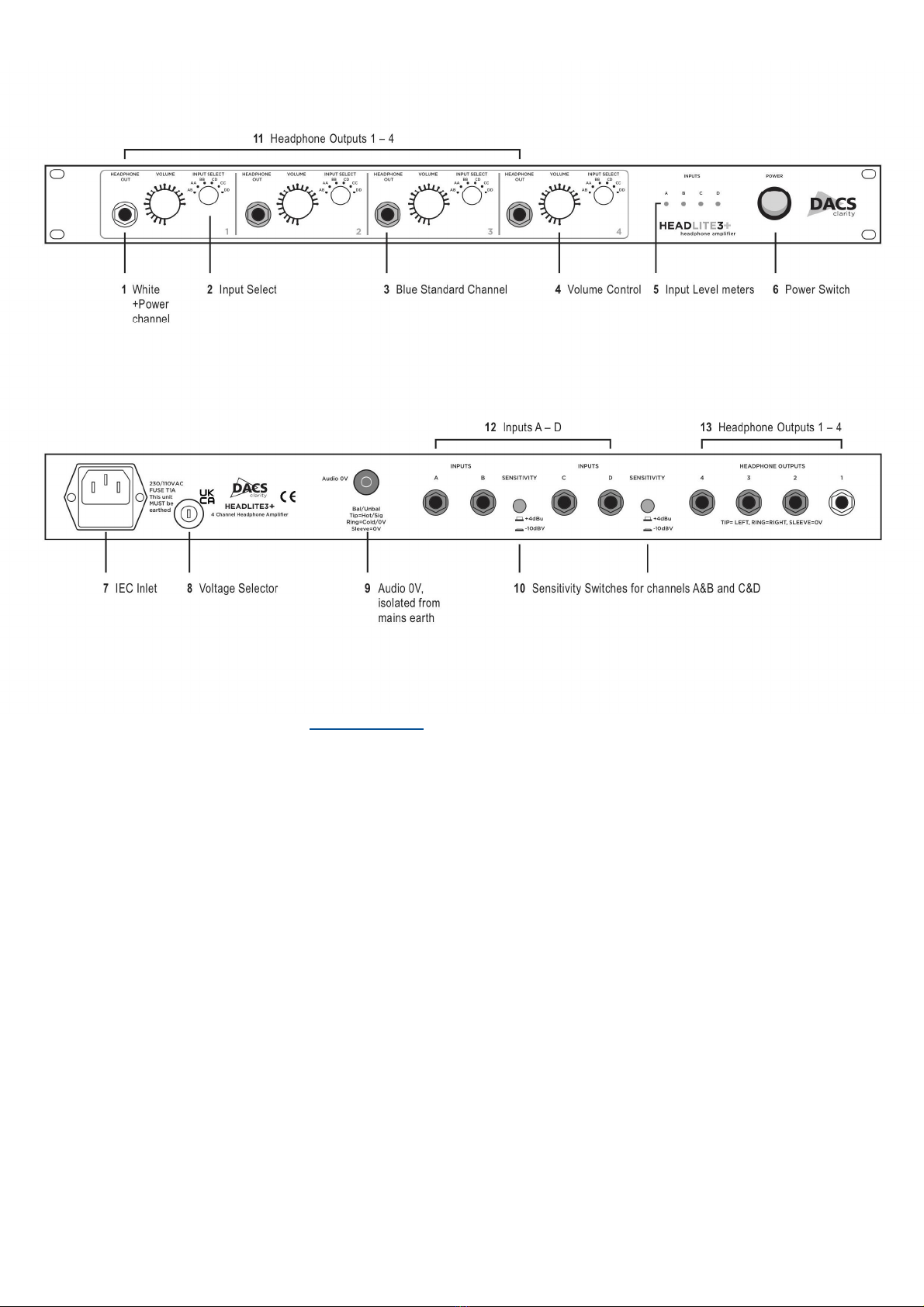
7 IEC Inlet
The unit will accept 240 VAC and 110/115 VAC mains supplies selected as described below.
12 Inputs A-D
Use TRS ¼” jack plugs for balanced sources two pole jacks for unbalanced. Input impedance is
10kΩ. If no connector is plugged in the inputs are shorted to 0V; if connected to a patchbay it is
advisable to normalise them at the patch bay to avoid the potential for interference pick up. In
case of accidental patching of phantom power in OB or studio applications we have included
overvoltage protection on the inputs so 48V cannot damage the input stage.
5 Input Level Meters
These tri colour LED meters indicate the level on the 4 busses feeding the headphone amplifiers.
They are calibrated as follows:
Green starts to glow at -24duB and is fully on at -8dBu to 0dBu
Orange starts at 0dBu and is fully on at +10dBu to +16dBu
Red starts at +16dBu and is fully on over +18dBu
For optimum performance operate HEADLITE 3+ at 0dBu to +10dBu.
6 Power
This switches the power on and off and is illuminated when the unit is on. If the switch does not
illuminate the fuse may be blown. The unit comes with a spare fuse in the fuse carrier (T1A).
Clarity HEADLITE 3+ is fitted with an ultra quiet regulated linear power supply.
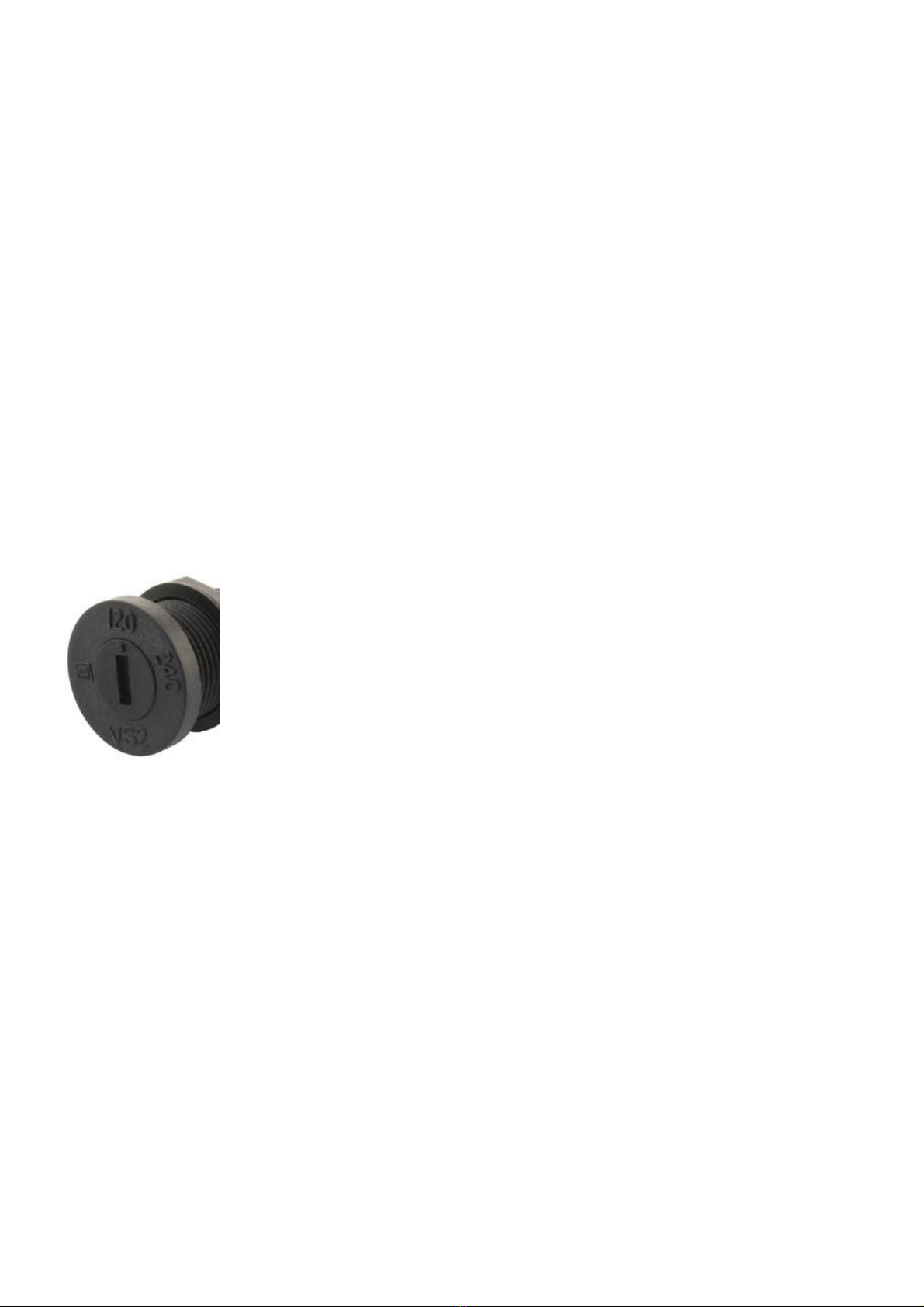
8 Voltage Selector
Using a flat head screwdriver insert the tip into the slot and turn it to point to either 240 (for
240/230VAC) or 120 (for 110/115VAC).
9 Audio 0V
The Audio 0V is separate from the mains earth. This separation allows unbalanced operation with
a large measure of immunity to hum problems since the amplifier is not referenced to or connect-
ed to any earth other than the signal source. The mains earth is connected to the case of the de-
vice. If you wish to connect the signal earth to the mains earth or a technical earth this may be
done by running a wire from the 0V terminal. This connection should only be made by quali-
fied personnel, if it is necessary. If in doubt please call us.
10 Sensitivity Switches
On the rear panel there are sensitivity switches for channels A&B and C&D. This allows user se-
lection of input sensitivity as an operational control; -10dB adds 12dB gain to the incoming signal
(-10dBV to +4dBu) while +4dBu adds no gain.