manuals.online logo
Brands
  1. Home
  2. •
  3. Brands
  4. •
  5. DURKOPP ADLER
  6. •
  7. Sewing Machine
  8. •
  9. DURKOPP ADLER 697 Parts list manual

DURKOPP ADLER 697 Parts list manual

Other manuals for 697

2

Other DURKOPP ADLER Sewing Machine manuals

DURKOPP ADLER 745-34-1 User manual

DURKOPP ADLER

DURKOPP ADLER 745-34-1 User manual

DURKOPP ADLER 610-10 Operating instructions

DURKOPP ADLER

DURKOPP ADLER 610-10 Operating instructions

DURKOPP ADLER 275 Series User manual

DURKOPP ADLER

DURKOPP ADLER 275 Series User manual

DURKOPP ADLER DAC classic 281 User manual

DURKOPP ADLER

DURKOPP ADLER DAC classic 281 User manual

DURKOPP ADLER 969 Classic Operating instructions

DURKOPP ADLER

DURKOPP ADLER 969 Classic Operating instructions

DURKOPP ADLER 550-867 Operating instructions

DURKOPP ADLER

DURKOPP ADLER 550-867 Operating instructions

DURKOPP ADLER 867 - 10-2010 User manual

DURKOPP ADLER

DURKOPP ADLER 867 - 10-2010 User manual

DURKOPP ADLER 745-34-2 User manual

DURKOPP ADLER

DURKOPP ADLER 745-34-2 User manual

DURKOPP ADLER 511 - User manual

DURKOPP ADLER

DURKOPP ADLER 511 - User manual

DURKOPP ADLER 1280-5-1 User manual

DURKOPP ADLER

DURKOPP ADLER 1280-5-1 User manual

DURKOPP ADLER 869-M Premium Operating instructions

DURKOPP ADLER

DURKOPP ADLER 869-M Premium Operating instructions

DURKOPP ADLER M-Type Delta D867 Operating manual

DURKOPP ADLER

DURKOPP ADLER M-Type Delta D867 Operating manual

DURKOPP ADLER 838 User manual

DURKOPP ADLER

DURKOPP ADLER 838 User manual

DURKOPP ADLER 381 Guide

DURKOPP ADLER

DURKOPP ADLER 381 Guide

DURKOPP ADLER DAC classic 867 Operating manual

DURKOPP ADLER

DURKOPP ADLER DAC classic 867 Operating manual

DURKOPP ADLER 195 User manual

DURKOPP ADLER

DURKOPP ADLER 195 User manual

DURKOPP ADLER 911-210 User manual

DURKOPP ADLER

DURKOPP ADLER 911-210 User manual

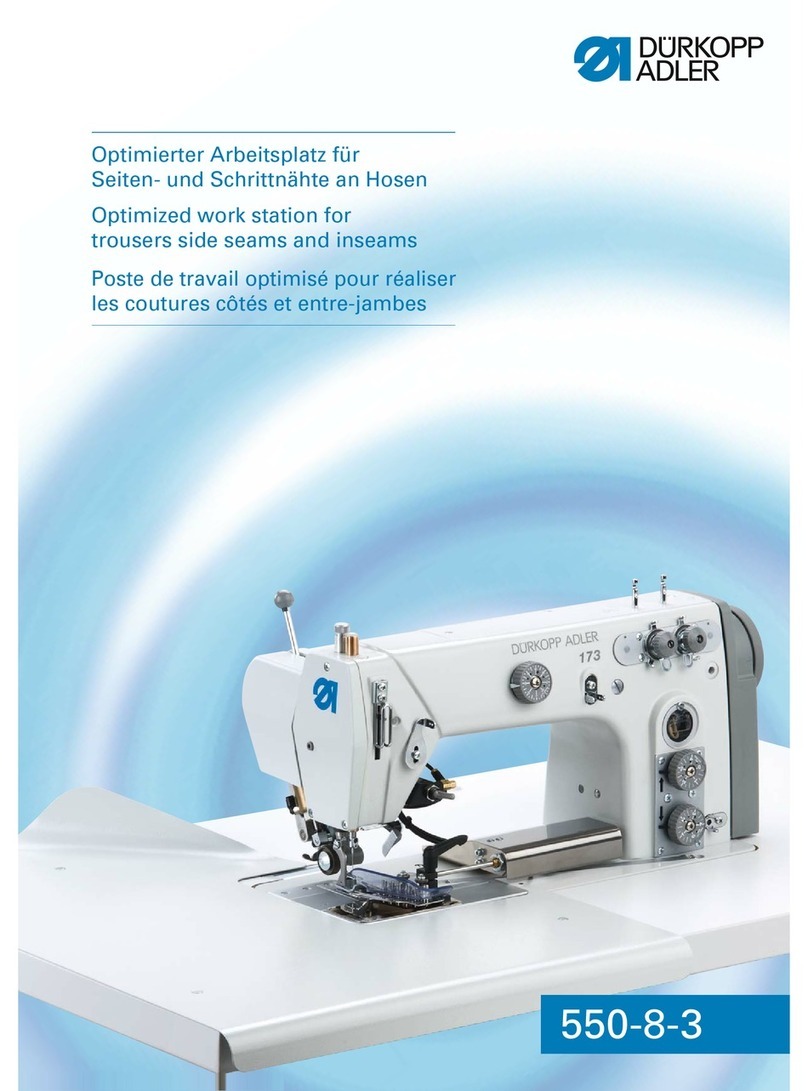
DURKOPP ADLER 550-8-3 User manual

DURKOPP ADLER

DURKOPP ADLER 550-8-3 User manual

DURKOPP ADLER 380 Guide

DURKOPP ADLER

DURKOPP ADLER 380 Guide

DURKOPP ADLER 745-35-10 S Operating instructions

DURKOPP ADLER

DURKOPP ADLER 745-35-10 S Operating instructions

DURKOPP ADLER 967 User manual

DURKOPP ADLER

DURKOPP ADLER 967 User manual

DURKOPP ADLER 767 - Operating instructions

DURKOPP ADLER

DURKOPP ADLER 767 - Operating instructions

DURKOPP ADLER 745-34-2 Installation manual

DURKOPP ADLER

DURKOPP ADLER 745-34-2 Installation manual

DURKOPP ADLER 100-68-1 User manual

DURKOPP ADLER

DURKOPP ADLER 100-68-1 User manual

Popular Sewing Machine manuals by other brands

Brother PE-180D Service manual

Brother

Brother PE-180D Service manual

Singer 569U1100 Operator's guide

Singer

Singer 569U1100 Operator's guide

ELNA 2002 instruction manual

ELNA

ELNA 2002 instruction manual

Siruba DL7200D-NM1 Instruction book

Siruba

Siruba DL7200D-NM1 Instruction book

Silver Viscount 9500e instruction manual

Silver

Silver Viscount 9500e instruction manual

Pfaff 3588-05/020 instruction manual

Pfaff

Pfaff 3588-05/020 instruction manual

JUKI DDL-9000A instruction manual

JUKI

JUKI DDL-9000A instruction manual

Pfaff 284 Instruction book

Pfaff

Pfaff 284 Instruction book

Reliable MSK-335B Specification sheet

Reliable

Reliable MSK-335B Specification sheet

Kenmore 385. 19000 owner's manual

Kenmore

Kenmore 385. 19000 owner's manual

Brother FD4-B271 instruction manual

Brother

Brother FD4-B271 instruction manual

Brother Computerized Embroidery Machine Operation manual

Brother

Brother Computerized Embroidery Machine Operation manual

Husqvarna Viking Designer SE user guide

Husqvarna Viking

Husqvarna Viking Designer SE user guide

Singer 645 owner's manual

Singer

Singer 645 owner's manual

Riccar RL634DE user manual

Riccar

Riccar RL634DE user manual

ZOJE ZJ9800 Operation manual

ZOJE

ZOJE ZJ9800 Operation manual

Siruba C007JP Instruction book

Siruba

Siruba C007JP Instruction book

IKEA SY user guide

IKEA

IKEA SY user guide

manuals.online logo
manuals.online logoBrands
  • About & Mission
  • Contact us
  • Privacy Policy
  • Terms and Conditions

Copyright 2025 Manuals.Online. All Rights Reserved.

697
Special sewing machine
Instructions for operating
Instructions for service
Postfach 17 03 51, D-33703 Bielefeld •Potsdamer Straße 190, D-33719 Bielefeld
Telefon: + 49 (0) 5 21 / 9 25-00 • Telefax: + 49 (0) 5 21 / 9 25 24 35 • www.duerkopp-adler.com
B
Ausg./Edition: 11/94 Printed in Federal Republic of Germany Teile-Nr.: 0791 697722
GBGB
697
Special sewing machine
Instructions for operating
Instructions for service
Postfach 17 03 51, D-33703 Bielefeld •Potsdamer Straße 190, D-33719 Bielefeld
Telefon: + 49 (0) 5 21 / 9 25-00 • Telefax: + 49 (0) 5 21 / 9 25 24 35 • www.duerkopp-adler.com
B
Ausg./Edition: 11/94 Printed in Federal Republic of Germany Teile-Nr.: 0791 697722
GBGB
All manuals and user guides at all-guides.com
all-guides.com
Foreword
This instruction manual is intended to help the user to become
familiar with the machine and take advantage of its application
possibilities in accordance with the recommendations.
The instruction manual contains important information on how to
operate the machine securely, properly and economically.
Observation of the instructions eliminates danger, reduces costs
for repair and down-times, and increases the reliability and life of
the machine.
The instruction manual is intended to complement existing
national accident prevention and environment protection
regulations.
The instruction manual must always be available at the
machine/sewing unit.
The instruction manual must be read and applied by any person
that is authorized to work on the machine/sewing unit. This
means:
–Operation, including equipping, troubleshooting during the
work cycle, removing of fabric waste,
–Service (maintenance, inspection, repair and/or
–Transport.
The user also has to assure that only authorized personnel work
on the machine.
The user is obliged to check the machine at least once per shift
for apparent damages and to immediatly report any changes
(including the performance in service), which impair the safety.
The user company must ensure that the machine is only operated
in perfect working order.
Never remove or disable any safety devices.
If safety devices need to be removed for equipping, repairing or
maintaining, the safety devices must be
remounted directly after completion of the maintenance and
repair work.
Unauthorized modification of the machine rules out liability of the
manufacturer for damage resulting from this.
Observe all safety and danger recommendations on the
machine/unit! The yellow-and-black striped surfaces designate
permanend danger areas, eg danger of squashing, cutting,
shearing or collision.
Besides the recommendations in this instruction manual also
observe the general safety and accident prevention regulations!
Foreword
This instruction manual is intended to help the user to become
familiar with the machine and take advantage of its application
possibilities in accordance with the recommendations.
The instruction manual contains important information on how to
operate the machine securely, properly and economically.
Observation of the instructions eliminates danger, reduces costs
for repair and down-times, and increases the reliability and life of
the machine.
The instruction manual is intended to complement existing
national accident prevention and environment protection
regulations.
The instruction manual must always be available at the
machine/sewing unit.
The instruction manual must be read and applied by any person
that is authorized to work on the machine/sewing unit. This
means:
–Operation, including equipping, troubleshooting during the
work cycle, removing of fabric waste,
–Service (maintenance, inspection, repair and/or
–Transport.
The user also has to assure that only authorized personnel work
on the machine.
The user is obliged to check the machine at least once per shift
for apparent damages and to immediatly report any changes
(including the performance in service), which impair the safety.
The user company must ensure that the machine is only operated
in perfect working order.
Never remove or disable any safety devices.
If safety devices need to be removed for equipping, repairing or
maintaining, the safety devices must be
remounted directly after completion of the maintenance and
repair work.
Unauthorized modification of the machine rules out liability of the
manufacturer for damage resulting from this.
Observe all safety and danger recommendations on the
machine/unit! The yellow-and-black striped surfaces designate
permanend danger areas, eg danger of squashing, cutting,
shearing or collision.
Besides the recommendations in this instruction manual also
observe the general safety and accident prevention regulations!
All manuals and user guides at all-guides.com

General safety instructions
The non-observance of the following safety instructions can cause bodily in-
juries or damages to the machine.
1. The machine must only be commissioned in full knowledge of the instruction
book and operated by persons with appropriate training.
2. Before putting into service also read the safety rules and instructions of the
motor supplier.
3. The machine must be used only for the purpose intended. Use of the machine
without the safety devices is not permitted. Observe all the relevant safety
regulations.
4. When gauge parts are exchanged (e.g. needle, presser foot, needle plate, feed
dog and bobbin) when threading, when the workplace is left, and during
service work, the machine must be disconnected from the mains by switching
off the master switch or disconnecting the mains plug.
5. Daily servicing work must be carried out only by appropriately trained persons.
6. Repairs, conversion and special maintenance work must only be carried out by
technicians or persons with appropriate training.
7. For service or repair work on pneumatic systems, disconnect the machine from
the compressed air supply system (max. 7-10 bar).
Before disconnecting, reduce the pressure of the maintenance unit.
Exceptions to this are only adjustments and functions checks made by
appropriately trained technicians.
8. Work on the electrical equipment must be carried out only by electricians or
appropriately trained persons.
9. Work on parts and systems under electric current is not permitted,
except as specified in regulations DIN VDE 0105.
10. Conversion or changes to the machine must be authorized by us and made
only in adherence to all safety regulations.
11. For repairs, only replacement parts approved by us must be used.
12. Commissioning of the sewing head is prohibited until such time as the entire
sewing unit is found to comply with EC directives.
It is absolutely necessary to respect
the safety instructions marked by these signs.
Danger of bodily injuries !
Please note also the general safety instructions.
General safety instructions
The non-observance of the following safety instructions can cause bodily in-
juries or damages to the machine.
1. The machine must only be commissioned in full knowledge of the instruction
book and operated by persons with appropriate training.
2. Before putting into service also read the safety rules and instructions of the
motor supplier.
3. The machine must be used only for the purpose intended. Use of the machine
without the safety devices is not permitted. Observe all the relevant safety
regulations.
4. When gauge parts are exchanged (e.g. needle, presser foot, needle plate, feed
dog and bobbin) when threading, when the workplace is left, and during
service work, the machine must be disconnected from the mains by switching
off the master switch or disconnecting the mains plug.
5. Daily servicing work must be carried out only by appropriately trained persons.
6. Repairs, conversion and special maintenance work must only be carried out by
technicians or persons with appropriate training.
7. For service or repair work on pneumatic systems, disconnect the machine from
the compressed air supply system (max. 7-10 bar).
Before disconnecting, reduce the pressure of the maintenance unit.
Exceptions to this are only adjustments and functions checks made by
appropriately trained technicians.
8. Work on the electrical equipment must be carried out only by electricians or
appropriately trained persons.
9. Work on parts and systems under electric current is not permitted,
except as specified in regulations DIN VDE 0105.
10. Conversion or changes to the machine must be authorized by us and made
only in adherence to all safety regulations.
11. For repairs, only replacement parts approved by us must be used.
12. Commissioning of the sewing head is prohibited until such time as the entire
sewing unit is found to comply with EC directives.
It is absolutely necessary to respect
the safety instructions marked by these signs.
Danger of bodily injuries !
Please note also the general safety instructions.
All manuals and user guides at all-guides.com
Description of proper use or proper application:
The 697 is a sewing head which can be used for sewing light to medium heavy
sewing material. In general, such sewing material is made up of textile fibres
but also leather. Such sewing materials are used by the clothing and upholstery
industry. It would also be possible to make so called technical seams with these
sewing machines. However, for this application the operator of the machine(s)
must have the possible dangers assessed (cooperation with Dürkopp Adler
would be welcomed), as such applications are, on the one hand, relatively rare
and, on the other hand, have an immensely wide range of possibilities.
Depending on the results of this assessment suitable safety measures might
have to be implemented.
In general, only dry sewing material may be used on this machine. The material
must not exceed 12 mm in thickness when compressed by the lowered needle
butt. The material must not contain any hard objects as eye shields would
otherwise have to be worn when operating the machine. However, such eye
shields are currently not available.
In general, the seam will be sewn with sewing threads made of textile fibres in
sizes of up to 60/3 NeB (cotton threads), 65/2 Nm (synthetic thread), or 65/2 Nm
(covering twists). Using other threads would also require an assessment of the
related possible dangers and risks in advance, and the implementation, where
necessary, of suitable safety measures.
This sewing machine may only be put up and used in dry and clean rooms.
Should the machine be used in other rooms which are not dry and clean, further
measures may have to be taken which have to be agreed
(see EN 60204-31: 1999).
As a manufacturer of industrial sewing machines we assume that operators who
are at least semi-skilled will work at our products, so that it can be assumed that
all standard operations and, where applicable, the dangers are known.
Noise level Lc
Workstation related emission according to DIN 45635-48-A-l-KL2
Number of stitches: 1000 min-1
Sewing material: 2-play fabric 400 g/m2
Lc = 75 dB (A)
Description of proper use or proper application:
The 697 is a sewing head which can be used for sewing light to medium heavy
sewing material. In general, such sewing material is made up of textile fibres
but also leather. Such sewing materials are used by the clothing and upholstery
industry. It would also be possible to make so called technical seams with these
sewing machines. However, for this application the operator of the machine(s)
must have the possible dangers assessed (cooperation with Dürkopp Adler
would be welcomed), as such applications are, on the one hand, relatively rare
and, on the other hand, have an immensely wide range of possibilities.
Depending on the results of this assessment suitable safety measures might
have to be implemented.
In general, only dry sewing material may be used on this machine. The material
must not exceed 12 mm in thickness when compressed by the lowered needle
butt. The material must not contain any hard objects as eye shields would
otherwise have to be worn when operating the machine. However, such eye
shields are currently not available.
In general, the seam will be sewn with sewing threads made of textile fibres in
sizes of up to 60/3 NeB (cotton threads), 65/2 Nm (synthetic thread), or 65/2 Nm
(covering twists). Using other threads would also require an assessment of the
related possible dangers and risks in advance, and the implementation, where
necessary, of suitable safety measures.
This sewing machine may only be put up and used in dry and clean rooms.
Should the machine be used in other rooms which are not dry and clean, further
measures may have to be taken which have to be agreed
(see EN 60204-31: 1999).
As a manufacturer of industrial sewing machines we assume that operators who
are at least semi-skilled will work at our products, so that it can be assumed that
all standard operations and, where applicable, the dangers are known.
Noise level Lc
Workstation related emission according to DIN 45635-48-A-l-KL2
Number of stitches: 1000 min-1
Sewing material: 2-play fabric 400 g/m2
Lc = 75 dB (A)
All manuals and user guides at all-guides.com
all-guides.com
All manuals and user guides at all-guides.com