Formula for Half-Wave Dipole:
123 = 1/8-Wavelength Factor, Freq = Frequency in MHz,
0.88 = Velocity Factor of DXE-LL300 300 ΩLadder Feedline
A feedline made in the appropriate electrical length closely duplicates the antenna feedpoint impedance
which, in these cases, makes it easier to match a 50 Ωimpedance. Avoid using coax for antennas with an
SWR of more than 5:1 due to the high loss of coax under these circumstances as well as high current and
voltage potential.
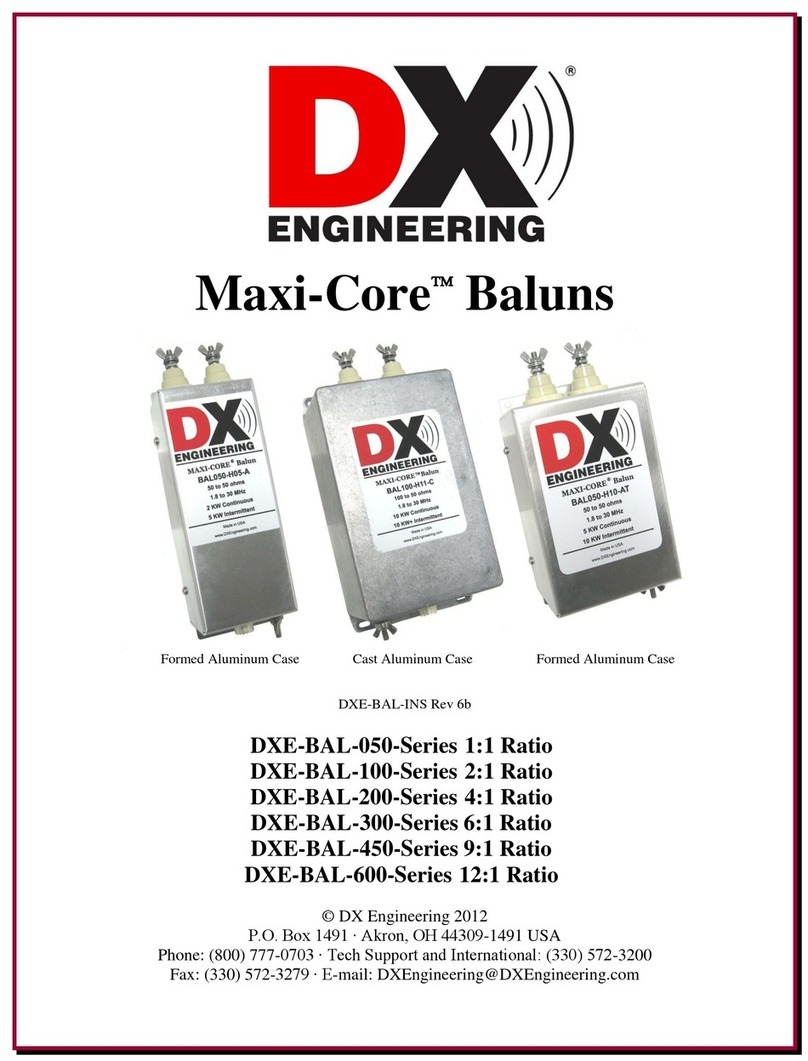
Often, a 4:1 balun is suggested for Multi-Band Dipoles. However, the best balun to use for this application is
a 1:1 ratio - DXE-BAL050H10AT or DXE-BAL050H11CT. The impedance at the end of the feedline will
vary considerably from very high to very low. Tuners have an easier time with high impedance than a low
one. A balun with a ratio of 4:1 or more will transform already low impedance to
an even lower one that will make the antenna hard to tune. The 1:1 ratio balun
will just pass the low impedance through.
The parallel conductor feedline should be constructed according to the chart
above, and routed to the balun located at a convenient location. The balun should
be located such that the coax between it and the tuner is as short as possible.
However, do not route the parallel line so close to the tuner or the rest of the
station equipment that RF feedback occurs. This will manifest itself by making
the antenna very difficult to tune and the tuner controls will be very touchy. There
may also be RF present on the microphone, key, etc.
Although it may not seem logical, shortening a relatively low to the ground multi-
band dipole, intended for 160 through 10 meter operation, to less than 220 feet
will actually help your wide range antenna tuner cover lower frequencies easier.
That is because you are using a non-resonant antenna system, when you use
ladder line feed systems for multi-band operations also, changing the length of the
ladder line will alter resulting impedances enough so that the tuner may be able to
reach a certain frequency that was giving it trouble. The coax from the DX
Engineering 1:1 Balun to the tuner should be kept short; typically 5 to 15 feet is
best.
You can read more about this on the DX Engineering web site
(www.DXEngineering.com) look for the article "Choosing the Correct Balun".
Even when properly done, this arrangement will subject the coaxial line between
the tuner and balun to very high standing waves and high voltage and/or current.
You should use good low loss coaxial line and keep the coaxial line length as
short as possible. RG-8X and smaller may not do a proper job; DX Engineering
RG-213/U or equivalent is the minimum recommended coaxial cable.
Note: Balun mounting brackets are required to help keep the connections from
getting too much strain on them.
Using a 1:1 balun with a Loop antenna is not recommended except when using the Loop antenna far from a
resonant or harmonic frequency. When operating the Loop antenna on random unplanned frequencies far
from resonance, use the balanced feedline with the lowest impedance and loss available. Using 300 ΩDXE-
LL300 transmitting ladder line is best. Place the balun as close to the tuner as possible. Use a 1:1 tuner
balun. Avoid using coax in any part of the system with high SWR (over 5:1).