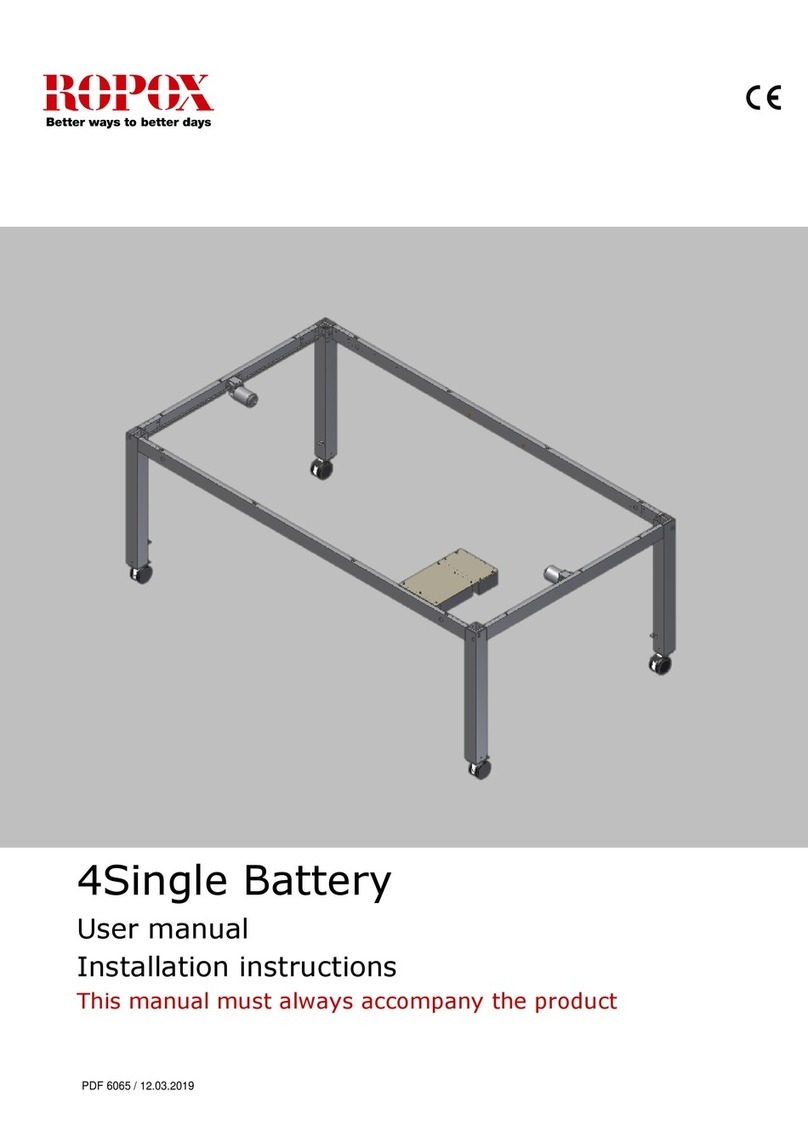
Obviously the racks must be assembled and installed
prior to installation of the batteries. Instructions for the
rack assembly are contained in a separate pamphlet
received with the racks.
The batteries are rated at 77° F (25° C). Operation at
cooler temperatures will decrease the operating time.
Operation at elevated temperatures will decrease the
overall life of the battery. There is a 50% life reduction
for each 15° F above 77° F.
Required Installation Tools & Equipment
Preparation for System Installation
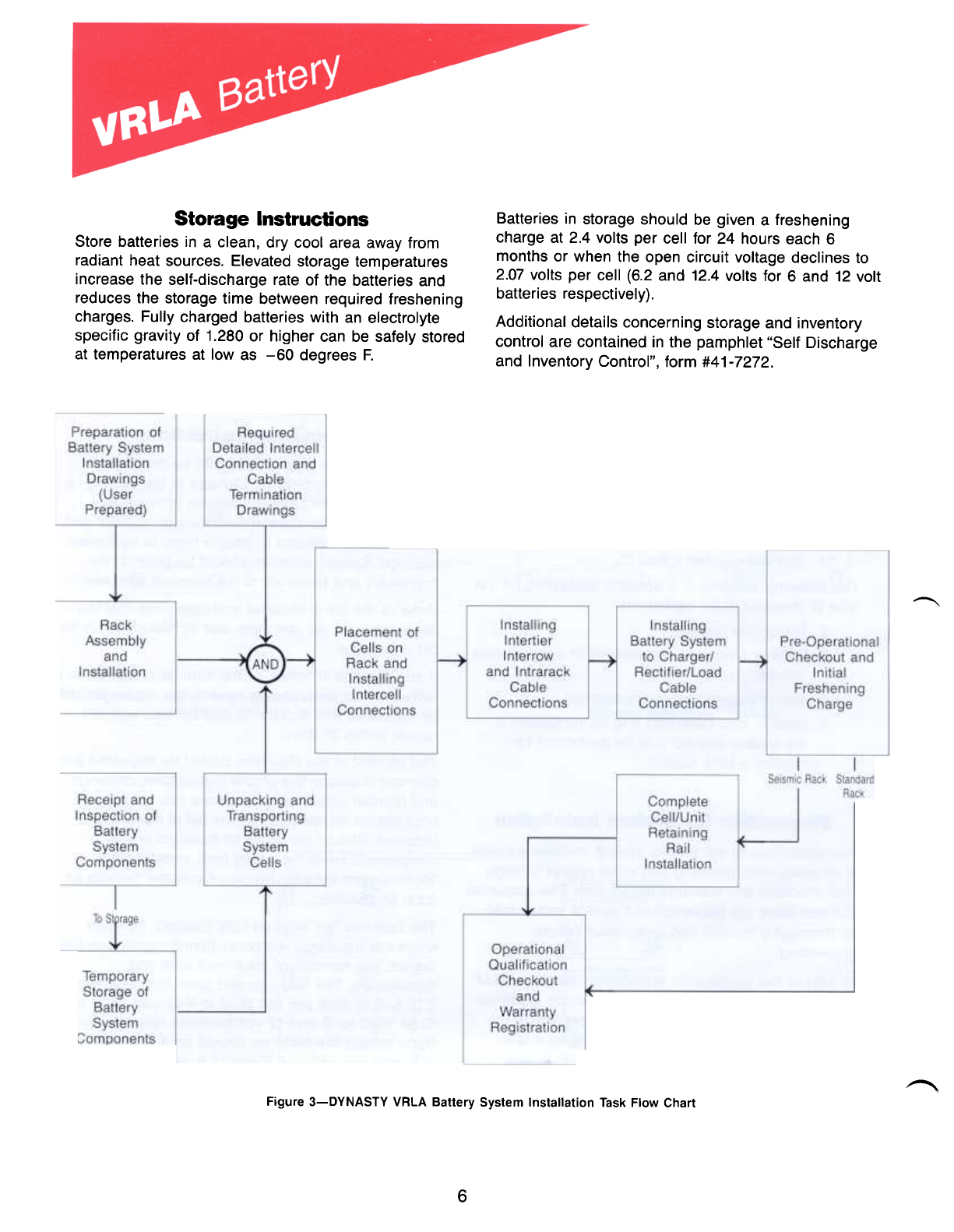
The installation of the battery system involves a series
of activities from planning and initial receipt through
final checkout and warranty registration. The sequence
of these tasks are presented in Figure 3 and should
be thoroughly studied and understood before
proceeding.
Receiving Instructions
Upon receipt the shipment should be thoroughly
inspected for any physical damage to the packaging
and to assure the proper quantities of items are
received. The packages should then be opened and
the batteries inspected to assure there is no hidden
damage. Special attention should be given to the
containers and terminals of the received batteries.
Refer to the bill of material and determine that the
items received are complete and as described on the
bill of material.
If any damage is noted, or the number of packages is
different from the shipping papers, the carrier should
be contacted and a claim should be filed with the
carrier within 10 days.
The content of the shipment should be inspected and
counted to assure the proper instructions, drawings
and number of batteries, hardware kits, cables and
accessories as identified on the bill of material are
received. Should the count be incorrect or the
components be of the wrong type, contact C&D
Technologies Dynasty Division Customer Service as
soon as possible.
The batteries are shipped fully charged, however
some self-discharge will occur during transit and the
degree is a function of the transit time and
temperature. The fully charged open circuit voltage is
2.12 to 2.14 volts per cell (6.36 to 6.42 and 12.72 to
12.84 VDC for 6 and 12 volt batteries respectively).
Upon receipt the batteries should be a minimum of
2.07 volts per cell or 6.2 and 12.4 volts for 6 and 12
volt batteries respectively. If at these minimum
voltages the batteries should be recharged as soon as
possible. If at or below 2 volts per cell (6 and 12 volts)
the batteries should not be used and the vendor
should be contacted immediately.
~
As part of this preparation activity the installer should
develop a system schematic diagram which identifies
how the individual batteries are to be placed on the
rack, interconnected and numbered. Figure 4 is a
schematic for a typical system of 30 each 12 volt
batteries on a single 3 tier rack while Figure 5 is a
schematic for a typical string of 40 each 12 volt
batteries on two each 3 tier racks. The cabling
received with the system presumes a specific rack
and installation configuration.
5
At a minimum, the following tools and equipment are
required to install the DYNASTY VRLA battery.
1.Digital voltmeter.
2. Socket wrench, insulated.
3. Torque wrench calibrated in inch-pounds.
4. Box end wrench, insulated.
5. Battery lifting equipment (handles) and fork lift
to lift pallets of batteries.
6. Rubber gloves.
7. Full face shield.
8. Plastic apron.
9. Potable eyewash.
10. Spill kit.
11. Fire extinguisher (class C).
The following equipment is optional depending on the
type of checkout to be performed.
1. Micro-ohm meter.
2. Battery resistance, impediance or conductance
test set.
3. 100 amp momentary load test set.
4. System load bank (DC if to be performed at
the battery and AC if to be performed by
loading a UPS output).