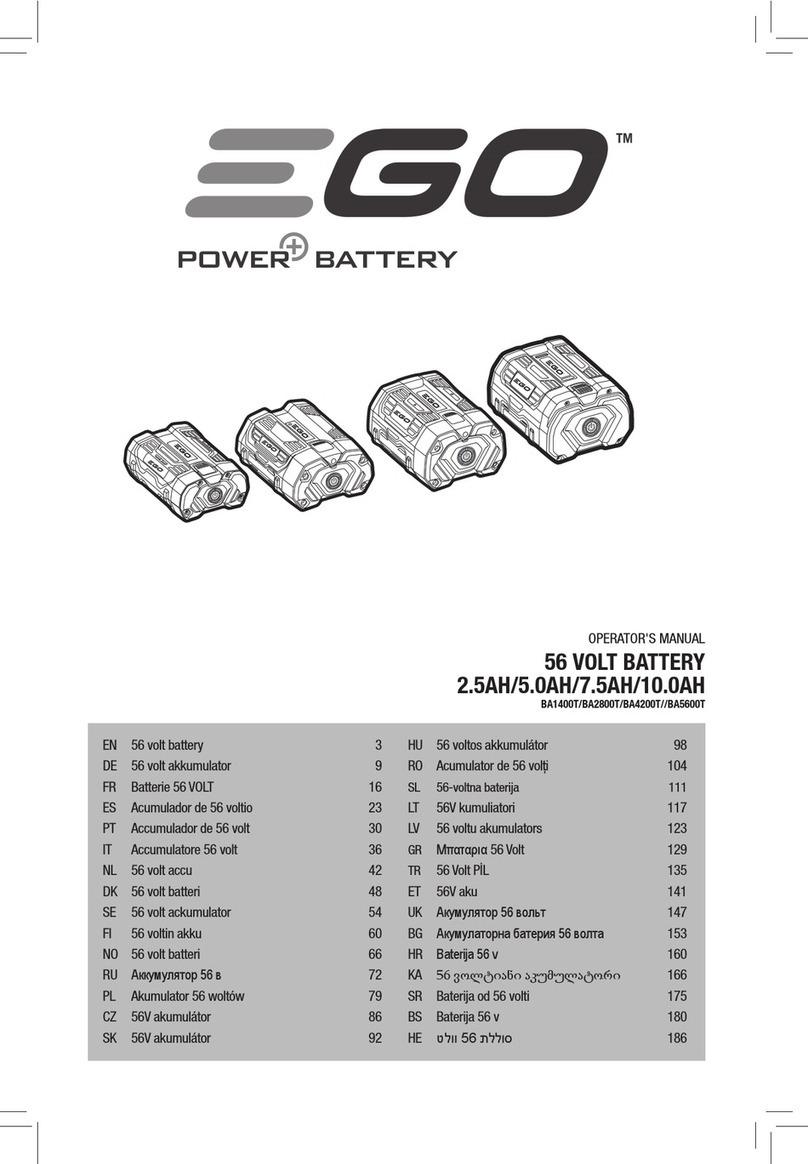
EASTMAN GOLD-Series User manual

The Content
01
About Us
02
Important Safety Instructions
A.
General Instructions
B.
Personal Precautions
C.
Grounding Instructions
D.
Safety Precautions
03
Tubular Conventional Battery Installations
A.
Storage Location
B.
Installation and Commissioning
C.
Location
D.
Freshening Charge
E.
Charging Methods
F.
Connection Method with Inverter/System
04
Know Your Tubular Battery
A.
What Makes Our Battery Superior
B.
Technology
C.
Advantage & Key Benefits
D.
Unique Features
05
A.
Discharge Rates
B.
Cycle Life
C.
Battery Selection Chart
06
Maintenance &
Trouble shooting Instructions
07
Warranty Conditions
08
Do’s & Dont’s
09
FAQ’S

TUBULAR CONVENTIONAL, PAGE NO : 1
About Us
The Eastman Global group began its journe y inthe year
1970 with presence inover 105 countries, supply &
trading of batteries to OEM's and 2200+ loyal
distributor and dealer network across the world.
Eastman Auto & Power Limited incorporated by
Eastman Group in 2006 is a leading manufacturer of
Tall Tubular Conventional Batteries, Tubular Gel Sealed
Maintenance Free Batteries, Solar Batteries,
E-Rickshaw Batteries andAutomotive Batteries.
OUR ACHIEVEMENTS
Establis hed in
1970
2000 C rore
Tur nov er
2500+ H appy
Employe es
Pres ence in 1 05
Cou ntr ies

Important Safety
Instructions
A.
General Instructions
Battery can present a risk of electrical shock and high short circuit current.
The following precautions shall be followed when working with batteries.
1.
Verify that the Power Supply is “OFF” and that power cord is disconnected from
the power source.
2.
Remove watches, rings or other metal objects.
3.
Use tools with insulated handles to prevent inadvertent shorts.
4.
Wear rubber gloves and boots.
5 Do not lay tools or metal parts on top of batteries.
6.
Determine if the battery is inadvertently grounded, remove source of ground.
Contact with any part of a grounded b attery can result in electrical shock. The
likelihood of such shock will be reduced if su ch ground s are removed during
installation and maintenance.
7.
Verify circuit polarities before making connections.
8.
Disconnect charging source and load before connecting or disconnecting
terminals.
9.
Do not smoke, cause a flame or spark in the immediate area of the batteries.
This includes static electricity from the body.
10.
Use proper lifting means when moving batteries and wear all appropriate
safety clothing and equipment.
11.
Do not dispose of lead acid batteries ex cept through channels in accordance
with local, state and federal regulations.
B.
Personal Precautions
Becau se Tubular Conventional batteries contain acid, always wear protective
clothing and use the correct safety tools.
In case of skin contact with sulphuric acid, immediately
1.
Remove contaminated clothing
2.
Flush the area thoroughly with water at least 15 minutes with large a mounts of
water
3.
Get medical attention, if required.
4.
Apply the solution until bubbling stops, then rinse with clean water.
5.
In case of eye contact with sulphuric acid, immediately wash your eyes with
plenty of water ortake medical attention.
6.
Apply a solution of sodium bicarbonate solution (1.0lb/1.0g al or 0.5 kg/5.0
liters of water)
TUBULAR CONVENTIONAL, PAGE NO :2

TUBULAR CONVENTIONAL, PAGE NO : 3
C.
Grounding Instructions
ELECTRICAL CONNECTIONS
Follow the instructions given below for safe operation.
•
Do not touch un-insulated battery connectors or terminals.
•
Isolate the battery from the power plant while working on the battery.
•
Insulate all tools to avoid the accidental shorting of batteries.
•
Do not allow metal object to rest on the battery or fall across the terminals.
Remove metal wristbands, chains and loose coins from shirt
/
overall
pocketswhen workingonthe battery topreventaccidental shorting.
•
Ensure that connections are made as per general arrangements drawing
enclosed.
•
Do notattempttomove installed battery without removing the connectors.
•
Do expose the battery toopen flame or sparksin the immediate vicinity.
•
Do not tamper with cell vent plugs.
•
Keep the battery clean and dry.
•
In case ofaccidental contact with acid,wash theaffected area with a continuous
flow of water for 15 min. and consult a doctor immediately.
D.
Safety Precautions
•
Use insulating equipment such as gloves, shoes andeye protectors.
•
Insulate all tools required for installation (wrenches, spanners etc).
•
Avoid keeping the tools across the battery terminals.
•
Wipe thecontact surfaces clean with dry,lint free cotton cloth.
•
Avoid cleaning the cell directly with liquids (gasoline, paint thinner etc.,) or with
liquid impregnated cloth.
•
Connect the batteries to the load firmly with the help of stainless steel bolts &
washers.

TUBULAR CONVENTIONAL, PAGE NO :4
Tubular Conventional
Battery Installation
General
Batteries shall beunpacked , installed and charged as soon as possible after receipt.
However, if this is not possible, follow the instructions below for storing the battery before
installation.
A.
Storage Location
Store the batteries indoors in a clean, dry and cool location away from direct sunlight a nd
rain. Storage at higher temperatures will result in a ccelerated rates of self-discharge and
possible deterioration of battery performance and life. Place the packing boxes on the
floor as indicated by the arrow on the pa cking box. Do not stack packing boxes one over
the other more than two DAMAGE MAY OCCUR AND THE WARRANTY MAY BE VOIDED.
The maximum storage period from the date of dispatch is 3 months for batteries stored
at ambient temperat ures. Do not store b atteries supplied in factory charged condition
for a period beyond 3 months without giving freshening charge.
*
*This
period
applies
only
to
an
average
ambient
temperature
of
27
0
C.
For
every
10
0
C
rise
in
temperature, storagep erioddecreases byonehalf (Refer Below chart and Graph).
Self Discharge (Storage Period & Temperature)
Storage Temperature
Max Storage Period
< 25 ºC
3 Months
25ºC - 35 ºC>
2 Months
35 ºC
1 Months
Shelf Life Graph
If storage period exceeds the storage period recommended inabove table giv e the battery
freshening charge before the endof the recommended storageinterval
B.
Installation and Commissioning
Unpacking and Handling for Installation Follow the instructions given below for unpacking at
the installation site (strongly recommended). Cut metallic straps with the help of cutter or
pliers.
Remov e the battery carefully from packing box and keep it on the floor in the upright
position
DO NOT lift any battery bythe terminal posts as this will vo id the warranty.
Follow the instructi ons given below for unp acking at the installation site. (Strongly
recommended).
Cut metallic straps with the help of cutter or pliers.
Remov e the battery carefully from packing box and keep it on the floor in the upright
position
DO NOT lift any battery by the terminal postsasthis will void the warranty

TUBULAR CONVENTIONAL, PAGE NO : 5
C.
Location
1.
Choose a cool and dry location for the batteries away from sunlight.
2.
Do not place them nearby a source that helps ignition.
3.
Minimize temperature variations between the cells. (To avoid temperature
variation between the b atteries, do not locate the battery near HVAC ducts or
exhausts, heats sources (i.e., equipment that generates heat) ordirect sunlight.
4.
Provide a minimum free space of 1-meter on all sides of the battery string for
fre eair circulation, easy assembly, and periodic checks during its operat ion.
D.
Freshening Charge
Batteries lose some initial charge during shipment and storage. Depending on
storage time, a battery may require a freshening charge.
Give freshening charge for batteries as given below :
When they are store beyond 3 months.
Failure to give freshening charge voids the battery's warranty.
Freshening Charge Details :
Charging voltage: 15.8 V (CC Charging).
Chargingcu rrent:limitedtoa maximum 10%ofthe C10 capacity.
Charging duration: Asper the battery stateofcharge (SOC)
E.
Charging Methods ( Constant Voltage Charging @ 27
O
C)
Stand By Use
Charging Voltage
- 14.4 V / battery
Maximum Charge Current
-10%oftheAH Capacity
Cyclic Use
Charging Voltage
- 14.2 V / battery
Maximum Charge Current
-10%oftheAH Capacity
Temperature Compensation - 5 milli volts/ battery/ C
0

TUBULAR CONVENTIONAL, PAGE NO :6
F.
Connection Method with Inverter/System:
The following connection points should be considered when connecting your battery
with Inverter
/
Solar systems
1.
The length between wire and inverter / sy stem should not be more than approx
1meter (recommended), if more than1meter then it will lead to reduced
battery battery back up due to wire losses
2.
Recommended wire size is 10 Sq.mm
3.
Before connecting the battery to Inverter/ Solar System apply petroleum jelly to
the battery terminals.
4.
Connection should not be losses across the battery terminals after complete
installation.
Wire Guage Sizes & Torque values - For Terminals
General Tools
Fig: Flat Head Screwdriver
Fig: Open end spanner/ratchet
Wire Gauge
Size (AWG)
Ampacity
(amps)
12
30
10
40
8
55
Terminal Type
Torque (In Ibs)
L
70-89

TUBULAR CONVENTIONAL, PAGE NO : 7
Know Your Battery
What Makes Our Battery Superior?
Alloy
•
Deep discharge able & higher life cycle due to antimony alloy.
•
Ultra LowMaintenance
Spine
•
High pressure di - casted spines which lead toless corrosion and higher life cycle.
•
The number of spines have been increased to accommodate more active
materialin a single plate which results inhigher capacity per given size.
Gauntlet
•
High bursting strength polyester material which prevents active material
shedding
•High porosity & low electrical resistant material results in higher charge
efficiency
•
Improved woven gauntlet gives higher active material utilization & higher
capacity
Separator
•
Low electrical resistant & high porosity polyethylene material which leads to
increase in electrical performance.
Process
•
Unique 4-step curing program good adh esion of active material tothe grid leads
to higher cyclic life.
Paste Recipe
•
Special additives and optimized negative paste recipe for faster charge
acceptance.
Charging Process
•
Automatic PLC based high precession ADOR chargers used to optimu m
charging
•
Programming, data logging and monitoring through PC
•
Battery charging with temperature controlled water tub

TUBULAR CONVENTIONAL, PAGE NO :8
Tubular Plate Technology
Asthe na me suggests, itisadesign inTu bular form for th e positive plate and grid p asted
design for the negative plate in order to accu mulate more active material as compared
to other plate technologies. Raw Material used for enhanced battery performance.
•
Pure Lead Alloy
•
Optimized antimony lead
–
improves cycle life andreduces water loss
•
Polyethylene separator with higher thickness sleeve type
•
Aesthetic container made ofpolypropylene with robust drop test passed.
•
Gauntlet –100% polyester with resin less than 24%
•
Industrial LR grades sulphuric acid
•
Optimum use of red oxide
Technical Specification
•
Operating temperature range : -20ºC to +55ºC
•
Grid Alloy : Optimized antimony alloy for positive & negative.
•
Applicable standa rds : IS 13369 : 1992
•
De sign cycl e life
: 1100 cycle at 80% DOD & > 2000 cycle at
50% DOD @ 27ºC.
Advantages
TubularPositive Plates–Provencycling & deep cycling capabilities.
Low Antimony Alloy
–
Longer shelf life because ofvery low self discharge
High Pressure Die Cast Spine Grids
–
Rate of grid corrosion isvery low and hence
floats life.
Supplied infilled&charges condition–100% capacity on firstdischarge
Separator –Special High Porosity & LowResistance Separator

TUBULAR CONVENTIONAL, PAGE NO : 9
Key Benefits
Higher Charge Efficiency
Low self-discharge
Ultra low maintenance & higher cycle life
Suitable for frequent power cut areas
Recommended for tropical climates
Level indicator for easy maintenance
Reliable & steady performance,
even on heavy load
Eco-Friendly aqua trap vent plugs
ensuring no acidic fumes
Unique Features
Thicker & Wider Spines for long life and deep cycle applications.
Usage of Best Antimony alloy for ultra-low maintenance
High porous & oxidation resistance gauntlet for extra backup & long life
Advanced high surface carbon used for enhanced performances

TUBULAR CONVENTIONAL, PAGE NO :10
Product Technology
Discharge Rates
When selecting and sizing a battery these discharge rates can be considered
C1
C3
C5
C10
C20
Tubular Battery Constant Voltage Charging Profile:

TUBULAR CONVENTIONAL, PAGE NO : 11
Cycle Life:
Cycle life depends on the depth of discharge. Higher the depth of discharge lesser
the cycle life and lesser the depth of disch arge higher t he cycle life ex pected
GOLD-SERIES
DIAMOND-SERIES

TUBULAR CONVENTIONAL, PAGE NO :12
Battery Selection Chart:
Selecting the correct battery for the correct application is a key for long battery life
Battery Selection Chart for Eastman Range of Inverter Batteries
S l No
Electrical Load
(W ith respe ct to
M ax. I nverter
Rati ng)
Applia nces Loa d
M a x I n v e r te r R a ti n g
Sy ste m
Vo ltage
Recom mended Batte ry @ C20 for Differe nt Backup Time
El e ctr ic a l L o a d
5.0 Hrs.
4.0Hrs.
3.0 Hrs.
2.0 Hrs.
1
160 Wa tts
1 Light Bulb + 1 Ceilin g
Fan
250 VA
12 V
EM 150 48S T / EM 15015TT
EM 150 18T T / EM 155 48T T
EM 150 D/ EM 2 0 03 6S S
EM 1504 8T S
EM 150 48S T /EM 15015TT /
EM 15018T T /EM 15 548T T /
EP 20 0 00X PL/ EM 15 0 /
EM 150 D/ EM 1 503 0S S /
EM 15 04 8SS / EM 2003 6S S /
EM 15 04 8T S
EM 150 48S T /EM 150 1 5T T /
EM 150 18T T / EM 155 48T T /
EP 36 00 X P L/ E P 16 50 X P L/
EM 150 /EM 150 D/
EM 15 03 0SS / EM 1504 8S S /
EM 15 04 8T S
EM 15 04 8S T / EM 150 1 5T T /
EM 1 50 1 8T T / EM 1 55 4 8T T /
EP 1 0 0 0X PL / EM 1 0 0/
EM 15 0/ EM 15 0 D/
EM 15 0 4 8SS
2
240 W atts
2 Light Bulb + 1 Ceilin g
Fan
350 VA
EM 160 4 8 T T / EM 1 60 6 0 T T /
EP 3 6 0 0X PL / E P 2 0 0 00 X P L /
EM 200 / EM 20 0 D /
EM 20 0 3 6SS / EM 15 04 8T S
EM 150 48S T / EM 15015TT /
EM 1501 8T T / EM 15 54 8T T /
EP 36 00 X P L/ E P 16 50 X P L/
EP 20 00 0X P L/ EM 150/
EM 200 /EM 150 D/ EM 200D/
EM 15 03 0SS / EM 1504 8S S /
EM 20 03 6S S/ EM 1504 8T S
EM 150 48S T / EM 15 0 15T T /
EM 15018T T / EM 1 5548T T /
EP 36 00 X P L/ E P 16 50 X P L/
EM 150 /EM 200 / EM 1 50 D/
EM 15 03 0SS / EM 1504 8S S /
EM 20 03 6S S/ EM 1504 8T S
EM 150 4 8 ST / EM 1 5 01 5T T /
EM 150 1 8 T T /EM 15 5 48 T T /
EP 1 0 0 0X PL / EM 10 0 /
EM 150 D
3
440 W atts
2Light B ulb + 1Ce iling
Fa n + 1 ( 2 5 ") C o lo u r T. V .
65 0VA –700 VA
2P - EM 15048ST/2P - EM 15015TT /
2P - EM 15018TT/ 2P - EM 15548TT /
2P- EM 200/2P EM 150D/EM 200D/
2P- EM 2 20D/2 P- EM 15030S S /
2P- EM 150 48S S /2P- EM 15 048S S /
2P- EM 200 36SS / 2P- EM 15048TS
2P- EM 150 48ST/2P - EM 15015TT /
2P- EM 15018TT/ 2P -EM 15548TT/
2P-EP3600 X PL/2P-EP 1 650X PL/
EP 20000 X PL/EP22000 X PL/
2P - EM 150/EM 200/ 2P EM 150D/
EM 200D/EM 220D/2P-EM 15 030SS/
2P-EM 15048 SS/EM 20 036SS/
2P- EM 1 5048TS
EM 23060TT/EP 36 00X PL/
E P 1 6 5 0 X PL / EP 2 2 0 0 0X P L/
E M 1 5 0 /E M 1 5 0 30 S S /E M 1 5 0 4 8 SS /
EM 20036SS/EM 1504 8TS
EM 16048TT/ EM 16060TT /
EP 1000X PL/2P- EM 100/
EM 150/EM 150D/EM 220D/
EM 15030SS/EM 1504 8SS /
EM 20036SS/EM 1504 8TS
4
600 Wa tts
4 L ig h t B u l b + 2 C e il in g Fa n
+ 1 ( 2 5 ") C o l o u r T. V .
800VA –900 VA
EM 23060TT /EP 220 0 0X PL/
2P- EM 2 20D/2 P- EM 20036S S /
2P- EM 200 36SS / 2P- EM 15 048TS
2 P- EM 1 8060TT/2P- EP 20000X PL/
2P- EP 22000X PL/P- EM 200/
2P- EM 2 20D/2P- EM 200 36SS /
2P- EM 200 36SS /2PEM 1 5048TS
2P- EM 150 48ST/ 2P- EM 15015TT/
2P- EM 150 18TT / 2P - EM 15548TT
2P- EP 360 0X PL/2P-EP 16 50X PL
EP 20000 X PL/EM 200/EM 22 0D/
2P- EM 150 30SS /2P-EM 150 48SS/
EM 20036SS/ EM1 5048TS
EM 23 060TT/EP 3600X PL/
EM 200/EM 220D/EM 15030SS/
EM 15048SS/EM 2003 6SS /
EM 15048TS
5
700 W atts
2 L ig h t B u l b + 1 C e il in g Fa n
+ 1 Desktop C omputer
1 050VA –1 100V A
3 P - EM 1 5048ST/3P - EM 15015TT /
3P - EM 15018TT / 3P - EM 15548TT/
3P- EM 200/3P- EM 200D/
3P-EM 20 036SS / 3 P- EM 1504 8TS
2 P- EM 2306 0TT /2P- EP20 000XPL/
2P- EP 220 00X PL/2P EM 200/
2P- EM 200D/3P-EM 2 0036SS/
3P- EM 1 5048TS
2P - EM 16 048TT/ 2P - EM 16060TT /
2P-EP 165 0X PL/2P- EM 200D/
2P-EM 2 0 0 3 6 SS / 2 P- E M 1 5 0 48 T S
2P -EM 1504 8ST / 2P- EM 15015TT /
2P- EM 150 18TT/ 2P -EM 15548TT
2P- EP 360 0X PL/2P - EP 1650X PL/
EM 15048TS
6
10 00 Watts
3 L ig h t B u l b + 2 C e i lin g F a n
+ 1 D e skt o p C o m pu t e r + 1
(2 5 " ) C o l o u r T. V .
1450 VA –1 500 VA
4 P - EM 2 0042TT / 4P - EM 2006 0TT/
4P-EP 200 00X PL/ 4P- EP 22000X PL /
4P-EM 200D
4P- EM 2 20D/ 4 P- EM 20036 S S
3 P- EM 2306 0TT /3P- EP22 000XPL/
3P- EM 200D/3P- EM 20 036SS
3P - EM 18060TT /3P- EP- 20000 X PL/
3P- EM 200/EM 3P- EM 200D/
3P- EM 200 36SS
2P - EM 23060TT
2P- EP 2 000 0X PL/ EM 200/
2P-EM 200D/ 2PEM 220D/
2P- EM 200 36SS
7
10 00 Watts
3 L ig h t B u l b + 2 C e i lin g F a n
+ 1 D e skt o p C o m pu t e r + 1
(2 5 " ) C o l o u r T. V .
1450 VA –1 500 VA
24V
2SX 2P- EM 20042TT/
2SX 2P - EM 20060TT
2S X 2PEP 200 00X PL /
2S X 2P EP22000 X PL
2SX 2P -EM 20 0/ 2S X2P -EM 2 00D
2SX 2PEM 220 D/2SX 2P-EM 20036SS
2SX 2P- EM 20042TT/
2SX 2P - EM 20060TT
2SX 2PEP 2 0000 X PL /
2SX 2P EP 22000X PL
2SX 2P -EM 20 0/ 2S X2P -EM 2 00D
2SX 2PEM 220 D/2SX 2P-EM 20036SS
2SX 2P- EM 1 5048ST/
2SX 2P- EM 15015TT/
2SX 2P- EM 15018TT/
2S X 2P - EM 15548TT /EP 360 0X PL
2SX 2P- EP1 650XPL/ 2SX 2P EM 200D
2 S X 2P EM 2 2 0 D /2 S X 2P- E M 2 00 3 6 S S
2S- EM 23060TT/2S- EP1 6 5 0 X PL
2S- EP 2 00 0 0 X PL / 2 S - EP 2 2 0 0 0 X PL /
2S -EM 200/2S -EM 200D
2 S - E M 2 2 0 D/ 2 S - E M 2 0 03 6 S S
1.
Cut-off voltage of Inverter considered 10.5V (Minimum).
2.
S - Series connection, P - Parallel connection. Eg. 2S X 2P - 2 Batteries
shall be connected in series in a string and such 2 strings shall be
connected in parallel
3.
There shall be an periodic equalizing charge for every three months from
the date of installation
4.
LightBulb- 60Watts Each; Ceiling Fan- 100Watts Each; Colour T.V.
(25")-150 Watts Each; Desktop Computer- 450 Watts Each
* User Conditions Only

TUBULAR CONVENTIONAL, PAGE NO : 13
Maintenance &
Troubleshooting
Instruction
Maintenance
Batteries lose some initial charge during shipment and storage. Depen ding on storage
time, a battery may require a fresheningcharge.
Battery Cleaning
Observe the battery for cleanliness at regular intervals. Keep cell terminals and
connectors free of corrosion. Terminal corrosion could adversely affect the performance
of the battery, and it could present a safety hazard.
Standard Cleaning
To perform a standard cleaning of the battery, follow the procedures below:
1.
Disconnect the battery.
2.
Wipe offany accumulation ofdustonthebattery coverswitha clothdampen edinclean
water.
To clean mild corrosion from the battery:
1.
Disconnect the battery.
2.
Remove corrosion by wiping with a cloth dampened with bicarbonate of soda solution
follow with a cloth dampened with clear water.
3.
Dry with a clean cloth.
4.
Apply Petroleum Jelly on Fasteners.
Do not u se any type of oil, solvent, detergent, petroleum-based solvent or ammonia
solution toclean thejars orcovers. Thes e materials will have an adverse af fect and cau se
permanent damage tothe battery jar andcover and will void the warranty.

TUBULAR CONVENTIONAL, PAGE NO :14
Warranty
Conditions
Warranty is null and void forthose batteries, which have been store for more than 3
months without giving any freshening charge.
Warranty claims will not entertained in case where operating instructions are not
strictly followed.
Warranty will cease if the units are opened or tampered with oran attempt is made
to repairthe battery by any personother than manufacturer's representative.
Warranty is not applicable for damag es due to natural calamities such as floods,
thunderstorms, lightning strikes & earthquakes.
Warranty is applicable only for those batteries for which the service record s have
been maintained as per the guidelines given in this booklet.
Physical damag e claims made from places other than delivery points which are not
covered by the warranty.
Litigation arising out of any transaction with the company is subject solely to New
Delhi jurisdiction.

TUBULAR CONVENTIONAL, PAGE NO : 15
Do's and Don'ts
Do's
Store the batteries in a cold and dry location, when not in use.
Keep the batteries away from the heat source , sparks, fire, direct sunlight, rainetc.,
Keep the batteries clean and dry.
Refresh (Charge) the battery once in every 3 months, if stored forlongerperiods.
Check the tightness of the electrical connections for every month.
Monitorcharge voltage
/
current at monthly intervals and adjust it, if required.
After discharge recharge the batteries immediately.
Note down and record the battery voltage readings once in every month.
Use insulated tools only during installation to avoid the shortcircuit ofa battery.
Note: Apply correct torque 8 –10Nmfor tightening the bolts.
Top Upwith DM Water Only
Don'ts
Do not expose the packed batteries to rain and sunlight.
Do not add water or acid.
Do not make tap connections.
Do not mix batteries of different types & makes.
Do not charge th ebatteries insealed cubicles.
Do not short-circuit the battery
Do not exceed the storage period without giving the freshening charge.
Do not discharge the batteries below 10.50V.
Note: Do not over tighten the bolts.

TUBULAR CONVENTIONAL, PAGE NO :16
FAQ’s
How can the SOC(State Of Charge) of a Flooded Battery can be accurately
measured?
State Of Charge can be correctly measured by measuring the specific gravity ofthe
electrolyte with the help of an instrument called Hydrometer.
What is the Specific Gravity of a fully charged battery?
The SG for a fully charged battery is 1.255 (±0.01).
When should i top-up my flooded batteries?
Itisrecommended tocheck frequently yo ur battery for water loss. But ifthereisfrequent
cycling then in15 days o therwise on ce ina month the electrolyte level to be checked.
What type of water should be used for top-up?
The recommend ed water toping up should only bedone with DM(De Mineralized) water
which is available at battery sellers. No other form of water should be used as it may
contain excess mineral content which can contaminate the electrolyte leading to pre
mature failure of the battery
What is the proper electrolyte level
?
The electrolyte level should be 1/8 inch below the bottom of vent
well.
Doyoueveraddacidtobattery?
No, acid should never be added to the battery. Only distilled water orde mineralized water
may be used for top-up
What are the common mistakes made in flooded battery?
Undercharging- Leaving the battery in partial state ofcharge or storing the battery
in dischargedstateresultsin sulphationleadingtopre mature failure ofthebattery.
Overcharging - Continuous charging of the battery due to inverter problems leading
to
excess corrosion of plates, excess water consumption and in turn damaging
the batteries
Under Watering - If the water level drops below the plates, it will get hard ened leading
to
pre mature failure
Over Watering - Excess addition ofwater dilutes the electrolyte resulting in low battery

TUBULAR CONVENTIONAL, PAGE NO : 17
FAQ’s
performance.
Operating temperature of Tubular Flooded Battery?
Canoperatebetween-20
°
C to 55
°
C for optimumoutput
Canwe useTubularFloodedbatteryforSolar Application?
Yes thisbatterycanbe usedfor Solar applications.
What is the shelf life of battery?
3 Months @ 27
0
C.

TUBULAR MAINTENANCE FREE, PAGE NO : 18
Thank You
Eastman Auto & Power Ltd would like to thank you for keeping
your faith andtrust inus. Wevalue your trust inour
company, and we will do our best in meeting your
expectations.
For two decades we are serving our customers by providing
customized battery power solutions backed by outstanding
technical support.
We will continue to serve your battery needs and look forward
for your continuous support in future.
This manual suits for next models
1
Table of contents