everyday solutions
™
Est. 1992
4. TECHNICAL DATA
Mains voltage: 230-240 V~ 50 Hz
Power input: 140 W
Idling speed: 1200 min-1
Max. brush diameter 100 mm
Protection class: II /
Weight: 2.3 kg
Wear ear-muffs.
The impact of noise can cause damage to hearing.
Reduce noise generation and vibration to a minimum!
• Use only equipment that is in perfect condition.
• Maintain and clean the equipment regularly.
• Adopt your way of working to the equipment.
• Do not overload the equipment.
• Have the equipment checked if necessary.
• Switch off the equipment when not in use.
• Wear gloves.
Residual risks
Even if you use this electric power tool in accordance to instructions, certain residual risks cannot be
eliminated. The following hazards may arise in connection with the equipment’s construction and layout:
1. Lung damage if no suitable protective dust mask is applied.
2. Damage to hearing if no suitable ear protection is applied.
3. Health damage caused by hand-arm vibrations if the equipment is used over a longer period or is not
properly guided and maintained.
5. BEFORE STARTING THE EQUIPMENT
• Before you connect the equipment to the power supply make sure that the data on the rating plate are
identical to the supply voltage.
• Always pull out the power plug before making adjustments to the equipment.
Plug the top part of the housing (Fig. 3a/Item A) and the bottom part of the housing (Fig. 3a/Item B)
together and secure with one screw on each side (Fig. 3b/Item 10).
Insert the guide wheel (Fig. 4/Item 4) into the guide on the housing (Fig. 4/Item A). Make sure that there
is an audible click when it engages.
Plug on the guard hood (Fig. 5/Item 3) as shown in Figure 5 and secure with 2 screws (Fig. 5/Item 10).
Fit the brush (Fig. 6a/Item A) onto the drive axle (Fig. 6a/Item B). Make sure that the brush ts
accurately into the mount (Fig. 6a/Item C). The shaft must be xed in order to fasten the brush. To do
so, insert the bolt (Fig. 2/Item 13) into the recess on the shaft (Fig. 6b) and hold with one hand. Use the
open-ended wrench (Fig. 2/Item 12) to secure the nut (Fig. 6b/Item 11).
Important. Be sure to remove the bolt again from the shaft.
To dismantle the equipment for changing the brush proceed in reverse order.
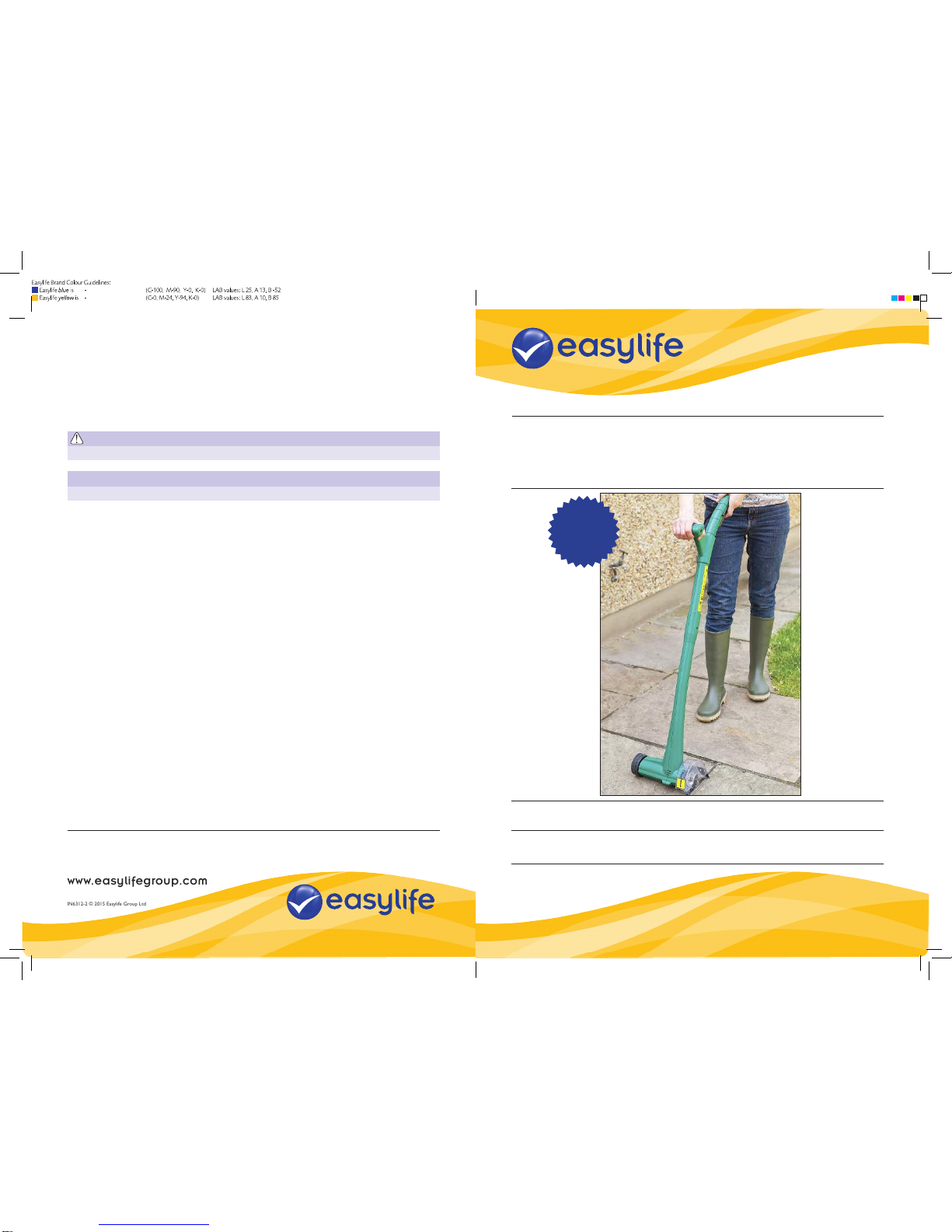
6. USING THE ELECTRIC PAVING SCRAPER
The tool can be plugged into any socket-outlet (with 230 V AC) that is equipped with a 10A fuse or
higher. The socket-outlet has to be safeguarded by an earthleakage circuit breaker (e.l.c.b.). The
operating current must not exceed 30 mA.
• Insert the tool plug into the power cord coupling (extension).
• Secure the power cable (Fig. 7/Item A) with the strain-relief clip (Fig. 7/Item 1) found on the equipment
as shown.
• To switch on the equipment hold the safety lockoff (Fig. 7/Item 6) and press and hold the ON/OFF
switch (Fig. 7/Item 2).
• To switch off, release the ON/OFF switch (Fig. 7/Item 2).
One steel brush (Fig. 2/Item 8) and one nylon brush (Fig. 2/Item 9) are supplied with the equipment.
The wire brush is suited for use on robust surfaces and obstinate weeds. We recommend using the
nylon brush for light vegetation and surfaces too sensitive for the steel brush.
Important. Always carry out a short trial run to check out possible effects on the surfaces of
the paving stones or slabs before starting with your work. Never use the equipment on very
sensitive surfaces, for example tiles.
Important. Only use brushes which are in awless condition. Replace excessively worn or
damaged brushes immediately.
Always use both hands to operate the equipment. Guide the equipment along the joints at a walking
pace. For uniform results carry out your work at a constant speed. If necessary, guide the equipment
along the same joint several times.
7. DAMAGE TO THE POWER CABLE
If the power cable for this equipment is damaged, it must be replaced by the manufacturer or its
aftersales service or suitably trained personnel to avoid danger.
PANTONE 072 C
PANTONE 123 C Paper weight 60gsm
Customer service: 0844 441 8448
For more innovative products from Easylife please visit:
www.easylifegroup.com