Emprex ParaEq MKII Deluxe User manual
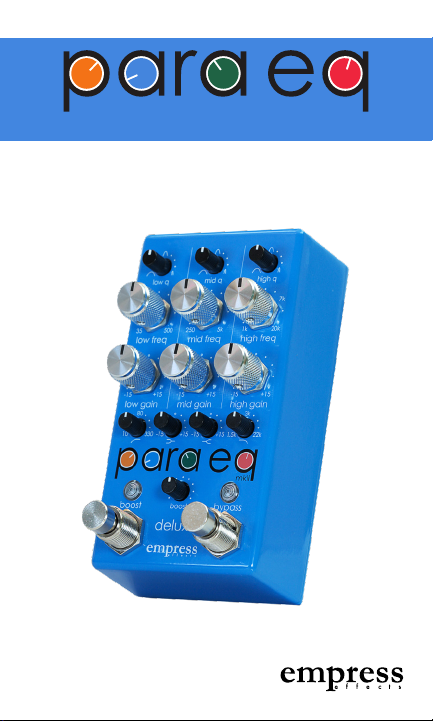
USER MANUAL
mkII
deluxe

Introducon
When we released our original ParaEq back in 2009,
it quickly became a favourite among musicians who
were searching for something more than the typical
oversimplied controls found on most Eq pedals.
Now, based on our users’ valuable feedback, we’ve
taken everything great about our original ParaEq
and made it even beer.
The Empress ParaEq MKII Deluxe is designed to be
a tool for sweetening the tone of any instrument.
We’ve designed it to give musicians a powerful,
musical, high quality Eq in a conveniently small
package. The signal path is comprised of the highest
quality components chosen for their transparency,
powerful tone shaping capabilies, and low
operang noise. We’ve increased the headroom to
27V, similar to rack-mount equipment, to ensure
clarity of sound no maer how hot the signal. With
added lters and Q knobs allowing for precise
parametric control, the ParaEq MKII Deluxe allows
for ulmate tonal shaping. Oh, and the whole
package is now half the size. Who doesn’t love a
small package?!
With the Empress ParaEq MKII Deluxe, your
instrument will sll sound like your instrument, only
beer, and with more control than ever before.
- Jason Fee

Sample Applicaons
General Sweetening: Perhaps you really like
the tone of your guitar but nd it could be
a lile brighter with more high end detail.
With the ParaEq MKII Deluxe, adding a small
boost in the range of 3 kHz to 5 kHz with a
wide Q will add a bit more detail, while sll
retaining the sound of your instrument. In
a similar manner, adding a wide Q boost to
the low frequency range will warm up your
instrument’s sound.
Tone Correcon: Say you’ve set your amp
up in a venue and nd that the acouscs of
the stage are making it sound too boomy. By
cung some of the frequencies in the low
mids (200Hz– 600Hz) with a medium width Q,
you can minimize the negave eects of the
room acouscs on your sound.
If you nd your guitar isn’t cung through
the rest of the band, you can boost the
upper mid frequency range (1kHz–4 kHz)
instead of simply turning up the volume of
your amplier, which could lead to you just
drowning out the rest of the band.

Sample Applicaons
Feedback Zapping: With a DI’ed acousc
instrument, playing live at stage volumes
can somemes be a nightmare. Feedback
through monitors can quickly ruin a great
performance. By using the ParaEq MKII
Deluxe’s mid and hi frequency bands and
narrow width Q sengs you’ll be able to cut
the frequencies causing the feedback while
retaining much of your instruments sonic
signature. The narrow width Q seng ensures
the range of frequencies being reduced is
very small, prevenng your instrument from
sounding dull or muddy.
Distoron Enhancement: Having the ParaEq
MKII Deluxe before your amplier lets you
use it to shape your distoron sounds in
radical ways. For example, if you want the
treble of your signal to distort a lile more
you can boost the high frequency band before
it reaches your amplier. This lets you add
a lile sonic slicing capability to your sound
without muddying up your boom end. The
boost control on the ParaEq MKII Deluxe is
a great way to push an already cooking tube
amplier into musical overdrive.

Q Controls
The Q is a measurement of how much the Eq
band aects a range of frequencies.
Tight or Narrow Q ( ): Knob fully CW. This
seng is best for aacking problems. For
example, if you have an acousc instrument
feeding back, a ght Q will allow you to cut
the oending frequency without aecng the
frequencies around it.
Medium Q ( ): Knob at 50%. This seng
is great for general tone shaping. Most
equalizers in instrument ampliers are
medium Q. Try using this seng to cut
frequencies in the 300Hz-400Hz range if your
amp is sounding a lile muddy, or boosng
in the 1kHz-5kHz range if your guitar is a lile
dark.
Wide Q ( ): Knob fully CCW. Wide Q
sengs are best when you want a really
transparent change to the signal. For
example, boosng at around 100Hz can add
a bit of warmth, and a lile boost in the 3k
range can add detail and denion, all while
retaining the original tone.

HP and LP Filters
High-pass and low-pass lters are used
to remove specic bands of frequencies
from the sonic spectrum. These bands are
determined by the lter shape and the cut-o
frequency at which the lter is set.
High-Pass Filter( ): The high-pass lter
aenuates frequencies below the cut-o
frequency set by the knob, which ranges from
10Hz to 330Hz, by 12dB/octave.
Low-Pass Filter( ): The low-pass lter
aenuates frequencies above the cut-o
frequency set by the knob, which ranges from
1.5kHz to 22kHz, by 12dB/octave.

Shelving Filters
Shelving lters are used to boost or aenuate
a specic band of frequencies from the sonic
spectrum. The lters’ shape and amount of
gain/aenuaon applied determines the
lters frequency response. The ParaEQ MKII
Deluxe shelving lters are extremely gentle
and musical sounding baxandall lters.
Low-Shelf Filter( ): Very gentle slope that
boosts or aenuates frequencies below
200Hz by -15dB to +15 dB, depending on the
knob posion.
High-Shelf Filter( ): Very gentle slope that
boosts or aenuates frequencies above 1kHz
by -15dB to +15 dB, depending on the knob
posion.

Advanced Conguraon
Advanced Conguraons are used to control the
bypass and boost states of the ParaEq MKII Deluxe.
Entering the advanced conguraon: Unplug the
power from the pedal. Plug the power back in while
holding down both the boost and bypass stomp
switches. The LEDs should ash momentarily to
conrm that you are in the advanced conguraon.
Modifying the advanced conguraon: To toggle
between true bypass and buered bypass use the
bypass stomp. The bypass LED will display which
mode you are in:
Bypass LED o = true bypass (default)
Bypass LED on = buered bypass
To toggle between normal bypass mode and
independent bypass mode use the boost stomp
switch. With independent mode you can apply
boost without having the equalizaon engaged. This
makes it almost like having a separate Eq and boost
pedal each with their own bypass switch.
Boost LED o = normal (default)
Boost LED on = independent
Exing the advanced conguraon: Hold down
both the tap and bypass stomp switches. The bypass
LEDs will blink momentarily to conrm the ParaEq
MKII Deluxe has exited the advanced conguraon.

Frequency Region Descripons
Here’s a rundown of dierent frequencies
that should be helpful when using the ParaEq
MKII Deluxe to achieve a specic end result.
Electric Guitar
80Hz – 150Hz: Boosng can add a subtle
warmth and bigness to the sound. Cung can
bring down any rumble you’re experiencing.
150Hz – 400Hz: Cung in this region can
remove a bit of mud, and boosng will bring
out the warmth.
400Hz – 800Hz: Cung in this region can
make the sound more prisne. Boosng will
add an aggressive edge to the sound.
800Hz – 2kHz: Boosng in this region will
bring out the twang in your sound. Cung
will create a rounder, less aggressive tone.
Above 3kHz: Boosng in this region can add
brightness and sheen. Cung in this region
can minimize noise and reduce harshness.
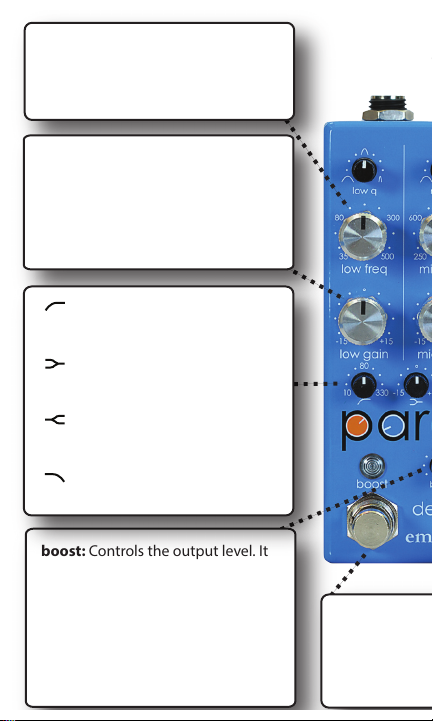
low freq, mid freq, high freq:
Selects the center frequencies
around which you’d like to boost or
cut for each band.
bypass stompswitch: When the LED
is shining, the ParaEq MKII Deluxe
eect is applied to the signal. When
o, the eect is being bypassed (true
and buered bypass available. See
advanced conguration).
low q, mid q, high q: The q
switches determine the range of
frequencies aected by the
equalizer on each band.
Wide q ( ) will aect a wide
range of frequencies around the
selected frequency. q ≈ 1 aects
about 1.5 octaves
Medium q ( ) will aect some
frequencies around the selected
frequency. This is a good place to
start for overall tone shaping. q ≈
2.5 aects about 2/3 octave
Narrow q ( ) will only aect a very
narrow range of frequencies around
the selected frequency. q ≈ 4
aects about 1/3 octave
There is a q control for each of the
three frequency bands available on
the ParaEq MKII Deluxe.
gain: Determines the amount of
boost or cut applied to frequency
band. At the 12:00 setting, there is
no boost or cut applied. The range
of boost or cut available for each
frequency band is -15dB to +15dB.
Controls at a Glance
boost: Controls the output level. It
is a clean boost, perfect for
providing gain before an eects
chain to minimize noise or to
overdrive the input of a tube amp.
The available boost ranges from 0
dB to +30 dB and is toggled on/o
with the boost stompswitch.
boost stompswitch: Toggles
on/o the boost section of the
unit. When the LED is shining,
the boost is applied to the
signal.
( ) Sets the cut-o frequency of
the high-pass lter.
( ) Sets the gain/attenuation of
the low-shelf lter.
( ) Sets the gain/attenuation of
the high-shelf lter.
( ) Sets the cut-o frequency of
the low-pass lter.
Table of contents