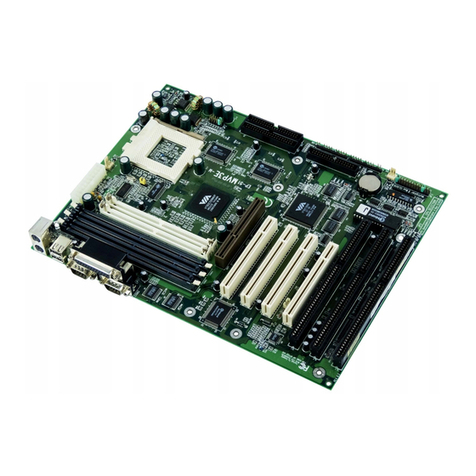
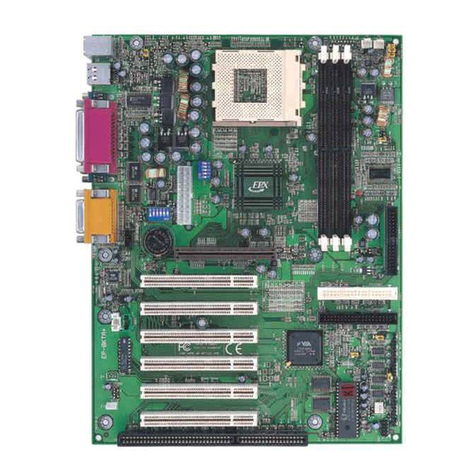
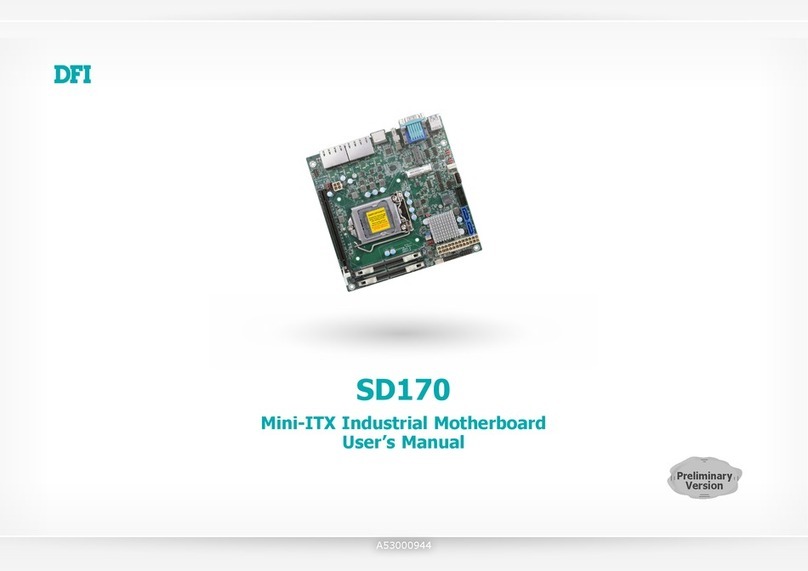
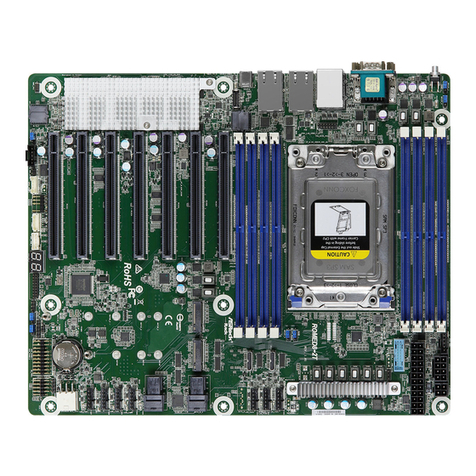
EPOX EP-7KXA User manual

TRADEMARK
All products and company names are trademarks or registered
trademarks of their respective holders.
These specifications are subject to change without notice.
Manual Revision 3.1
January 28, 2
EP-7KXAEP-7KXA
EP-7KXAEP-7KXA
EP-7KXA
An AMD Athlon Slot A ProcessorAn AMD Athlon Slot A Processor
An AMD Athlon Slot A ProcessorAn AMD Athlon Slot A Processor
An AMD Athlon Slot A Processor
based mainboarbased mainboar
based mainboarbased mainboar
based mainboard (133/100MHz)d (133/100MHz)
d (133/100MHz)d (133/100MHz)
d (133/100MHz)
SupporSuppor
SupporSuppor
Supports PC-133 SDRAM Modulests PC-133 SDRAM Modules
ts PC-133 SDRAM Modulests PC-133 SDRAM Modules
ts PC-133 SDRAM Modules

EP-7KXA
Table of Contents
Section 1 Introduction
Components Checklist ........................................ 1-1
Overview
AMD Athlon Processor ...................................... 1-2
S. .C. Cartridge Terminology ............................. 1-3
Accelerated Graphics Port .................................. 1-4
Hardware Monitoring .......................................... 1-4
P-7KXA Form-Factor....................................... 1-5
I/O Shield Connector .......................................... 1-6
Power-On/Off (Remote) ..................................... 1-6
System Block Diagram........................................ 1-7
Section 2 Features
P-7KXA Features .............................................. 2-1
Section 3 Installation
P-7KXA Detailed Layout ................................. 3-2
Easy Installation Procedure
Configure Jumpers .............................................. 3-3
System Memory Configuration .......................... 3-5
Installing Processor ............................................ 3-7
Device Connectors .............................................. 3-8
xternal Modem Ring-in Power ON and
Keyboard Power ON Function (KBPO) ............. 3-10
STR (Suspend To RAM) Function ....................... 3-11
Section 4 Award BIOS Setup
Main Menu ...................................................................... 4-1
Advanced BIOS Features ................................................ 4-2
Advanced Chipset Features ............................................. 4-8
Integrated Peripherals..................................................... 4-11
Power Management Setup .............................................. 4-15
PNP/PCI Configuration.................................................. 4-18
PC Health Status ............................................................. 4-20
Frequency/Voltage Control ............................................ 4-21
Page

EP-7KXA
Defaults Menu................................................................. 4-22
Supervisor/User Password Setting ................................. 4-23
xit Selecting .................................................................. 4-24
Appendix
Appendix A
Memory Map ....................................................... A-1
I/O Map ................................................................ A-1
Timer & DMA Channels Map ............................. A-2
Interrupt Map ....................................................... A-2
RTC & CMOS RAM Map .................................... A-3
Appendix B
POST Codes......................................................... A-5
Appendix C
Load Setup Defaults ............................................ A-13
Appendix D
GHOST 5.1 Quick Users Guide ......................... A-15

EP-7KXA
Page Left Blank

IntroductionEP-7KXA
Page 1-1
Section 1
INTRODUCTION
Components Checklist
99
99
9A. (1) EP-7KXA mainboard
99
99
9B. (1) EP-7KXA users manual
99
99
9C. (1) Floppy ribbon cable
99
99
9. (1) ATA-66 Hard drive ribbon cable
99
99
9E. (1) Foldable Retention Module
F. (1) USB Cable (Optional)
99
99
9G. (1) river and utility
A
-
B
USERS
MANUAL
EP-7KXA
G
or
D
C
F

Introduction EP-7KXA
Page 1-2
Overview
AMD AthlonTM Processor
The AM AthlonTM processor is the newest microprocessor in the AM K86TM
family of microprocessors. The AM Athlon processor brings superscalar RISC
performance to desktop systems running industry-standard x86 software. This
processor implements advanced design techniques such as:
Three out-of-order, superscalar, pipelined Multimedia Units
Three out-of-order, superscalar, pipelined Integer Units
Three x86 instruction decoders
Fixed-sized internal instruction formats (MacroOPs)
72-entry Instruction Control Unit
AM 3 NOW!TM technology
Large L1 and L2 caches and translation lookaside (TLB) structures
Register renaming and data-forwarding
ynamic branch prediction
S2K Interface Technology
The AM Athlon processor is the first x86 processor ever to incorporate the S2K
interface technology to deliver unprecedented system performance. The S2K
interface technology is based on the EV6 bus technology from igital/Compaq
and provides 1.6 Gbytes per second bandwidth to the system.
The AM Athlon Processor utilizes Single Edge Contact (S.E.C.) (Figure 1)
cartridge packaging technology. The S.E.C. cartridge utilizes surface mounted
core components and a printed circuit board with an edge finger connection. The
S.E.C. cartridge package introduced on the AM Athlon Processor will also be
used in future Slot A processors.
The S.E.C. cartridge has the following features: a thermal plate, a cover and a PCB
with an edge finger connection. The thermal plate allows standardized heatsink
attachment or customized thermal solutions. The thermal plate enables a reusable

IntroductionEP-7KXA
Page 1-3
heatsink to minimize fit issues for serviceability, upgradeability and replacement.
The full enclosure also protects the surface mount components. The edge finger
connection maintains socketabilty for system configuration. The edge finger
connector is denoted as Slot A connector in this and other documentation.
S.E.C. Cartridge Terminology
Processor card
The green PCB (with or without components on it)
Processor core
The CPU silicon chip on the processor card.
Cover
The plastic cover on the opposite side from the thermal plate.
Slot A
The slot that the S.E.C. cartridge plugs into.
Retention mechanism
Formerly retention module the dual posts, etc. that holds the cartridge in
place.
Thermal plate
The heatsink attachment plate.
Heat sink supports
The support pieces that are mounted on the mainboard to provide added
support for heatsinks.
Figure 1: AMD Athlon Processor with S.E.C.C.

Introduction EP-7KXA
Page 1-4
Accelerated Graphics Port
(AGP or A.G.P.)
Typically, 3 graphics rendering requires a tremendous amount of memory, and
demands ever increasing throughput speed as well. As 3 products for the
personal computer become more and more popular, these demands will only
increase. This will cause a rise in costs for both end users and manufacturers.
Lowering these costs as well as improving performance is the primary motivation
behind AGP. By providing a massive increase in the bandwidth available between
the video card and the processor, it will assist in relieving some of these pressures
for quite sometime.
Hardware Monitoring
Hardware monitoring allows you to monitor various aspects of your systems
operations and status. The features include CPU temperature, voltage and RPM of
fan.

IntroductionEP-7KXA
Page 1-5
EP-7KXA Form-Factor
The EP-7KXA is designed with ATX form factor - the new industry standard of
chassis. ATX form factor is essentially a Baby-AT baseboard rotated 90 degrees
within the chassis enclosure and a new mounting configuration for the power
supply. With these changes the processor is relocated away from the expansion
slots, allowing them all to hold full length add-in cards. ATX defines a double
height aperture to the rear of the chassis which can be used to host a wide range of
onboard I/O. Only the size and position of this aperture is defined, allowing PC
manufacturers to add new I/O features (e.g.; TV input, TV output, joystick, modem,
LAN, etc.) to systems. This will help systems integrators differentiate their
products in the marketplace, and better meet your needs.
Smaller size promotes a smaller system size.
I/O shield does not need to be retooled in an ATX 2.01 or later. The
mainboard should be used in an ATX 2.01 (or later) compliant case.
A smaller power supply can be used. High integration on mainboard
reduces the system costs.
Full length
slots
Expandable I/O
5 1/4"
Bay
3 1/2"
Bay
Figure 2: Summary of AT chassis features
CPU located near
Power Supply
Single chassis
fan for system
ATX
Power
Supply
ATX power connec-
tor
Floppy / I E
connectors
close to
peripheral
bays

Introduction EP-7KXA
Page 1-6
Power-On/Off (Remote)
The EP-7KXA has a single 20-pin connector for ATX power supplies. For ATX
power supplies that support the Remote On/Off feature, this should be connected
to the systems front panel for system Power On/Off button. The systems power
On/Off button should be a momentary button that is normally open.
The EP-7KXA has been designed with Soft Off" functions. You can turn Off the
system from one of two sources: The first is the front panel Power On/Off
button, and the other is the "Soft Off" function (coming from the EP-7KXAs
onboard circuit controller) that can be controlled by the operating system.
Windows 95/98 will control this when the user clicks that they are ready to
Shutdown the system.
Figure 4: Simple AT Power ON/OFF Controller
J 3
AT
POWER SUPPLY
Case (chassis) Power
ON/OFF button (J 3)
I/O Shield Connector
The EP-7KXA is equipped with an I/O back panel. Please use the appropriate I/O
shield (figure 3).
Figure 3: I/O back panel layout
PS/2 Mouse
PS/2
KEYBOARD
USB port
COM1 COM2
parallel port
Speaker
Line_in
MIC
Joystick/Midi
Table of contents
Other EPOX Motherboard manuals




EPOX
EPOX MVP4M User manual
EPOX
EPOX AMD Socket et A Processor based AGP (8X)... User manual

EPOX
EPOX F62 User manual

EPOX
EPOX EP-MVP3G-M User manual
EPOX
EPOX An Intel Socket 478 Processor Based Mainboard... User manual

EPOX
EPOX F61 User manual
EPOX
EPOX EP-4B2AE User manual
EPOX
EPOX EP-61EXA-A User manual
EPOX
EPOX LX370Y User manual
EPOX
EPOX EP-GXB-M User manual