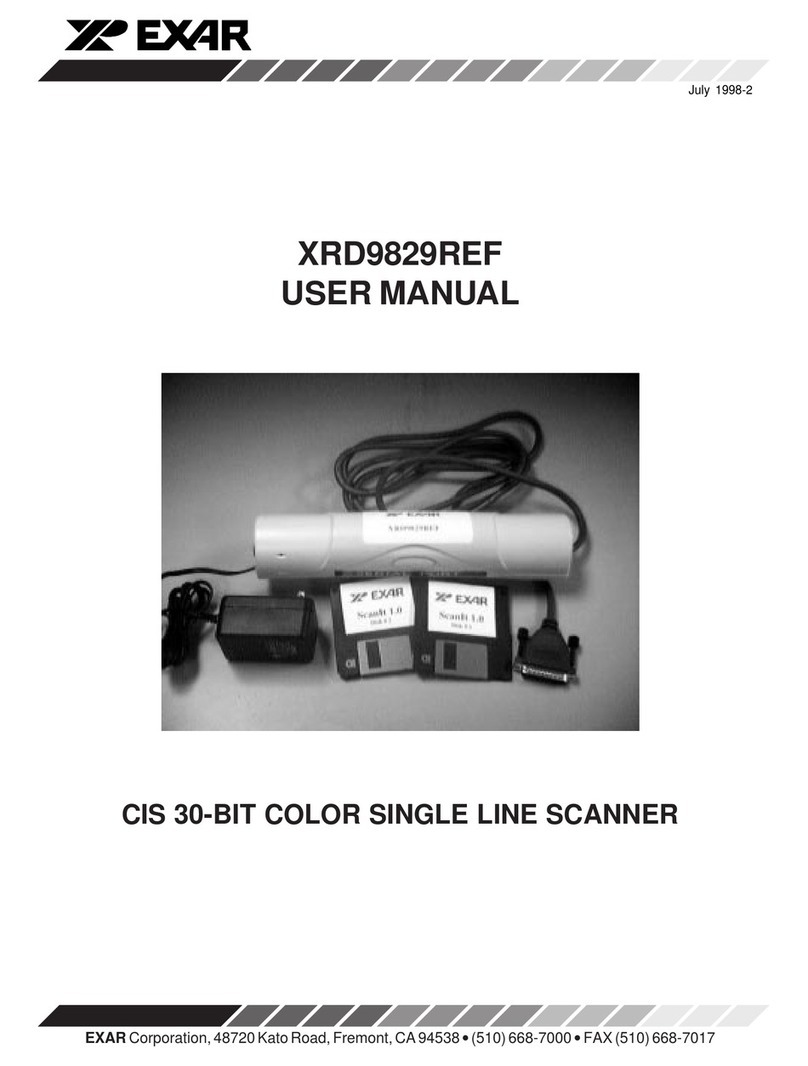
Exar XRD9827REF User manual

XRD9827REF
USER MANUAL
CANNON CIS 36-BIT COLOR
SINGLE LINE SCANNER

... the analog plus comp
a
TM
EXAR Corporation 48720 Kato Road, Fremont, CA 94538 Phone (510)-668-7000, Fax (510)-668-7030
PRELIMINARY
2
EVALUATION KIT PART LIST
This kit contains the following:
•XRD9827REF CIS 36-Bit Color Single Line Scanner
•XRD9827REF User Manual
•SenseIt 1.0 Software Installation Diskettes (2)
•XRD9827 Data Sheet
•Scan Targets (Black, White, Color)
FEATURES
•One line scanning functionality of XRD9827 with CANON 600DPI CIS (Contact Image Sensor)
•Easy to use with most personal computers through Parallel Port Interface
•Simple way of loading the Serial Port of XRD9827 to adjust gain and offset
•Software SenseIt 1.0 to view single line scan
•Optimized PCB Layout with Four Layer
SYSTEM REQUIREMENTS
•Intel 486 compatible computer with Windows 95 operating system
•8 MBytes system memory
•25-pin D-shape parallel port receptacles
•3 1/2” floppy disk drive
INTRODUCTION
The XRD9827REF is a demo system which includes a PCB design with a CANON CVA-60216K 600DPI
Color Contact Image Sensor (CIS). It demonstrates how to interface a CIS with EXAR’s XRD9827, a 12-
bit Linear CIS/CCD Sensor Signal Processor to output a single line scan and display the amplitude of each
of the three colors. The XRD9827REF is designed to provide a signal path for the CIS output signals to be
processed, digitized by the XRD9827 and transmitted to a personal computer. There are no software
algorithms or hardware implementations, for example, gamma correction, to adjust for color response.
The XRD9827REF board is loaded with the XRD9827, a Vantis MACH435 CPLD, two FIFO SRAMs and
peripheral circuits for the CIS. The MACH435, which is a CMOS Programmable Logic Device (CPLD)
provides timing signals to the XRD9827, the SRAMs and the CIS. It also programs the XRD9827 to
operate in the correct mode and adjust for gain and offset values. The XRD9827 processes the analog
output from the CIS sensor, level-shifts and converts the signal into 12-bit digital codes. The SRAMs gate
the digitized data from the XRD9827 and stores the data temporarily. Controlled by the software, the
SRAMs send the data through a parallel port connection to the PC and histograms of raw data are
displayed in the monitor using the SenseIt software. A block diagram of the XRD9827REF is shown below
in Figure 1.

... the analog plus comp
a
TM
EXAR Corporation 48720 Kato Road, Fremont, CA 94538 Phone (510)-668-7000, Fax (510)-668-7030
PRELIMINARY
3
CANON CVA-60216K 600DPI COLOR CIS
XRD9827
FIFO
SRAM
FIFO
SRAM
INTEL 486 Compatible
MACH435 CPLD
PARALLEL
PORT DB25
CONNECTOR
CIS CONTROL SIGNALS
8-BIT DATA
DATA
8-BIT DATA
6-BIT BUS NIBBLE
XRD9827 CONTROL SIGNALS
PARALLEL PORT CONTROL
CIS OUTPUT
CIS REFERENCE
VOLTAGE
Figure 1. Block Diagram of XRD9827REF
The XRD9827 is a complete linear CIS or CCD sensor signal processor on a single monolithic chip. The
XRD9827 includes a high speed 12-Bit ADC, a 6-Bit Programmable Gain Amplifier with gain adjustment
of 1 to 10 and an 8-Bit programmable input referred offset calibration range of 800 mV. The XRD9827
also provides the necessary biasing voltage for the CANON CIS, eliminating the use of external
components (two diodes and two resistors). See the XRD9827EVAL User Manual / PCB board for
evaluating the XRD9827 CIS / CCD signal processor chip. A simplified functional block diagram of
XRD9827 is shown below for your reference.

... the analog plus comp
a
TM
EXAR Corporation 48720 Kato Road, Fremont, CA 94538 Phone (510)-668-7000, Fax (510)-668-7030
PRELIMINARY
4
RED
GRN
BLU
VDCEXT
VREF+
DB7:0
DVDD
DGND
AVDD
AGND
ADCCLK
CLAMP
SYNCH
PGA
TIMING &
CONTROL LOGIC
AVDD
6-BIT GAIN
REGISTERS
12-BIT
ADC
RL
AGND
DATA
I/O
PORT
BUFFER VRT
VRB
S/H
&
3-1
MUX
8-BIT DAC
12 8
8-BIT OFFSET
REGISTERS
6
8
+
_
AGND
VDCREF
DC/AC
INT/EXT_VDCREF
CIS/CCD
G<5:0>
O<7:0>
R G B
R G B
CLP
CLAMP
Power
Down
Power
Down
VRT
CCD CIS
VBG
Biasing Circuit for CANON
CIS
Figure 2. Simplified Functional Block Diagram of XRD9827
OPERATIONAL PROCEDURE
The routine listed below will first calibrate the photo response of the CIS using the XRD9827 by optimize
its offset and gain. After calibration, the XRD9827REF can be used to scan any color target to show CIS
non-color corrected response. (Color correction is typically done in the digital ASIC.)

... the analog plus comp
a
TM
EXAR Corporation 48720 Kato Road, Fremont, CA 94538 Phone (510)-668-7000, Fax (510)-668-7030
PRELIMINARY
5
How to Run the XRD9827REF Demonstration
1. Make sure the computer is powered off and the AC power adapter is disconnected from a wall outlet
2. Connect the parallel port cable to the printer port of the computer
3. Connect the AC power adapter into a wall outlet
4. Turn on the computer and activate Windows 95
Loading EXAR Software
5. Load the diskette labeled SenseIt 1.0 Disk # 1 into the floppy drive
6. Select the Start menu in the program manager and choose RUN
7. Inside the small pop-up window, type: A:\setup
8. Follow the instructions to finish software installation
Parallel Port Configurations
9. Confirm the parallel port address as follows:
I. Select the Start Menu, choose Settings, then choose Control Panel
II. From the Control Panel window which pops up, double-click on System
III. In the System Properties window, select Device Manager
IV. From the Device Manager window, double-click on Ports (COM & LPT)
V. Double-click on Printer Port (LPT1). If you can not find it, please goto Step 10
VI. From the pop-up window, select Resources
VII. Verify the Input/Output Range is set to 0378 - 037F
VIII. If the range is not correct, clear the Use Automatic Settings check box by clicking it
IX. Choose correct address which is 0378 by default and click OK
X. Re-start the computer as advised
10. If you do not have a Printer Port configured on your computer, please follow the steps listed below:
I. From the Control Panel window which pops up, double-click on Add New Hardware
II. From the pop-up window, click the Next > button
III. Select ‘No’ when prompted for ‘Do you want Windows to search for your new
hardware?’, then click the Next > button
IV. Choose Ports (COM & LPT), then click the Next > button
V. Choose Printer Port, then click the Next > button
VI. Make a note of the Input/Output Range of Printer Port of your computer and click OK.
You will use these values later when configure the SenseIt software
VII. Re-start the computer as advised
Offset Adjustment With a Black Target
11. Set the dip switches located on the side panel of the scanner to [110 01000000] as shown in Figure 3
and push the Serial Port button which is located on the front panel of the demo system. This will reset the
XRD9827.

... the analog plus comp
a
TM
EXAR Corporation 48720 Kato Road, Fremont, CA 94538 Phone (510)-668-7000, Fax (510)-668-7030
PRELIMINARY
6
1
0
S
1S
0
S
2D
5D
4
D
7D
6D
2D
1
D
3D
0
Figure 3. Dip Switches Set to Value [110 01000000] to Reset XRD9827
12. Select the Start Menu, choose Programs, then choose SenseIt icon
13. A window will pop up as shown below. The upper window shows the plot of captured data and the
lower window shows the histogram of data. Figure 4 shows the pop-up window when SenseIt is first
started.

... the analog plus comp
a
TM
EXAR Corporation 48720 Kato Road, Fremont, CA 94538 Phone (510)-668-7000, Fax (510)-668-7030
PRELIMINARY
7
Figure 4. SenseIt Software Window Before Scanning
14. Select SETUP from the pull-down menu and choose I/O ADDRESS. In the window that pops up, type
in the Input/Output Range of Printer Port of your computer. The default setting is 378H.
15. Pick the black target out from the kit and put it on a flat area. Place the XRD9827REF on top of the
black target with the CIS sensor facing downwards. From the CAPTURE menu select SNAP SHOT (or
simply press CTRL and B buttons simultaneously) for a single line scan of the black target with the dip
switches set to [000 00000000]. A typical result of a black target scan is shown below:

... the analog plus comp
a
TM
EXAR Corporation 48720 Kato Road, Fremont, CA 94538 Phone (510)-668-7000, Fax (510)-668-7030
PRELIMINARY
8
Figure 5. Non-calibrated Black Target Scan
16. Set the dip switches to [110 00010000] to tie VDCREF and VDCEXT pin together internally. Push the
Serial Port button. The XRD9827 will subtract whatever voltage appears on VDCEXT (pin 16) from the
input and thus perform a global offset adjustment. A typical result of the global offset adjustment is shown
below. Please notice that the black code value has moved down.

... the analog plus comp
a
TM
EXAR Corporation 48720 Kato Road, Fremont, CA 94538 Phone (510)-668-7000, Fax (510)-668-7030
PRELIMINARY
9
Figure 6. Black Target Scan After Global Offset Adjust Using the 9827 Internal
Bandgap Reference Voltage
17. Then, set the dip switches to [111 00010000] and push the Serial Port button again. By doing this, a
1.24V reference voltage provided by an internal bandgap is applied to the VDCEXT pin. VDCEXT is
connected to VREF pin (Pin 5) of the CANON CIS, this voltage is used by the CIS as a biasing voltage.
Moreover, a 12K built-in resistor of the XRD9827 serves as a pull-down for the output of the CIS. By
interfacing the XRD9827 with a CANON CIS, a designer can save two biasing diodes and two resistors
and thus reduce cost.

... the analog plus comp
a
TM
EXAR Corporation 48720 Kato Road, Fremont, CA 94538 Phone (510)-668-7000, Fax (510)-668-7030
PRELIMINARY
10
RL
VRT
VRB
VDD
XRD9827
C
I
S
PIN 19
(RED)
2.2uF
PIN 16
(VDCEXT)
BANDGAP
1.24V
M
U
X
12K
Figure 7. Simplified Block Diagram Showing Global Offset Adjustment by XRD9827 Using
Internal Bandgap and CIS Using VDCEXT for Biasing
18. Set the dip switches to [001 01010000] to select the internal offset DAC for fine offset adjustment.
Push the Serial Port button. From the CAPTURE menu select SNAP SHOT. The offset should now move
the output of the CIS to almost zero scale. The other way to do a SNAP SHOT is by pressing CTRL and B
button at the same time. Please refer to data sheet for offset adjustment. A typical result of the fine offset
adjustment is shown below.
Table of contents
Other Exar Scanner manuals