Technical specication
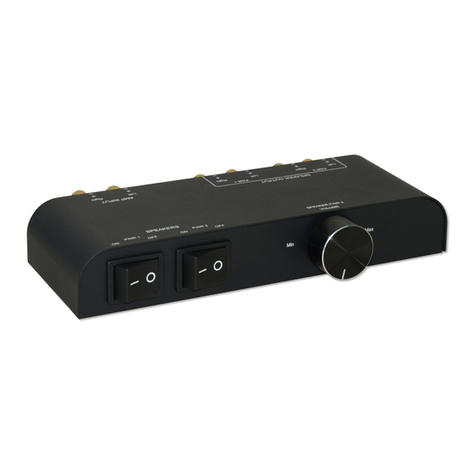
Voltage: 230 VAC.
Power supply, DALI bus: 21 V, max. 200 mA.
Power supply, detectors: 12 V, max. 200 mA.
Number of light ttings: Approx. 100 depending on
type.
Relay: Switching.
Switch-off delay: 0–120 minutes.
Dimensions (W x H x D): 72 x 92 x 76 mm (4 modules).
Optional equipment
PD-2200 presence detector
Order no. 13140, E-no. 13 060 20
PD-2200 is a passive IR detector intended for
presence detection. The electronics and soft-
ware in the microprocessor of the PD- 2200
have been specially designed for presence de-
tection. The number 15 standard lens gives a
detection area of 41 m x 41 m.
LS-10 light sensor
Order no. 13100, E-no. 13 060 16
Light sensor for connecting to NP-2T DL, etc.
The light sensor monitors the light level in the
premises.
AD-500/600 detector
Order no. 13095/13091, E-no. 13 060 10/13 060
12 AD500/600 are acoustic presence detectors
for lighting control. These detectors detect pres-
ence by listening for sounds in two different fre-
quency ranges and analysing the signals. The
lighting is switched on by inaudible low-frequen-
cy sound that is generated when a door is opened. The light-
ing remains on as long as higher frequency sound such as foot-
steps and speech are detected.
AD-300 acoustic auxiliary detector
Order no. 13126, E-no. 13 060 40
AD-300 is an auxiliary acoustic detector inten-
ded for use in combination with an IR detector.
The purpose of the detector is to switch on light-
ing when someone enters the premises by de-
tecting the infrasound (low-frequency sound) that is generated
when a door is opened. This improves convenience, by ensur-
ing that lighting is switched on in areas that the IR detector can-
not “see”, such as concealed doorways.
AD-350 acoustic auxiliary detector
Order no. 13130, E-no. 13 060 41
AD-350 is an auxiliary acoustic detector in-
tended for controlling lighting in combination
with an IR detector. It listens solely to a lim-
ited frequency range between 3 and 7 kHz and
switches on the lighting (or keeps it switched on) when sound is
detected in this range, before the IR detector detects presence.
The AD-350 is often used to supplement IR detectors, to ensure
that lighting remains on when people are present.
Commissioning
Adjusting levels and times
As a standard solution the potentiometers should be adjusted to
give the following minimum and maximum levels:
Low level potentiometer – base lighting (Low level, blue) to 1
per cent = lowest possible (fully anticlockwise) or whatever set-
ting the HF ballast permits or gives the desired level of comfort
High level potentiometer – normal lighting (High level, red) to
a maximum of 80 per cent. A lux meter can be used to adjust
this setting. To make adjustment of light levels easier the relev-
ant level is switched on for a few seconds every time a level po-
tentiometer is adjusted.
Timer function (Timer, yellow) controls the switching on and
off of lighting (possibly via a contactor). This should be set to
1–2 hours (Base Level). A longer time means that the lighting is
switched on fewer times each day.
Longer time = less wear to the cathodes of uorescent tubes.
Adjust the delay for detector(s) to 1–2 minutes or slightly
longer to suit wishes. This time determines how long the light-
ing remains at the higher level after presence was last detected.
This time should therefore be kept as short as possible.
It is very important that the settings for the installation are
documented and kept as a record that adjustment has been
carried out according to the instructions.
A form for documenting settings can be found in the En-
ergy-saving Detection Technology handbook and at www.ex-
tronic.se/dokumentation/manualer.
Add Det. Time potentiometer – detector delay
The detector's additional delay time is set to the required dura-
tion, 0–20 minutes.
Light sensor (Light Sensitivity, white potentiometer)
NOTE! The light sensor should be adjusted so that it prevents
the lighting from being switched on when there is sufcient nat-
ural light.
1. Turn the potentiometer fully anticlockwise to the Min posi-
tion.
2. Then turn the potentiometer clockwise until the green Start
block LED lights up.
3. Now the lighting will not be switched on until the natural
light level falls below the level at the time of setting.
4. NOTE! The lighting will not be prevented from switch-
ing on until presence is no longer detected, the light-
ing has dimmed to the base level and presence is once
again detected.
Dimmer rate (Soft Dim). Should be set so that ramping up
takes place at the required rate. The ramp down rate is xed at
around 20 seconds. A good base setting is to adjust the poten-
tiometer to the one o’clock position.
Fluorescent tube burn-in. New uorescent tubes should be
burned in to deliver their rated performance Burn-in entails run-
ning the tubes at 100 per cent power for 100 hours.
There is a button on the circuit board that starts the burn-in pro-
cess for uorescent tubes:
- A single press turns on the uorescent tubes at 100% for 100
hours.
- Pressing again interrupts the burn-in process.
During the burn-in process the lighting can be switched on or off
and dimmed manually.
Extronic Elektronik AB +46 8 609 29 00 72016-04-14