To add to the confusion surrounding
“sandpaper,” there are three different
“standards” applied to describing the size
of the abrasive particles. The US grades
are called “CAMI,” the European grades
including the Festool sanding media are
identified as “FEPA” and in Japan the
grades are identified as “JIS.”
The table on the previous page lists how
these different size grades relate one to
another with the actual size of the parti-
cles measured in microns. In coarser
grades they are quite close, but as you
move to the finer grades the differences
become greater.
It is not as important to know these differ-
ences as it is to recognize how the abrad-
ing materials you are using have been
graded. This is important because in or-
der to achieve a desired very smooth final
finish you need to progressively “sand”
the finish with finer and finer grits before
you apply the finish and often afterwards
as well. You don’t want to be inadver-
tently jumping back and forth between
grading standards or you could be mov-
ing from a finer to a coarser grit without
realizing it.
Dust Control With Festool Sand-
ers
All Festool sanders feature built-in dust
ports to which a vacuum or dust collector
can be attached. These dust ports lead
to pads which have a series of holes cut
in them. The Festool sandpapers have
matching holes cut in them so the vast
majority of the sanding dust is pulled
through the holes and out through the
dust port into the vacuum or dust collec-
tor without spilling out into the open air,
and therefore into the operator’s lungs.
Festool sanders
which use round
abrasives fea-
ture a unique
pattern of eight
smaller holes
around the out-
side edge of the
pad and paper
plus one larger
hole in the cen-
ter of the pad
and paper.
Here is a picture of a typical Festool
round sanding material in the 150mm di-
ameter size. The photo shows the back
of the material which has printed on it the
type (which we will discuss in a moment)
and grade (P180 in this case.) All Festool
sanders and supplied sanding media use
a hook-and-loop style of fastening which
means you can remove and reattach the
sanding material repeatedly and quickly.
For the sanders which use the round me-
dia, vacuum is drawn through the dust
collector port which is routed to the outer
eight holes. The center hole aligns with
specially designed air inlet ports in the
backing plates. This allows air to be
drawn in through the center hole and
then pulled out to outer holes bringing
with this air stream most of the sanding
particles. As a result Festool sanders are
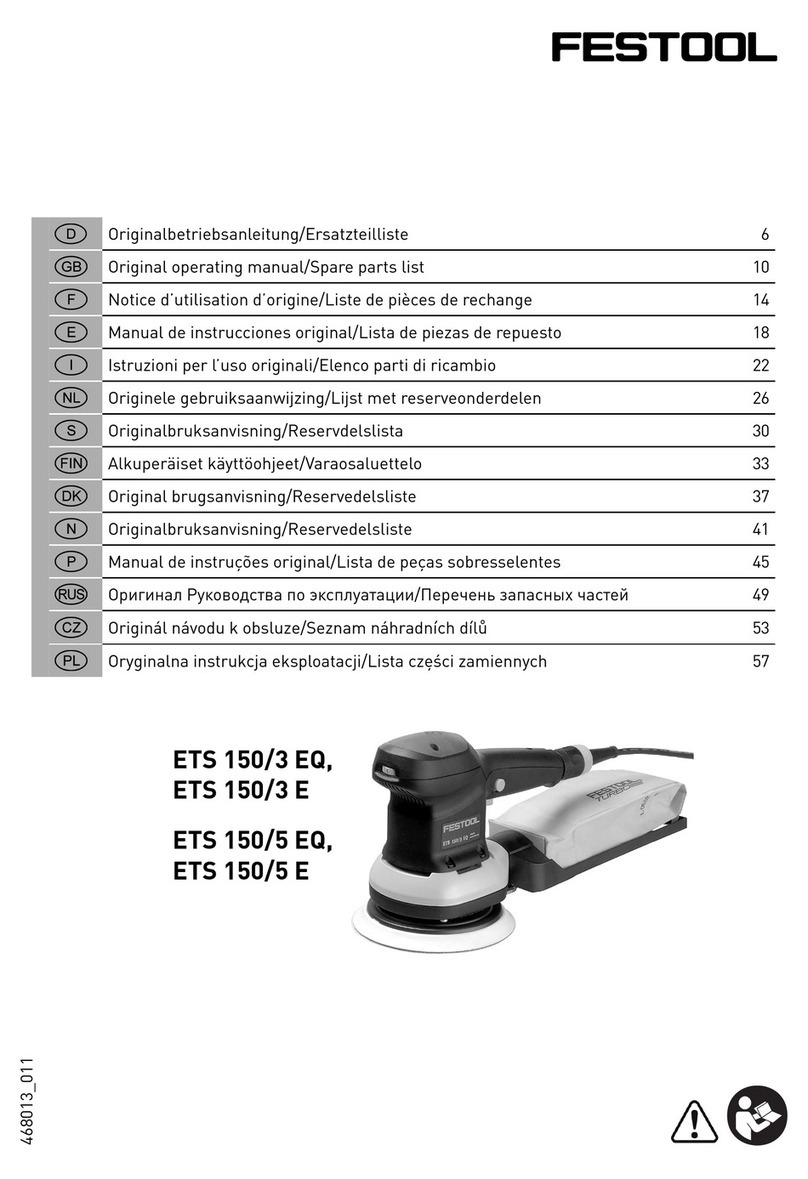
Note the 9 hole pattern on the
pads on these two Festool
Rotex sanders