manuals.online logo
Brands
  1. Home
  2. •
  3. Brands
  4. •
  5. FULGOR
  6. •
  7. Dishwasher
  8. •
  9. FULGOR DWF8010 User manual

FULGOR DWF8010 User manual

Other FULGOR Dishwasher manuals

FULGOR MILANO FDW8293 User manual

FULGOR

FULGOR MILANO FDW8293 User manual

FULGOR Milano FDW 8207 User manual

FULGOR

FULGOR Milano FDW 8207 User manual

FULGOR F6DW24 SS1 MILANO User manual

FULGOR

FULGOR F6DW24 SS1 MILANO User manual

FULGOR F6DW24F 1 Series User manual

FULGOR

FULGOR F6DW24F 1 Series User manual

FULGOR DW524L1AWH User manual

FULGOR

FULGOR DW524L1AWH User manual

FULGOR DW324K1ABL User manual

FULGOR

FULGOR DW324K1ABL User manual

Popular Dishwasher manuals by other brands

Samsung DW-FN320T user manual

Samsung

Samsung DW-FN320T user manual

LG LDS 5811WW Service manual

LG

LG LDS 5811WW Service manual

Elba EDW-B1462D owner's manual

Elba

Elba EDW-B1462D owner's manual

VESTEL NOVUS Series Service manual

VESTEL

VESTEL NOVUS Series Service manual

Bosch SMS4EMW00E Instructions for use

Bosch

Bosch SMS4EMW00E Instructions for use

Global-Tek GT-CR 2 manual

Global-Tek

Global-Tek GT-CR 2 manual

Smeg Dishwasher 85028 Instructions for installation and use

Smeg

Smeg Dishwasher 85028 Instructions for installation and use

LG LD-4080W Service manual

LG

LG LD-4080W Service manual

Bauknecht GCF 625 operating instructions

Bauknecht

Bauknecht GCF 625 operating instructions

Sharp QW-HX13F47EI-EU user manual

Sharp

Sharp QW-HX13F47EI-EU user manual

Asko D5536XLFI operating instructions

Asko

Asko D5536XLFI operating instructions

Modena WP 7134 WVM User manual book

Modena

Modena WP 7134 WVM User manual book

Beko DFN39340X instruction manual

Beko

Beko DFN39340X instruction manual

AEG FAVORIT 65050 VI1P user manual

AEG

AEG FAVORIT 65050 VI1P user manual

Siemens SN23HI37VE user manual

Siemens

Siemens SN23HI37VE user manual

Maytag MDB4651AWB - Tall Tub Dishwasher User instructions

Maytag

Maytag MDB4651AWB - Tall Tub Dishwasher User instructions

Hotpoint Ariston LL 42 Instruction book

Hotpoint Ariston

Hotpoint Ariston LL 42 Instruction book

Siemens SN45ZW56CS user manual

Siemens

Siemens SN45ZW56CS user manual

manuals.online logo
manuals.online logoBrands
  • About & Mission
  • Contact us
  • Privacy Policy
  • Terms and Conditions

Copyright 2025 Manuals.Online. All Rights Reserved.

DWF8010
14 place settings
Alt function
www.fulgor.com.au
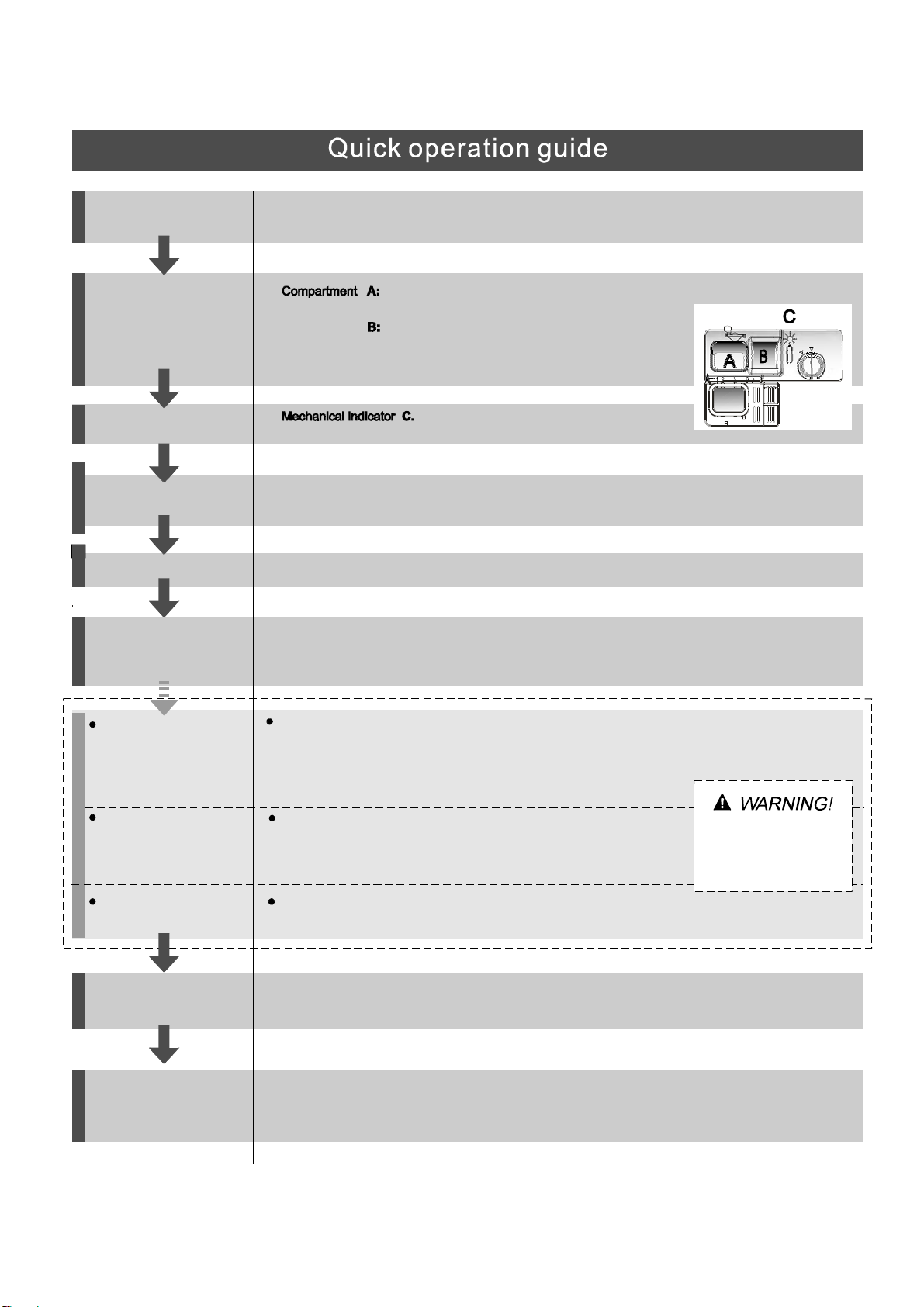
Witheachwashcycle.
Compartment
For programmes with pre-wash only.
(Follow the user instructions!)
Electric indicator on control panel (if provided).
Check the rinse aid level
Load the baskets
Select a programme
Running the dishwasher
Switch off the appliance
Turn off the water tap,
unload the baskets
Fill the detergent dispenser
Warning: wait a few minutes (about 15 minutes) before unloading the dishwasher to avoid handling
the dishes and utensils while they are still hot and more susceptible to break.
They will alsodry better.Unload the appliance, starting from the lower basket.
Changing theprogramme
Add forgotten dishes in the
dishwasher.
Scrape off any large amount of leftover food. Soften remnants of burnt food in pans,
then load the baskets. Refer to the dishwasher loading instructions.
When the working cycle has finished, the buzzer of the
dishwasher will sound 8 times, then stop.
Turn off the appliance using the On/Off Button.
If the appliance is switched
off during a wash cycle.
Open the door carefully.
Hotsteam may escape
when thedoorisopened!
If the appliance is switched off during a wash cycle, when switched
on again, please re-select the washing cycle and operate the dishwasher
according to the original Power-on state.
Switch on the appliance
For detailed operating method read the corresponding content onthe instruction manual.
Close the door, turn on the water tap. The machine will start working
after about 10 seconds.
Press the Programme Button, the selected programme indicator lights up.
( See the section entitled Operation instruction )“”
Open the door, press the On/Off button to switch on the appliance.
1. Arunning cycle can only be modified if it has been running for a short time. Otherwise the detergent
may have already been released and the water already drained. If this is the case, the detergent
dispenser must be refilled.
2. Open the door, press the program button more than 3 seconds, the machine will be in
standby state, then you can change the program to the desired cycle setting.
1.Open the door a little to stop the washing.
2.After the spray arms stop working, you can open the door
completely.
3.Add forgotten dishes.
4.Close the door, the dishwasher will run after 10 seconds.
To review the section on troubleshooting Tips
willhelp you tosolve some common problems
by yourself .
Dear Customer,
Please carefully readthismanualbefore usingthe
dishwasher,itwill help you to use and maintain the
dishwasher properly.
Pass it on toany subsequent owner of the appliance.
Thismanual contains sections on safety Instructions,
Operating Instructions, InstallationInstructionsand
Troubleshooting Tips, etc.
The manufacturer, following a policy of constant
development andupdating of the product, may
make modifications without giving prior notice.
Keep it as a refer in the later days.
If you can not solvethe problems by yourself ,
please ask forthe help of professional technicians.
This appliance is intended tobe used in household
andsimilar applications suchas:
-staff kitchen areas in shops, offices and other
working environments;
-farm houses;
-byclients inhotels,motels and otherresidential
type environments;
-bed and breakfast type environments.
Dishwasher Features.................................... ...2
AttentionbeforeorafterloadingtheDishwasher
Baskets..........................................................6
Filtering System.............................................11
Caring for the Dishwasher..................... .........12.
A Fill the RinseAidDispenser............. .. ..3、..... ...
B Function of Detergent .........................4、........
..............7
The Method Loading Normal Dishware
Wash CycleTable...........................................9
Turning on theAppliance................................9
Change the Programme.............. ................10....
At theEnd of the Wash Cycle...........................10
Positioning theAppliance................... ..........13..
Water Connection.................................. .......14.
AboutPowerConnection........................ .......13.
Startof dishwasher................................ ......15..
Before calling for service........................... .....16.
Errorcodes.................................... ..............17.
Technical information.............................. .....18..
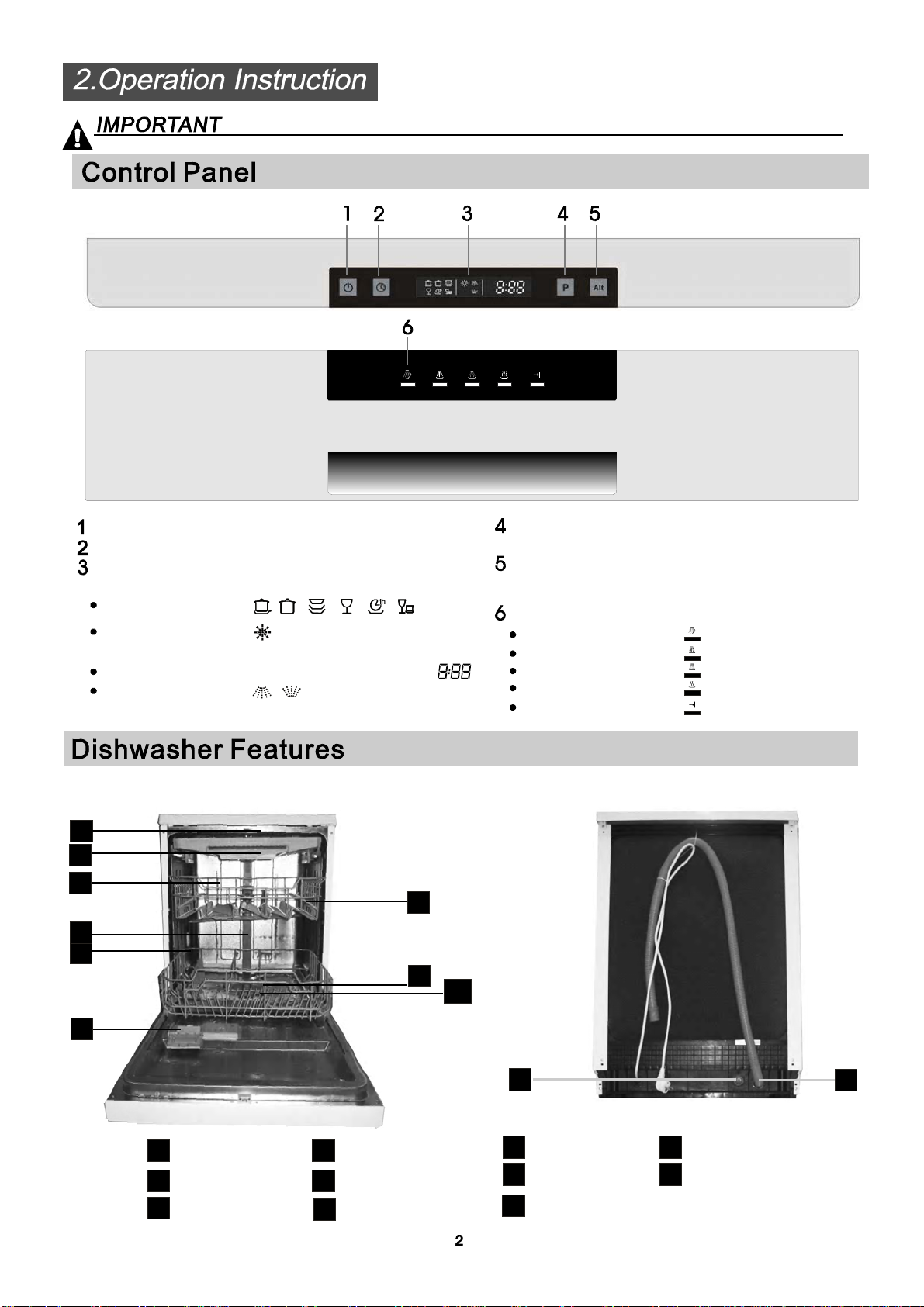
Control Panel...................................................2
This appliance must be grounded. In the event of a
malfunction or breakdown, grounding will reduce
the risk of anelectric shock by providing a path of
least resistance of electric current. This appliance
is equipped with a cord having an equipment-
grounding conductor and a grounding plug.
The plug must be plugged into an appropriate outlet
that is installed and grounded in accordance with
all local codes and ordinances.
When using your dishwasher, follow the precautions listed below:
Improper connection of the equipment-grounding
conductor can result in the risk of an electric shock.
Check with a qualified electrician or service
representative if you are in doubt whether the
appliance is properly grounded. Do not modify the
plug provided with the appliance; If it does not fit
the outlet. Have a proper outlet installed by a
qualified electrician.
Keep children away from detergent and rinse aid, keep
child away from the open door of the dishwasher,
there could still be some detergent left inside.
ren
Donotabuse,siton,orstandonthedoorordish
rack of the dishwasher.
Do not wash plastic items unless they are marked
dishwasher safe or the equivalent. For plastic items
not so marked, check the manufacturer's
recommendations.
Use only detergent and rinse additives
designed for an automatic dishwasher.
Never use soap, laundry detergent, or hand
washing detergent in your dishwasher. Keep
these products out of the reach of children.
During installation, the power supply must not
be excessively or dangerously bent or flattened.
Do not tamper with controls.
Do not place any heavy objects the
door when it is open. The appliance could tip
forward.
on or stand on
When loading items to be washed:
1) Locate sharp items so that they are not likely
to damage the door seal;
2 Warning: Knives and other utensils with
sharp points must be loadedin the basket
with their points down orplaced in a
horizontal position.
)
Ifthesupplycordisdamaged, it must bereplaced
bythemanufactureroritsserviceagentora
similarly qualified person in order to avoid a
hazard.
Please dispose of packing materials properly.
Use the dishwasher only for its intended function.
Remove the door to the washing compartment when
removing an old dishwasher from service or discarding it.
Dishwasher detergents are strongly alkaline, they
can be extremely dangerousif swallowed.Avoid
contact with skin and eyes and keep children away
from the dishwasher when the door is open.
Check that the detergent comparment isempty
after completionof thewash cycle.
The applianceis to be connected to the water
mains using new hose sets and that old hose-sets
should not be reused.
The maximum number of place settings to be
washed is14.
The maximum permissible inlet water pressure is
1Mpa.
The minimum permissible inlet water pressure is
0.04Mpa.
Children should be supervised to ensure that they do
not play with the appliance.
This appliance is not intended for use by persons
(including children with reduced physical, sensory or
mental capabilities, or lack of experience and
knowledge ,unless they have been given supervision
or instruction concerning use of the appliance by a
person responsible for their safety.
)
The door should not be left open,
since this could increase the riskof tripping.
Do not operate your dishwasher unless all
enclosure panels are properly in place. Open
the door very carefully if the dishwasher is
operating, there is a risk of water squirting out.

beforeusing it forthe first time.
To getthe best performance fromyour dishwasher, read all operating instructions
10 11
Back View
1
2
3
4
5
6
7
89
Front view
Lower basket
Dispenser
Cupshelf
Spray arms
Filter assembly
Inletpipeconnector
Drain pipe
Upperbasket
Cutlery rack
Top spray arm
1
Inner pipe
5
6
7
8
9
11
10
3
24
On/Off Button: To turn on/off the power supply.
Display screen: to show the remaining time
and the state(running state, delay time etc )
Program indicators:
RinseAid indicator:
Indicates whenthe dispenser needs to be refilled.
Delaytime ,Remain time,or error codes indicator:
Programstep indicators:
Delay Button : To Press the button to delay. Program Button : To Press the buttonto select
appropriate Program.
Alt function indicator:
Alt Button: Dual zone wash function, press the
button to select either upper basket or lower basket
loaded, and the response indicator .
Pre-washindicator:
Main-washindicator:
Rinseindicator:
Drying indicator:
Program end indicator:
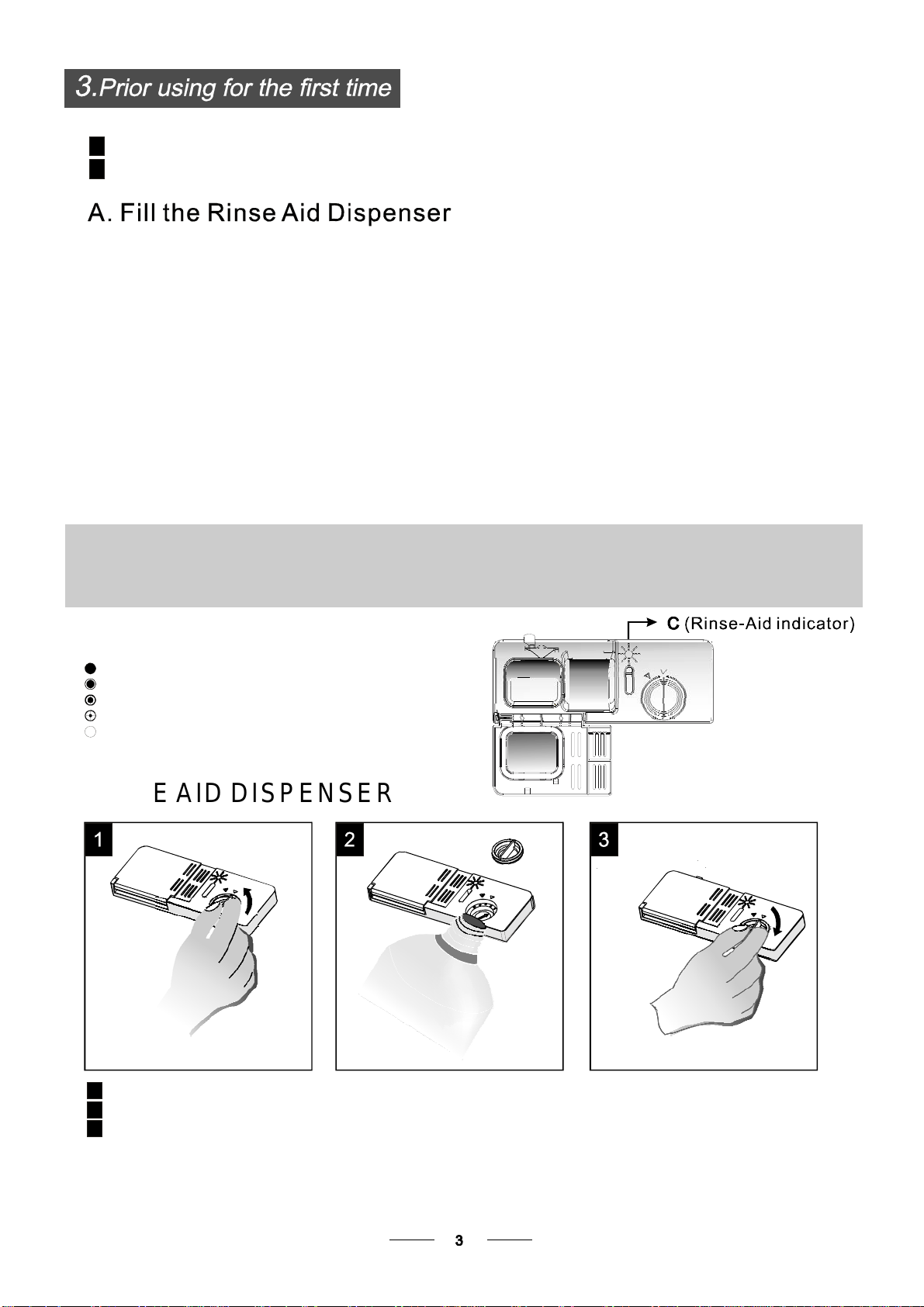
Before using your dishwasher for the first time:
A. Fill therinse aiddispenser
B. Fill in detergent
Therinse aid isreleasedduringthe finalrinse to prevent water from forming dropletsonyour dishes, which can
leave spots and streaks. It also improvesdrying by allowing water to rolloff thedishes. Yourdishwasheris
designed to use liquidrinseaids.The rinseaid dispenser islocatedinside the door next to thedetergent dispenser.
To fill the dispenser,open thecapand pour the rinse aidinto thedispenser until the level indicatorturns completely
black.Thevolume ofthe rinseaidcontaineris about110ml.
RinseAid Dispenser
Function of RinseAid
Rinse aid is automatically addedduring the last rinse,ensuring thoroughrinsing, andspot and streakfree drying.
Attention!
Only use branded rinse aid for dishwasher. Never fill the rinseaiddispenser with any other substances
(e.g. Dishwasher cleaning agent, liquid detergent). This would damage the appliance.
As the rinse aid diminishes, the size ofthe black dot
on the rinse aid levelindicator changes, as illustrated below.
Full
3/4full
1/2full
1/4full-Shouldrefilltoeliminatespotting
Empty
If there is no rinse-aid warning light in the control panel, you can judge the amount of rinse-aid by the color of the
optical level
indicator "C" located next to the cap. When the rinse-aid container is full, the whole indicator will be dark .As the
rinse-aid
diminishes, the size of the dark dot decreases.You should never let the rinse aid get below 1/ 4 full.
When to Refill the RinseAid Dispenser
RINSEAID DISPENSER
To open the dispenser,turn the cap to the "open" (left) arrow and lift it out.
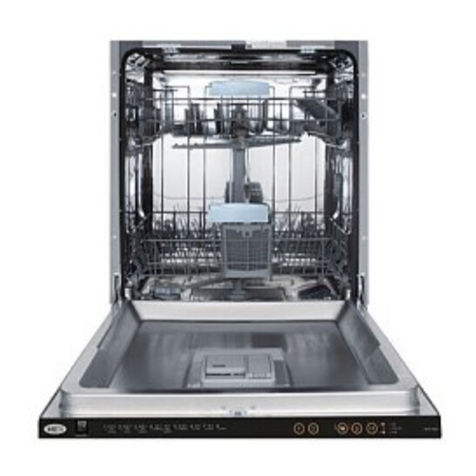
Pour therinse aid into the dispenser, being careful not to overfill.
Replacethe cap by inserting it alignedwith "open" arrow and turning it tothe closed (right) arrow.
Be careful not tooverfillthe dispenser, because this could cause over sudsing. Wipe away any spills
witha damp cloth. Don'tforget toreplace the cap beforeyou close dishwasher door.
Attention!
Clean up any rinse aid spill during filling with an absorbent cloth to avoid excess foaming
during the nextwash.
1
2
3
Adjusting RinseAid Dispenser
The rinse aid dispenser has six or four settings.Always start with the dispenser
set on "4". If spots and poor drying are a problem,increase the amount of rinse
aiddispensed by removing thedispenserlidandrotatingthedialto"5".Ifthe
dishes still are not drying properly or show spots,adjust the dial tothe next
higher lever until your dishes are spot-free. The recommended setting is "4".
(Factory value is "4".)
Increase the dose if there are drops of wateror limespots on the dishes after washing.
Reduce itif there are sticky whitish stains on your dishes or a bluish film on glassware or
knifeblades.
duringthenext wash.
Don't forget to replacethe cap before you close dishwasher door.
Cleanup any rinse aid spilled while duringfillingwithan absorbent cloth to avoid excessive foaming
Detergents with its chemical ingredients are necessary to remove dirt, crush dirt and transport it out ofthe dishwasher.
Most of the commercial quality detergents are suitable forthis purpose.
Detergents
There are 3 sorts of detergents
1.With phosphate and withchlorine
2.With phosphate and without chlorine
3.Without phosphate and without chlorine
Based on their chemicalcomposition, detergentscan be split in two basic types:
Theuse of normal washing programs in combination with concentrated detergents
reducespollutionand is goodforyour dishes;thesewashprograms are specificallymatched
to the dirt-dissolving properties of the enzymes of the concentrated detergent.For this reason
normal washprogramsinwhich concentrated detergents are used can achieve the same
results thatcan otherwise only be achieved using intensive programs.
“”
“”
“”
Detergent tablets of differentbrands dissolve at different speeds. For this reason some
detergent tabletscannot dissolve anddevelop their full cleaning power during short
programs. Therefore please use long programs when using detergent tablets, to
ensure the completeremovalof detergent residuals.
The dispenser must be refilled before the start of each wash cycle followingthe instructions
provided in the wash cycle table .Your dishwasheruses less detergent and rinse aid than
Conventional dishwasher. Generally, onlyone tablespoon of detergent is needed for
a normal wash load. More heavily soiled itemsneed more detergent.Alwaysaddthe
detergent just before starting thedishwasher, otherwise it couldget damp and will not
dissolve properly.
Concentrated Detergent
DetergentTablets
DetergentDispenser
conventional,alkaline detergents with caustic components
lowalkalineconcentrated detergents with natural enzymes
Normally new pulveriseddetergent is withoutphosphate.Thus the water softener function of
phosphate is not given. In this case we recommend tofill salt in the salt container even when
thehardness of water is only6 dH. Ifdetergents without phosphate are used in thecase ofhardwater
often whitespots appear ondishes and glasses. In this case please add more detergent to reach
better results. Detergents without chlorine doonlybleacha little. Strong and coloured spots will not
be removedcompletely.Inthiscase please choose aprogramwitha higher temperature.
°
AmountofDetergenttoUse
ProperUseofDetergent
Use only detergent specifically made for the usein dishwashers. Keep your detergent fresh and dry.
Don't put powdereddetergent into the dispenser until you're ready to wash dishes.
Dishwasher detergent is corrosive! Take care tokeepitout of reach of children.
Always add the detergentjustbefore starting each wash cycle.
Only use branded detergent aid for dishwasher.
If thelid is closed: press release button. The lid will spring open.
Detergent tablet
Detergent powder
Fill the detergentdispenser with detergent.
Themarkingindicatesthedosinglevels ,as
illustratedontheright:
The place of main wash cycle detergent placed.
The place of pre-wash cycle detergent placed.
Please observe the manufacturersdosing andstorage
Recommendations as stated on the detergent packaging.
Close the lid and press until itlocks inplace.
If thedishesare heavily soiled, placeanadditional
detergent dose in the pre-wash detergent chamber.This detergent will take effect during the pre-wash phase.
A
B
Fill in Detergent
You find information about the amount of detergent for the single programme on the last page.
Pleaseaware, that according to the levelsoiling andthe specifichardness of water differences are possible.
Pleaseobserve the manufacturer'srecommendations on the detergent packaging.
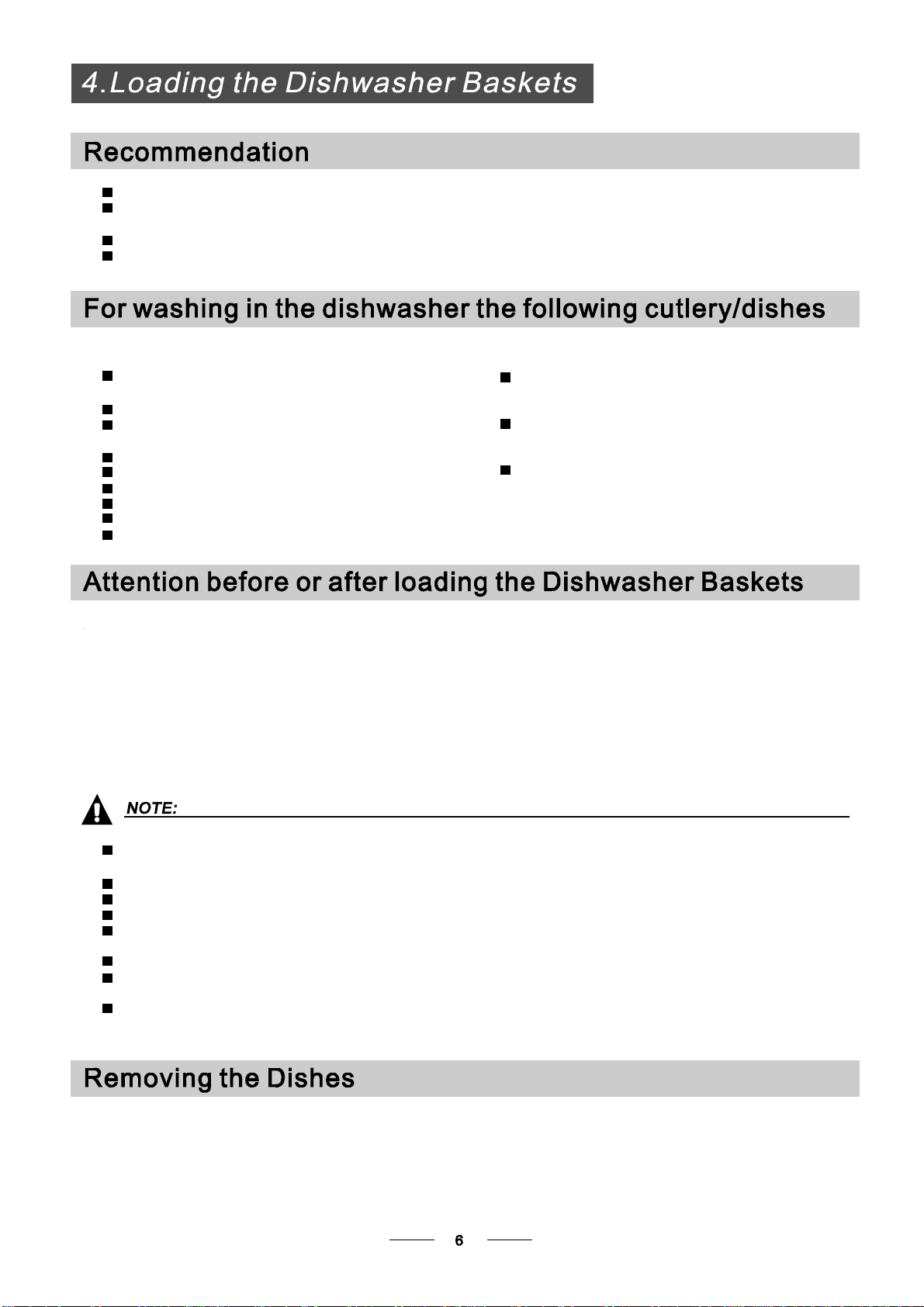
Cutlery withwooden, horn china or
mother-of-pearl handles
Plastic items that arenot heat resistant
Older cutlery with glued parts that are not
temperatureresistant
Bonded cutlery items or dishes
Pewter or cooper items
Crystal glass
Steel items subject to rusting
Wooden platters
Items madefromsyntheticfibres
Some types of glasses can become
dull aftera large number of washes
Silver and aluminum parts have a
tendencyto discolourduring washing
Glazed patterns may fadeif machine
washed frequently
Are not suitable Are oflimited suitability
Dishesand itemsofcutlerymustnotlie insideoneanother, orcover each other.
To avoiddamage to glasses, theymust not touch.
Load large itemswhich are most difficult to cleaninto the lower basket.
The upper basket isdesigned to holdmoredelicate and lighterdishware such as glasses, coffee
andteacups
Long bladed knives stored in an upright positionare a potential hazard!
Long and/or sharp items of cutlery such as carving knivesmust be positioned
horizontallyin the upper basket.
Please do not overload your dishwasher. This is important forgoodresults and for
reasonable consumption of energy.
Load hollow items such as cups, glasses, pans etc. With the opening facing downwardsso that
water cannot collect in the container or a deepbase.
Consider buying utensils which are identifiedasdishwasher-proof.
Usea mild detergentthatisdescribed as'kind todishes'. If necessary, seek further
information from the detergent manufacturers.
Forparticular items, select aprogramwithaslowa temperatureaspossible.
To prevent damage, do not take glassandcutlery out of the dishwasher immediately
after the programme has ended.
(For best performance of the dishwasher, follow these loading guidelines.
Features and appearance of baskets and cutlerybasketsmay vary from yourmodel.)
Scrape off any largeamounts ofleftover food. Soften remnants of burnt food inpans.
It is not necessary to rinse thedishes under running water.
Place objects in the dishwasher in following way:
1.Items such as cups, glasses, pots/pans, etc. are faced downwards.
2.Curved items, or ones with recesses, should be loaded aslant so that water can run off.
3.All utensils are stacked securely and can not tipover.
4.All utensils are placed in the way that the spray arms can rotate freely during washing.
Very small items should not be washed in the dishwasher as they could easily fall out of the basket.
To prevent water dripping from the upper basket into the lower basket, we recommend thatyou
empty the lower basket first and then the upper basket.
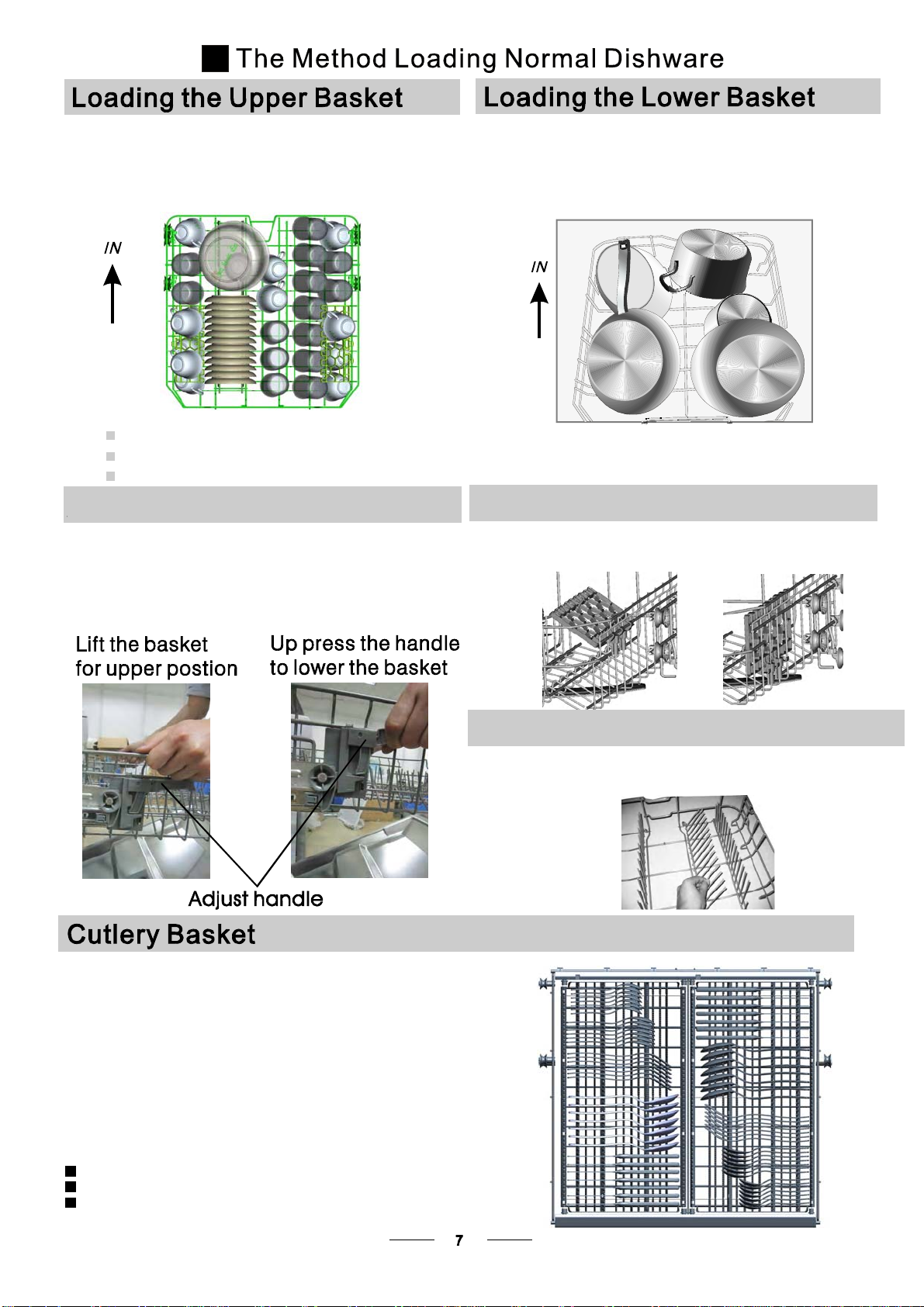
The upper basket is designed to hold more delicate
and lighter dishware such as glasses, coffee and
teacups and saucers, as well asplates,small bowls
andshallowpans (as long astheyare not too dirty).
Positionthedishes andcookwaresothatthey will
notgetmoved bythespray of water.
We suggest that you place large items and the most
difficulttocleanitemsareto be placedintothelower
basket: suchas pots, pans, lids, serving dishes and
bowls, as shown in the figure below. It is preferable to
place serving dishes and lids on the side of the racks
in order to avoid blocking the rotation of the top spray
arm.
Pots,servingbowls,etc,mustalwaysbeplacedtopdown.
Deep pots should be slanted to allow water to flow out.
Please bereminded that:
The Bottom Basket features folding spikes so that largeror more pots and pans can be loaded.
Folding Spikes of Lower Basket
For better stacking of pots and pans,
the spikescan be folded down as
show in the picture right.
Folding back the cup shelives
For better stacking of pots and pans,
the spikes can be folded down as
show in the picture right.
Cutleryshouldbe placed inthecutlery rackseparately
from each other in the appropriate positions, and do
make sure the utensils do not nest together,this may
causebadperformance.
For a top quality cleaning, place the silverware in the basket
makingsurethat:
They do not nest together.
Silverware is placed with the maleface up.
Long utensils in the middle.
Adjusting the Upper Basket
The height of the upper basket can be adjusted in order to
create more space for large utensilsboth for the upper
/lower basket. The height of the upper basket can be
adjusted by lift up the basket for the upper position, and up
press the handle to lower the upper basket, see the picture
below: