;hordd~e f%ien. Freezing,f~tsinsqrraMy‘
mdffavofiit cannotim’~~veqmdity.See
md ~sp&f. The quicker fmits and veg-
ttablcsare’ho~n .after”pjgk~ng.the better
thefrozcriproductwiffbe. YouVsavetime,
too,McmsaeJeascaftingandWrdngw~ be
ne&.,&aiy~Tfretfdrdrcquirementisproper .
packagirrjj~U~fnndwraps designedes&-
ciaffyfoifrix+zing;they’rereadifyavailable
inaq~de selectionat yo~ favorhestore. ‘
Lfmftf&&&of fresfa(&Sen) m&r@’or
wafnrirfa
to14pmarsdsat atfme. .
.,
10FREEZEMEAT, -
~SHANDPOULTRY
Wrapweflin freezer-weightfoil(or other
heavydutywrapping material),fOrrningit
carefutly’~theshapeof the contents.This
expefsrrir.fkddanderimpendaOfthepack:
ageto provide agond, lastingseal. Don’t
rcfreezcmestthat hascompletelydrawed;
mest,wherherrawo~cooked.canbefrozen
succmsfrdt yordyonce. .‘
SUGGESTEDFREQER
STORAGEllMES
(otherthanformoatandpoultry)
M.zstfruitsandvegelables.... . . . ... . . .8-12months
~anrish..........................S-8mnnths
‘Fattyfish,rollsand
breads, . .
SOUPS,slmv, ca;;erola. s.. . . . . . . . . . . . . .2-3months
Cahes.pies, sandwiches, left.overs(coohed), 1month
icecraam(originalcmton) .. .. :. . . . . . . . . . maximum
~,
Nsrrtecha!quss are cmalantty being developed. C6nsult
the Stsb? C611eseor C6unty Eatmmion Sewice or ynur
local LNility Company for the latest reformation on
rmmim and storins fends. -
ICECREAMSTORAGE
l%re-quali~yicecream,;widr high cream
conteitt,wiffnormallyrequireslightfylow-
er tempe~turea thanmore “airy”atready-
packedbr,midswithlowcream content. It
willbe rrec~ry to:ex~rirnent to deter-
minethe e~ct sccringto’kiep yourfavOr-
iteicecreamat the right ~iwbrgtempera-
ture.Afso,thercarofttie freezerisslightly
colderthan the timt~. .‘.
lcE:tiYs ,;‘i
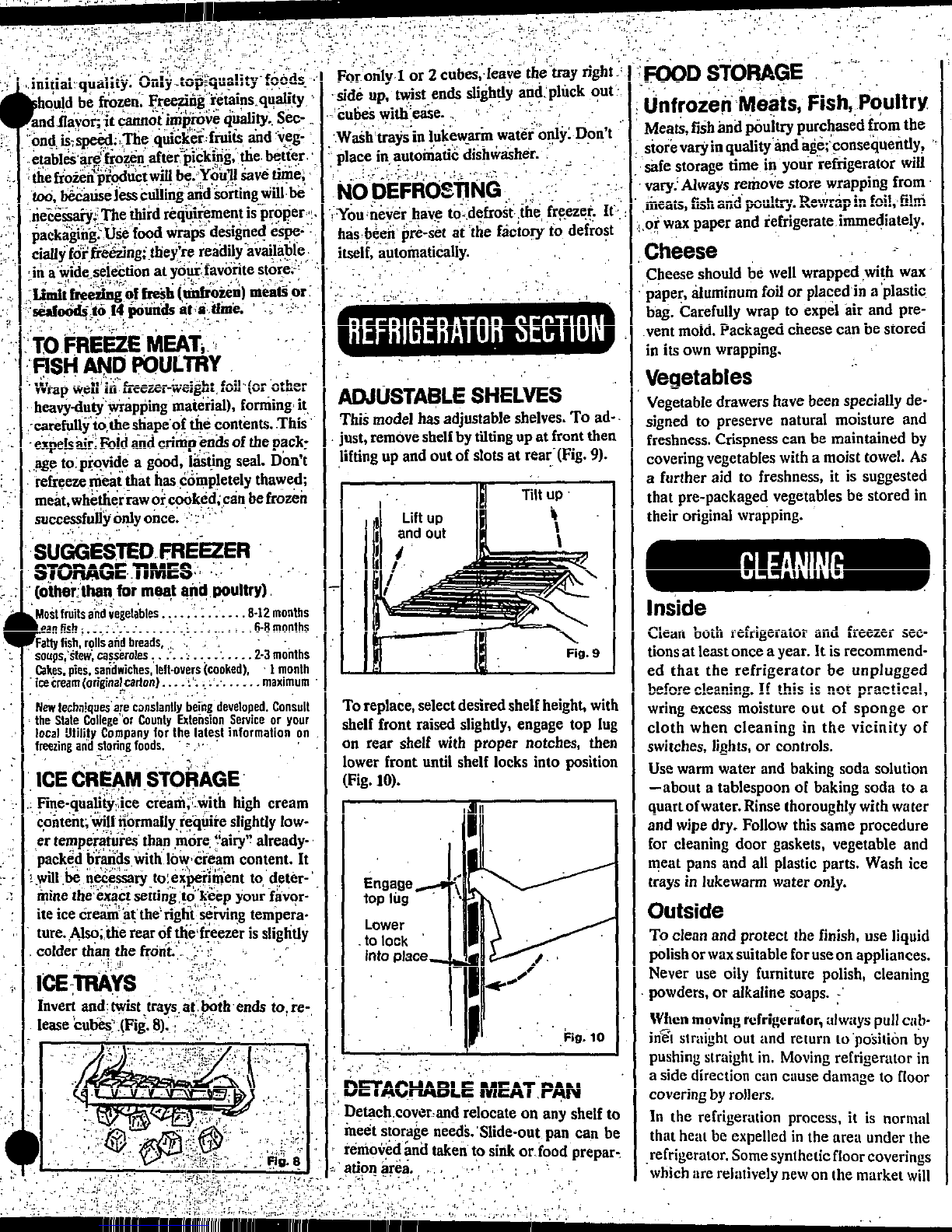
Invertand twist traysat ,Jmthends to.re-
leesecuhcs’(Fig.8). .“ c,
For”ody 1or 2cubes:leaw-the-trayright
side up, twistends *ghrfy and.phrck out
cubes withease. .‘
W6ahrrays’inlukkw.srinWateronfY.Don’t
placein automaticdishwasher.
~o&FR&$nNG
Youneverhave to.drrfrost,jhe freezer. It
has been pre-set at the factory to defrost
itself,automatically.
-.
. .
ADJUSTABLESHELVES
This modelhas adjustableshelves.To ad-
just,removeshelfbydfting upatfrorst then
liftingup andout of slots at rear (Fig.9).
IIll Tilt UP
Toreplace,sef@desiredshelf height with
shelffrontraisedslightfy,engagetop hag
on rearshelf with proper notches, then
lower front untilshelf locks into position
(Fig.10).
D~ACHASLEMEATPAN
Detachcover and relocateon any shelfto
meet storage needs.’Slide-outpan can be
removed6trdtakento sinkor food prepar-
,.
,, ‘.’ -. .
,.
.“ .,
FOODSTORAGE “‘
UnfrozenMeats,Fish,Poultry
Meats,fishandpo~frYPurch~ed fromthe
storevmyinquafity~d age;consequently,
safestorage time in your refrigerator wiil
vary.Afwaysremovestore wrappingfrom
meats,fishand pordtry.Rewrapin foil,film
or was paper and refrigerateimrnediateIy.
Cheese
Cheeseshould be well wrapped with wax
paper, afuminumfoifor placedin a’plastic
bag. Carefullywrap to expel air and pre-
ventmold.Packagedcheesecan be stored
in itsown wrapping.
Vegetables
Vegetabledrawershave beenspecialfyde-
signed to preserve natural moisture and
freshness.Crispneazcarsbe maintainedby
coveringvegetableswithamoisttowel. As
afurther aid to freshness, it is suggested
that pre-packaged vegetablesbe stored in
their originalwrapping.
Inside
Clean both refrigerator and freezer sec-
tionsat leastonce ayear. It is recommend-
ed [hat the refrigerator be unplugged
beforecleaning.If this is not practical,
wring excessmoisture out of sponge or
cloth when cleaning in the vicinity of
switches,lights,or controls.
Usewarmwater and bakingsoda solution
–about atablespoonof baking soda to a
quartofwater. Rinsethoroughlywithwater
and wipedry. Follow thissame procedure
for cleaningdoor gaskets, vegetable and
meat pans and all plasticparts. Wash ice
trays in lukewarmwateronly.
Outside
To cIeanand protect the finish, use liquid
polishorwaxsuitable foruseon appliances.
Never use oily furniture polish, cleaning
powders,or alkalinesoaps.
Whmsmovingrcfrigcr~tor,alwayspull citb-
in’1 s!raigh~out and return mposition by
pushingstraight in. Moving refrigerator in
aside directioncun cmrsedamage to floor
coveringbyrollers.
In the refrigermion process, i[ is nornml
that heal be expelledin the urea under the
refrigerator.Somesyntheticfloorcoverings
whichorerelativelynewon themwket will
discolortitthese normalandsafe operating
tesri+ratures. Yourfloorcoveringsupplier
should be consulted if you object to this
discoloration.
DefrostWaterPan
Panlocated behindgrilleshotdd be cleaned
at leastonce ayear.
Condenser
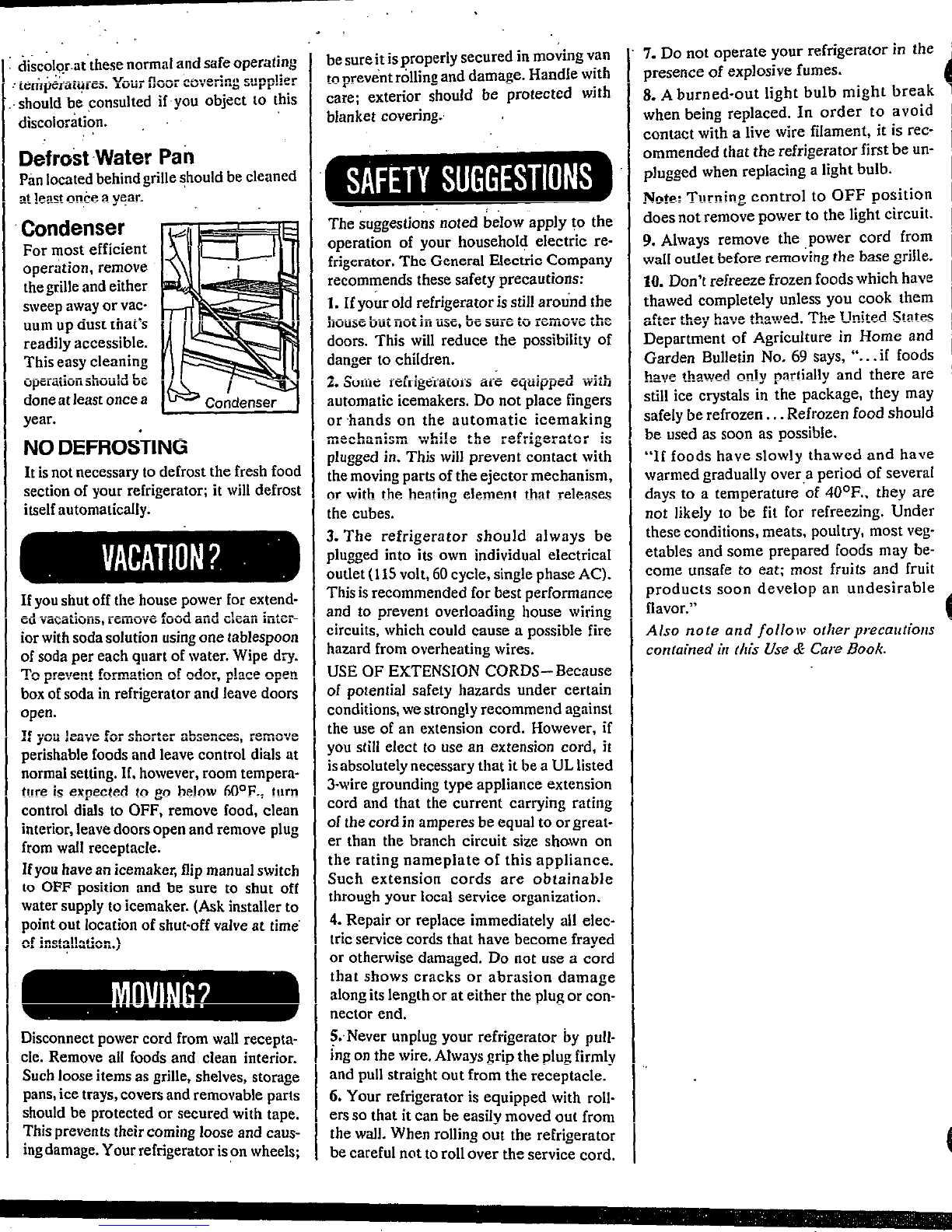
For most efficient
operation, remove
thegrilleandeither
sweepawayor vac-
uumup dust that’s
readily accessible.
This easy cleaning
operationshorsldbe
doneatleastoncea
year.
NODEFROSTING
Itisnot necessaryto defrost the fresh food
section of your refrigerator; it willdefrost
itselfautomatically.
Ifyoushut offthe house power for extend-
edvacations,remove food and clean inter-
iorwith sodasnfution usingone tablespoon
of soda per each quart of water.Wipe dry.
To prevent formation of odor, place open
boxofsoda in refrigerator and leavedoors
open.
If you leave for shorter absences, remove
perishable foodsand leavecontrol dials at
normalsetting. If, however,room tempera-
ture is expected to go below fJOOF.,turn
control diats to OFF, remove food, clean
interior,Ieavedoorsopen and remove plug
from waflreceptacle.
Ifyou havearricemake~flipmanualswitch
to OFF position and be sure to shut off
watersupply to icemaker.(Ask installerto
pointout location of shut-offvalveat time
of installation.)
besureitisprOPerlY secured in movingvan
topreventrolling and damage. Handfe with
care; exterior should be protected with
blanket covering.
7. Do not operate your refrigerator in the
presence of explosive fumes. {
8. Aburned-out light bulb might break
when being replaced. In order to avoid
contact with alive wire filament, it is rec-
ommended that the refrigerator first be un-
plugged when replacing alight bulb.
Note: Turning control to OFF position
does not remove power to the light circuit.
9. Always remove the power cord from
wall outfet before removing the base grille.
10. Don’trefreeze frozen foods which have
thawed completely unless you cook them
after they have thawed. The United States
Department of Agriculture in Home and
Garden Bulletin No. 69 says, “... if foods
have thawed only partially and there are
still ice crystals in the package, they may
safely be refrozen ...Refrozen food should
be used as soon as possible.
“If foods have slowly thawed and have
warmed gradually over aperiod of several
days to atemperature of 40°F., they are
not likely to be fit for refreezing. Under
these conditions, meats, poukry, mostveg-
etables and some prepared foods may be-
come unsafe to eat; most fruits and fruit
products soon develop an undesirable
flavor.” (
Also nole and follow otkerprecazttions
contained in (IrisUse &Cat.eBook.
I
Disconnect power cord from wall recepta-
cle. Remove all foods and clean interior.
Suchloose items as grille,shelves, storage
pans,ice trays,coversandremovable parts
Ishould be protected or secured with tape.
Thisprevents theircomingloose and caus-
ationarea, , , ,. ingdamage.Your refrigerator ison wheels;
. . .“,,
.- >’ .,,
~fllritili~ll[&~rn ‘“’ ‘“ ‘,, ~.,’ ~
::~~,.:.’::.!. .,.’-,J.:,; ., ~‘..
.::I
J,. , ,, !-’$,, ,5,., ;-,=.,,
.. ,.:. ~,- ‘., ‘
.,,
‘, ‘..
:?
.; -’ i~y; ,-,. .‘,. -tlW9. No. 464E60P0.4
. ..
The srrgg.%lionsnoted beIow apply to the
operation of your household electric re-
frigerator. The General Efectric Company
recommends these safety precautions:
1. Ifyour old refrigerator is stillaround the
house but not inuse, be sure to remove the
doors. This will reduce the possibility of
danger to children.
2. Some refrigerators are equipped witb
automatic icemakers. Do not place fingers
or hands on the automatic icemaking
mechanism while the refrigerator is
plugged in. This willprevent contact with
themovingparts ofthe ejector mechanism,
or with the heating element that releases
the cubes.
3. The refrigerator should always be
plugged into its own individual electrical
outlet (115volt, 60cycle,single phase AC).
Thisisrecommended for best performance
and to prevent overloading house wiring
circuits, which could cause apossible fire
hazard from overheating wires.
USE OF EXTENSION CORDS–Because
of potential safety hazards under certain
conditions,we stronglyrecommend against
the use of an extension cord. However, if
you still elect to use an extension cord, it
isabsolutely necessary that itbe aULlisted
3-wiregrounding type appliance extension
cord and that the current carrying rating
of the cord in amperes be equal to orgreat-
er than the branch circuit size shown on
the rating nameplate of this appliance.
Such extension cords are obtainable
through your local service organization.
4. Repair or replace immediately all elec-
tricservice cords that have become frayed
or otherwise damaged. Do not use acord
that shows cracks or abrasion damage
alongitslengthor at either the plugor con-
nector end,
5. Never unplug your refrigerator by pull-
ingon the wire.AIwaysgrip the plug firmly
and pull straight out from the receptacle.
6. Your refrigerator is equipped with roll-
ers so that it can be easilymoved out from
the wafl. When rolling out the refrigerator
be careful not to roll over the service cord.
)
Ill
Ii)