Greenlee Textron / Subsidiary of Textron Inc. 10 4455 Boeing Dr., Rockford, IL 61109-2988 815/397-7070
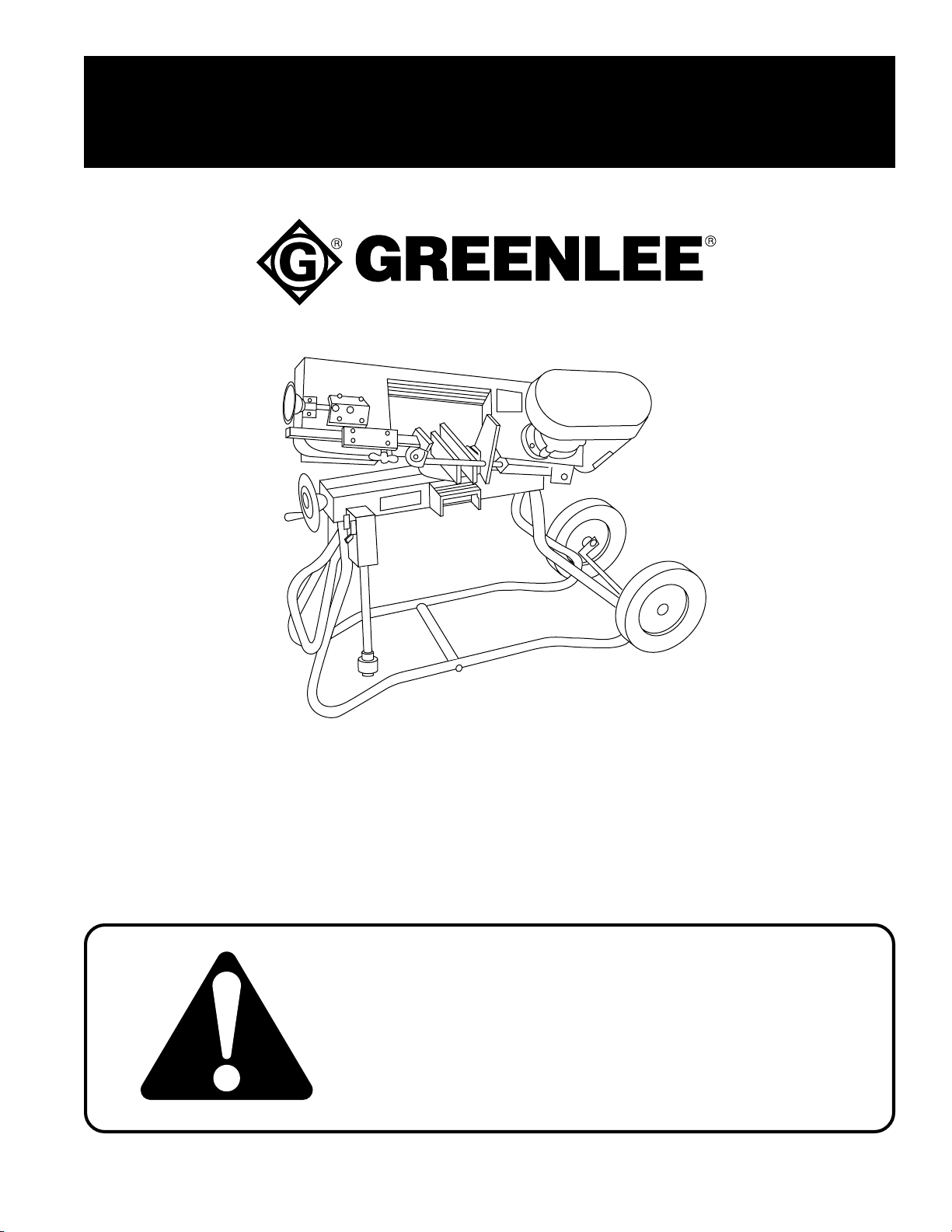
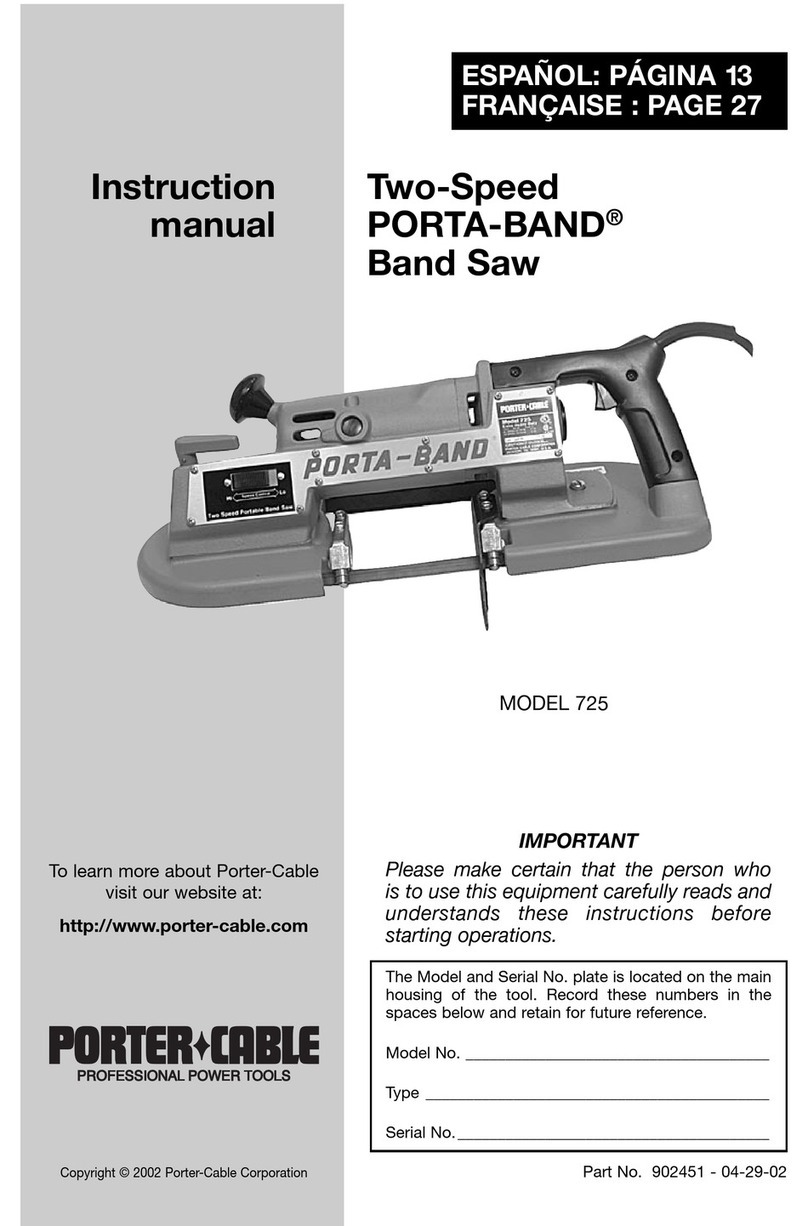
1357 Band Saw
Maintenance
Overload Shut-Off and Reset
The motor automatically shuts off if it is overloaded or
overheated. If the motor shuts off:
1. Disconnect the saw from the power supply.
3. Twist the blade. The bearings should be snug
enough to restrict the blade. If the blade twists
between the bearings, rotate the eccentric roller axle
(38) until the bearing is snug against the blade.
Wheel Pitch Adjustment
The blade should run within approximately .032" of
the wheel flange. Use a feeler gauge to measure this
distance. If it is more than .032", set the blade tension
according to the instructions under Replacing the Saw
Blade. If the distance is still more than .032", adjust the
wheel pitch as follows:
1. Disconnect the saw from power supply.
2.
Loosen the four hex head cap screws (24) that clamp
the take-up screw block (17). Twist the take-up screw
(14) to decrease the tension on the blade.
3. Raise the cutting head to the vertical position.
Loosen the wing nut (37) on the blade guard.
Remove the blade guard.
4. Loosen the thumb screw (13) on the hinged idler
wheel guard assembly (9). Swing the wheel guard
assembly away from the blade.
5. Loosen the two cap screws closest to the end of the
saw to decrease the distance. Loosen the two cap
screws furthest from the end of the saw to increase
the distance.
6. Twist the take-up screw to put tension on the blade.
7. Put the guard (9) back in place and lower the
cutting head.
8. Connect the saw to the power supply and run the
saw for a few moments. Disconnect from power and
check the adjustment.
Do not inspect, adjust, or service the tool while
it is connected to a power source. Accidental
start-up can result in serious injury.
• The blade is sharp and can cut even when
stationary. Failure to observe this warning can
result in injury.
• The blade and other saw components may be
hot. Contact with hot surfaces can cause severe
burns.
• The blade is sharp and can cut even when
stationary. Failure to observe this warning can
result in injury.
• The blade and other saw components may be
hot. Contact with hot surfaces can cause severe
burns.
2. Raise the cutting head to the vertical position.
Examine the saw and material to determine the
cause for shut-off.
3. Check the saw blade for damage.
4. Lower the cutting head and allow the motor to cool.
5. See the reset instructions on the motor housing.
6. Reposition the item to begin a new cut.
7. Reconnect the saw to the power supply.
Cutting Head Weight Adjustment
The cutting head should exert approximately 10 lbs of
force. To check the amount of force it exerts, attach a
hook-type scale to the handwheel (15). If the cutting
head force is not approximately 10 lbs, loosen the wing
nuts (108) and twist the spring adjusting screw (101).
Reweigh the cutting head.
Checking and Adjusting the Blade Guide Ball
Bearings
Six ball bearing blade guides (31) keep the blade
aligned. Periodically remove the blade and check the
condition of the ball bearings. Lubricate bearings that do
not turn freely and replace bearings that show signs of
wear or damage.
The bearings should be snug against the side of the
blade. To check for proper adjustment:
1. Disconnect the saw from power supply.
2. Raise the cutting head to the vertical position.
The blade and other saw components may be hot.
Contact with hot surfaces can cause severe burns.
Failure to observe this warning can result in severe
injury.