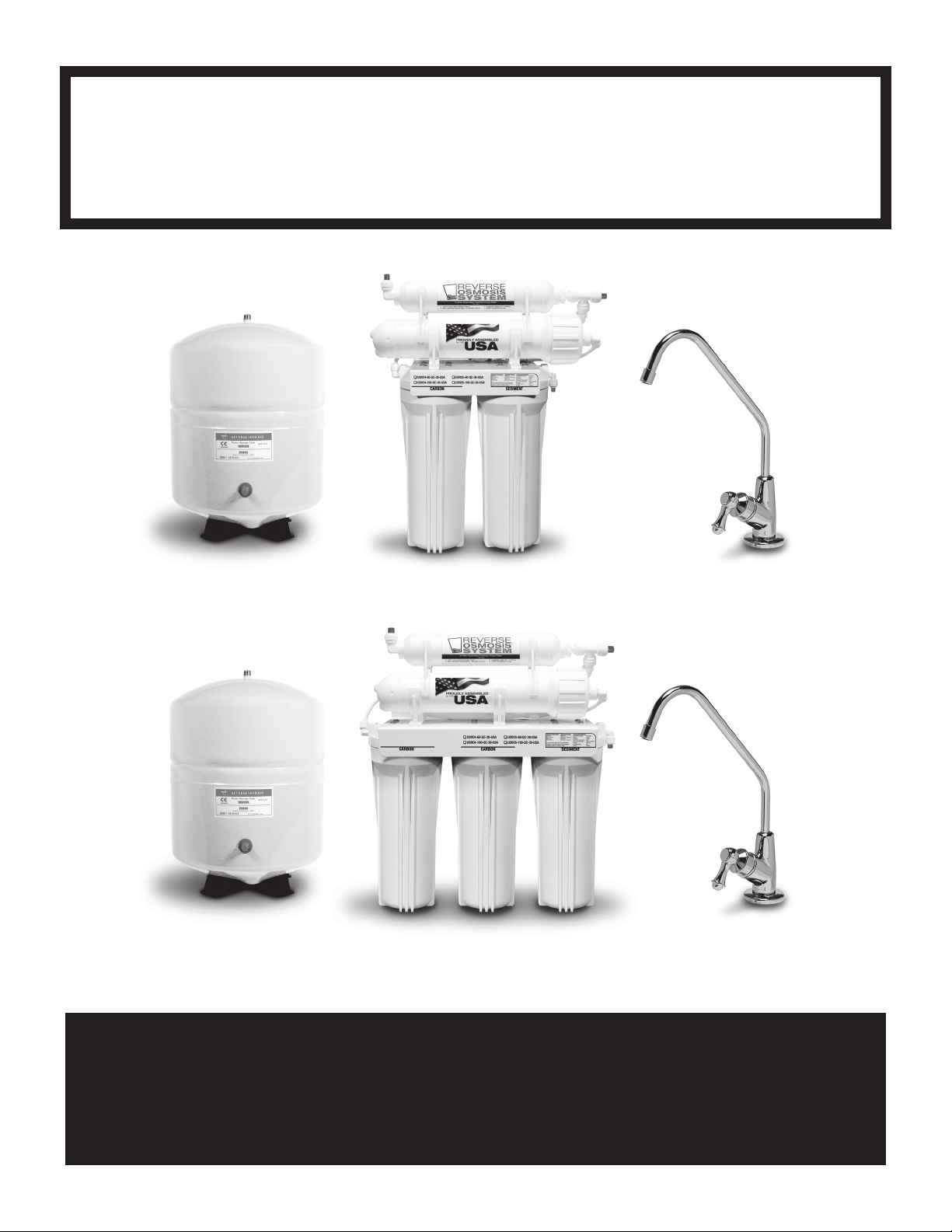
7. RO Unit Installation
The RO unit is normally mounted to the right or left sink
cabinet sidewall, depending on where supply tank is to be
located. Generally the unit is installed at the front of the
cabinet and the tank at the rear.
To mount the unit, elevate it at least 2” o the oor, level
it and mark the location of mounting holes needed. Drill
hole for mounting screws and install screws allowing the
mounting bracket slots to slip over them.
Note: If the cabinet sidewalls are not solid, unit may sit
on the oor with screws used just to keep it against the
cabinet in a vertical position.
8. Pre-ll & Supply Tank Placement
Pre-lling the storage tank is recommended so there is
sucient pressure to check for leaks and water to ush
the carbon post lter. To do this connect the feed line that
will serve the RO unit directly to the bladder tank. A 3/8” x
1/4” reducer is provided for this purpose. Allow the water to
ll the bladder until it stops. Close the tank valve, shut o
the feed pressure, release the tube from the reducer and
remove the reducer from the tank valve.
The supply tank should be placed under the counter or
within 10 feet of the RO unit.
Note: Tanks are pre-pressurized with air at 7 psi.
9. Final Tubing Connections
With all components in place, complete nal tubing
connections with these guidelines:
1. Tubing should follow contour of the cabinets.
2. Cut tubing to correct length using square cuts and a
proper cutting tool
3. Make sure there are no crimps in the tubing.
4. Keep tubing from the RO unit to the tank and faucet as
short as possible for good ow.
5. The Drain line is a short ¼” tube connected to the
membrane housing. On this tube is a 3” cylindrical
drain ow restrictor. This is where the drain line
connects to the RO unit. Do not remove the drain ow
restrictor as this will cause a failure in the system.
Icemaker hookup (optional and requires a T tting and
additional shut-o valve not supplied with RO unit)
The RO unit can be connected to any standard refrigerator
icemaker or ice maker/water dispenser.
(Do not connect to a commercial type bar icemaker)
To complete this operation, connect a T with a shut
o valve into the faucet tubing and route tubing to the
refrigerator. (Hooking up to existing copper tubing is not
recommended due to possible corrosion) Turn o icemaker
inside freezer prior to turning o the existing tap water
supply line to the refrigerator. Turn on the icemaker after
the RO system has been drained several times and the
tank has a full supply of water.
Icemaker lines are often run in the rafters of unnished
basements or nished basements with drop ceilings and
then up to the fridge. If the basement has a hard ceiling,
this won’t be an option and the line would have to be run
through cabinets. In cases where a basement or cabinets
connecting sink and fridge are not available, icemaker
connections cannot be made.
Note: Before any service is performed on the RO system,
turn o icemaker valve and icemaker unit. Turn back on
only after RO system has been sanitized and ushed out.
System Start-up
Prior to start-up:
1. Check all tting connections.
2. Open angle stop valve, allow system to pressurize and
check for leaks.
3. Open valve on bladder tank and open faucet until
water ows.
4. Close faucet, wait ve minutes and check for leaks.
5. Allow system to produce a full tank of RO water. (2-3
hours)
Flushing System and Checking Operation
1. Flip the faucet lever up and this will keep faucet on. Do
this and allow tank to completely drain of all water.
! Do not use this water !
2. Close faucet and re-inspect system for leaks.
3. Allow system to produce water for 4 hours, at this point
the bladder tank will be full.
4. Open faucet again and allow tank to empty for a
second time.
! Do not use this water !
5. Close faucet and allow unit to produce another tank of
water.
6. At this point supply line to ice maker connection
(optional) may be opened and RO water is ready to be
consumed.
Replacing Filters & Sanitizing The System
Each year the lters in the system should be replaced.
Usually the membrane can be replaced every other year,
but the prelters and post-lter should be changed annually
and in some cases more often.
Filter Replacement
1. Turn o valve on bladder tank.