A6LXU
SAFETY PRECAUTIONS
NOTICE: Comply with all cautions and safety related notes
located on or inside the cabinet and on the chassis or pic-
ture tube.
WARNING: Since the chassis of this receiver isconnected
to one side of the AC power supply during operation, when-
ever the receiver is plugged in, service should not be at-
tempted by anyone unfamiliar with the precautions neces-
sary when working on this type of receiver.
The following precautions should be observed:
1. Do not install, remove, or handle the picture tube in any
manner unless shatterproof goggles are worn. People
not so equipped should be kept away from the picture
tube while handling.
2. When service is required, an isolation transformer should
be inserted between power line and the receiver before
any service is performed on a “HOT” chassis receiver.
3. When replacing a chassis in the receiver, all the protec-
tive devices must be put back in place, such as barriers,
nonmetallic knobs, adjustment and compartment cover-
shields, isolation resistors, capacitors, etc.
4. When service is required, observe the original lead dress
in the high voltage circuitry area.
5. Always use the manufacturer’s replacement components.
Critical components as indicated on the circuit diagram
should not be replaced by another manufacturer’s. Fur-
thermore, where a short circuit has occurred, replace
those components that indicate evidence of overheat-
ing.
6. Before returning a serviced receiver to the customer, the
service technician must thoroughly test the unit to be
certain that it is completely safe to operate without dan-
ger of electrical shock, and be sure that no protective
device built into the receiver by the manufacturer has
become defective, or inadvertently defeated during ser-
vicing.
Therefore, the following checks shoutd be performed for
the continued protection of the customer and service tech-
nician.
Leakage Current Cold Check
With the AC plug removed from the 120V AC 60Hz source,
place a jumper across the two plug prongs. Turn the AC
power switch ON using an insulation tester (DCSOOV), con-
nect one lead to the jumpered AC plug and touch the other
lead to each exposed metal part (antennas, screwheads,
metal overlays, control shafts, etc.), particularly any exposed
metal part having a return path to the chassis should have
a minimum resistor reading of 0.24MQ and a maximum re-
sistor reading of 12MR . Any resistance value below or
above this range indicates an abnormality which requires
corrective action. Exposed metal part not having a return
path to the chassis will indicate an open circuit.
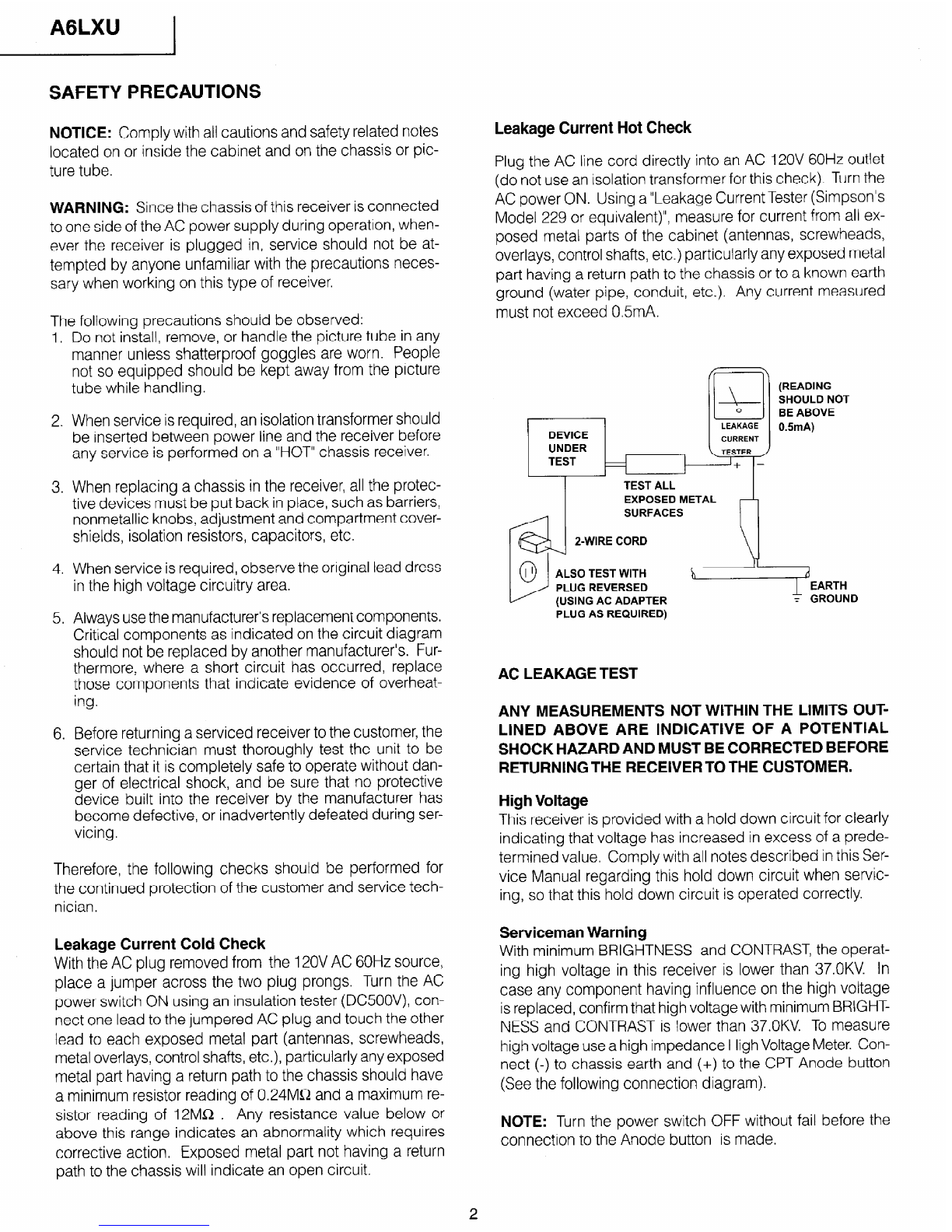
Leakage Current Hot Check
Plug the AC line cord directly into an AC 12OV 6OHz outlet
(do not use an isolation transformer for this check). Turn the
AC power ON. Using a “Leakage Current Tester (Simpson’s
Model 229 or equivalent)“, measure for current from all ex-
posed metal parts of the cabinet (antennas, screwheads,
overlays, control shafts, etc.) particularly any exposed metal
part having a return path to the chassis or to a known earth
ground (water pipe, conduit, etc.). Any current measured
must not exceed 0.5mA.
F----7
ll\I
I
TEST ALL I
EXPOSED METAL
AI
SURFACES I I
-G$--.l
Z-WIRE CORD
I
(READING
1
SHOULD NOT
BE ABOVE
0.5mA)
,I
0
I’
ALSO TEST WITH
PLUG REVERSED
(USING AC ADAPTER
PLUG AS REQUIRED)
AC LEAKAGE TEST
ANY MEASUREMENTS NOT WITHIN THE LIMITS OUT-
LINED ABOVE ARE INDICATIVE OF A POTENTIAL
SHOCK HAZARD AND MUST BE CORRECTED BEFORE
RETURNING THE RECEIVER TO THE CUSTOMER.
High Voltage
This receiver is provided with a hold down circuit for clearly
indicating that voltage has increased in excess of a prede-
termined value. Comply with all notes described in this Ser-
vice Manual regarding this hold down circuit when servic-
ing, so that this hold down circuit is operated correctly.
Serviceman Warning
With minimum BRIGHTNESS and CONTRAST, the operat-
ing high voltage in this receiver is lower than 37.OKV. In
case any component having influence on the high voltage
is replaced, confirm that high voltage with minimum BRIGHT-
NESS and CONTRAST is lower than 37.OKV. To measure
high voltage use a high impedance High Voltage Meter. Con-
nect (-) to chassis earth and (+) to the CPT Anode button
(See the following connection diagram).
NOTE: Turn the power switch OFF without fail before the
connection to the Anode button is made.