lp-473 Rev. 3.13.15
7
B. Thermal Expansion
Dielectric unions or galvanized steel ttings must not be used
in a system with this water heater. Doing so WILL VOID the
warranty. Use only copper, brass, or stainless steel ttings.
Teon thread sealant must be used on all connections.
Do not apply heat to the Hot or Cold water heater connections.
If sweat connections are used, sweat tubing to the adapter
before tting adapter to the water connections on the
heater. Any heat applied to the water ehater connections
will permanently damage the dip tube and/or heat traps.
Damages due to improper installation practices ARE NOT
covered by warranty.
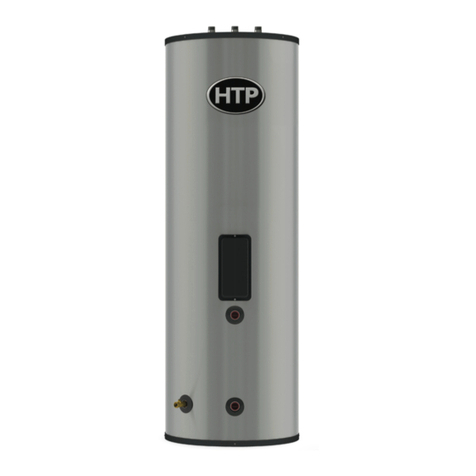
2. Connect the hot water line to the connection marked “HOT”
on the top of the water heater.
3. An opening is provided near the top of the heater for
installation of a Temperature and Pressure (T&P) Relief Valve.
4. Install drain valve in the opening provided near the bottom
of the heater.
A check valve may be installed in the cold water inlet line as
a separate backow preventer, or may be part of a pressure
reducing valve, water meter, or water softener. An “open
water system” refers to a system without a check valve. A
“closed water system” refers to a system with a check valve
installed in the cold water inlet line.
As water is heated, it expands in volume and increases
pressure within the water system. This action is referred to
as “thermal expansion”. In an open water system, expanding
water which exceeds the capacity of the system ows back
into the city main where pressure is easily dissipated.
A closed water system prevents expanding water from
owing back to the city main. The resulting thermal
expansion can rapidly increase pressure in the water heater
and system piping. This rapid pressure increase can exceed
the safety setting of the relief valve, causing it to operate
during each heating cycle. This rapid and repeated expansion
and contraction of components in the system can cause
premature failure of system components, including the relief
valve and possibly the water heater. Replacing the relief valve
will not correct thermal expansion.
A potable hot water expansion tank is required to oset
thermal expansion. Expansion tanks are designed with an air
cushion built in that compresses as system pressure increases,
thereby relieving the overpressure condition and eliminating
repeated operation of the relief valve. This expansion tank
should be installed in the cold water line between the water
heater and check valve, and must be sized for the entire water
C. Condensation
Condensation can form on the water heater when it is rst lled
with water, and may also occur with a heavy water draw and
very cold inlet water temperature. This condition is not unusual
and will disappear as the water becomes heated. However, if the
condensation should continue, examine the piping and ttings
for possible leaks.
D. Insulation Blankets
Insulation blankets for external use on electric water heaters
are not necessary with this water heater. An insulation blanket
is meant to reduce the standby heat loss encountered with
storage tank heaters. This water heater meets or exceeds
National Appliance Energy Conservation Act standards with
respect to insulation and energy factor requirements, thus
making an insulation blanket unnecessary.
The manufacturer’s warranty does not cover any damages
or defects caused by the installation, attachment, or use of
any type of energy saving or other unapproved devices (other
than those authorized by the manufacturer) into, onto, or in
conjunction with the water heater. The use of unauthorized
energy saving devices may shorten the life of the water heater
and endanger life and property. The manufacturer disclaims any
responsibility for any losses or injuries resulting from the use of
such unauthorized devices.
If local codes require external application of insulation blanket
kits, the manufacturer’s instructions included with the kit must
be carefully followed.
In addition, pay careful attention to the following so as not to
restrict the proper function and operation of the water heater:
• Do not cover the operating or warning labels attached
to the water heater or attempt to locate them on the
exterior of the insulation blanket.
• Do not apply insulation to the top of the water heater.
This could interfere with the safe operation of the
electrical junction box.
• Do not cover the jacket access panel(s) to the
thermostat(s) and heating element(s) or T&P valve.
• Inspect the insulation blanket frequently.
Failure to follow these instructions could result in property
damage, severe personal injury, or death.
E. Temperature and Pressure Relief Valve
For protection against excessive pressures and temperatures in
this water heater, install temperature and pressure protective
equipment as required by local codes, but not less than a
combination T&P valve meeting the requirements for Relief
Valves and Automatic Gas Shuto Devices for Hot Water Supply
Systems,ANSIZ21.22B /CSA 4.4-M99 by a nationally recognized
testing laboratory that maintains periodic inspection of
procuction listed equipment and materials. This valve must be
marked with a maximum set pressure not to exceed the marked
maximum working pressure of the water heater. Install the T&P
volume of the hot water system. See Figures 3 and 4.
Other methods of controlling thermal expansion are available.
Check with the local water utility to determine if a check
valve exists in the cold water inlet line. Contact your installing
contractor, water supplier, or plumbing inspector for additional
information regarding thermal expansion.
to properly install the water heater WILL VOID the warranty. It
is also necessary to use both thread tape and pipe dope on all
mechanical plumbing connections.
Install unions on the hot and cold water connections to easily
disconnect the water heater for servicing.
NOTE: It is recommended to install a shut-o valve on the
cold water line.
1. Connect the cold water line to the connection marked
“COLD” on the top of the water heater.