manuals.online logo
Brands
  1. Home
  2. •
  3. Brands
  4. •
  5. HYPE
  6. •
  7. Aircraft
  8. •
  9. HYPE JODEL ROBIN DR-400 User manual

HYPE JODEL ROBIN DR-400 User manual

Popular Aircraft manuals by other brands

Skywalk Mescal 4 instruction manual

Skywalk

Skywalk Mescal 4 instruction manual

Cessna U206G STATIONAIR Pilot operating handbook

Cessna

Cessna U206G STATIONAIR Pilot operating handbook

Cirrus SR22 Maintenance manual

Cirrus

Cirrus SR22 Maintenance manual

Schleicher ASK 21 Assembly & Disassembly

Schleicher

Schleicher ASK 21 Assembly & Disassembly

Cirrus SR20 Maintenance manual

Cirrus

Cirrus SR20 Maintenance manual

Skywalk Tequila 2 Manual/service

Skywalk

Skywalk Tequila 2 Manual/service

MAULE M-7-235B Airplane Flight Manual

MAULE

MAULE M-7-235B Airplane Flight Manual

Tecnam P92 Echo Super Maintenance manual

Tecnam

Tecnam P92 Echo Super Maintenance manual

Wills Wing HP II Owner's and service manual

Wills Wing

Wills Wing HP II Owner's and service manual

MAULE MX-7-180B Airplane Flight Manual

MAULE

MAULE MX-7-180B Airplane Flight Manual

Ozone ZENO 2 Pilot's manual

Ozone

Ozone ZENO 2 Pilot's manual

Boeing 737 Quick reference handbook

Boeing

Boeing 737 Quick reference handbook

MHD MHDFLY TINY GLIDER Z5630 Manual and using instructions

MHD

MHD MHDFLY TINY GLIDER Z5630 Manual and using instructions

Ozone Roadster Pilot's manual

Ozone

Ozone Roadster Pilot's manual

SpeedWing Mini SpeedWing EX Assembly instructions

SpeedWing

SpeedWing Mini SpeedWing EX Assembly instructions

Daher-Socata TBM 900 Pilot's information manual

Daher-Socata

Daher-Socata TBM 900 Pilot's information manual

Aircraft REIMS F152 Flight manual

Aircraft

Aircraft REIMS F152 Flight manual

Cessna 172 Skyhawk SERIES owner's manual

Cessna

Cessna 172 Skyhawk SERIES owner's manual

manuals.online logo
manuals.online logoBrands
  • About & Mission
  • Contact us
  • Privacy Policy
  • Terms and Conditions

Copyright 2025 Manuals.Online. All Rights Reserved.

Bauanleitung / Instruction Manual /
manuale d'istruzione
Ein Qualitätsprodukt aus dem Hause
Best.-Nr. 028-1040 (ARF)
Wichtiger Hinweis:
Bitte bewahren Sie diese Dokumentation für Ersatzteilbestellungen auf.
Dieses
Modell ist kein
Spielzeug, geeignet
für Modellsportler ab 14 Jahren.
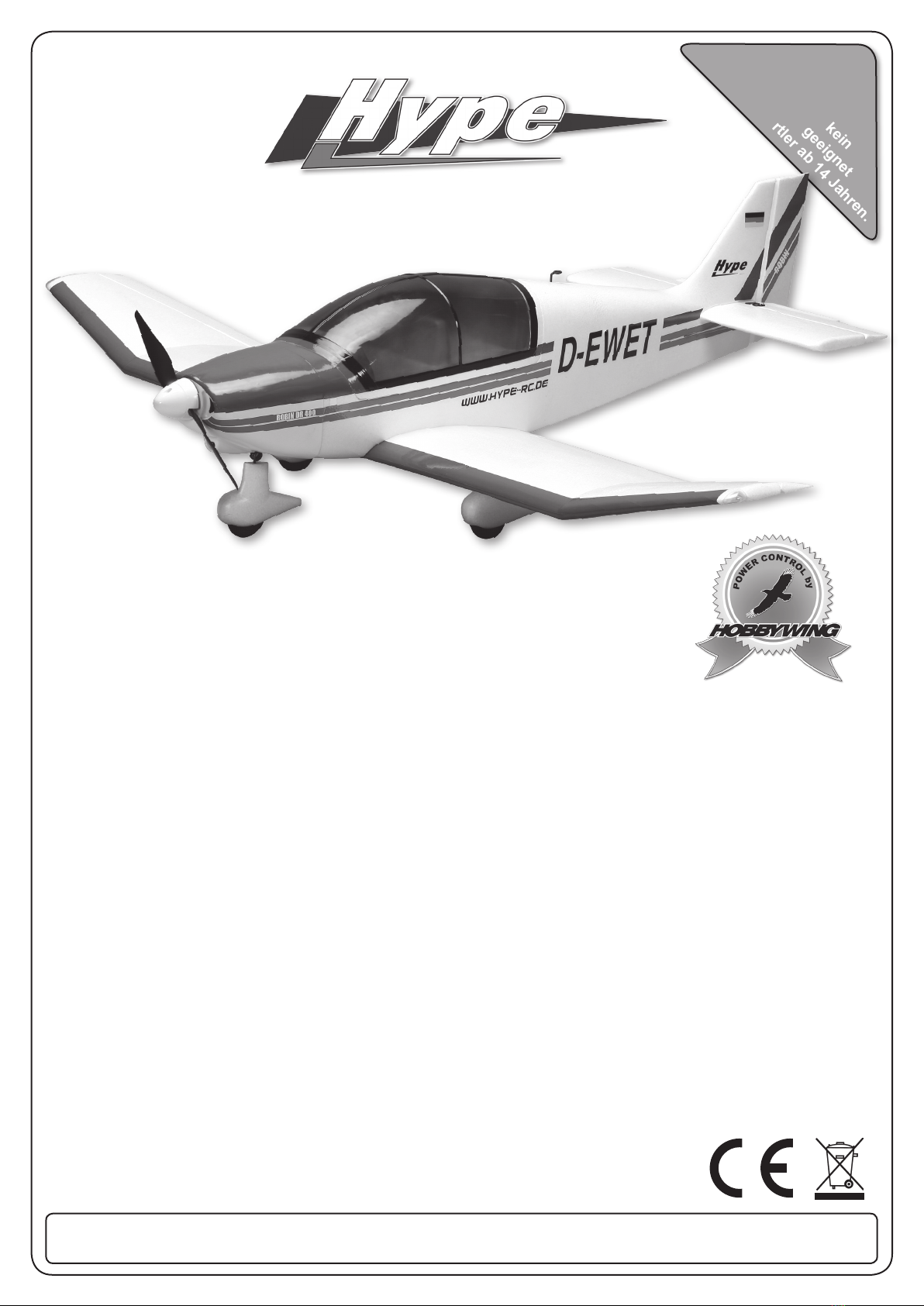
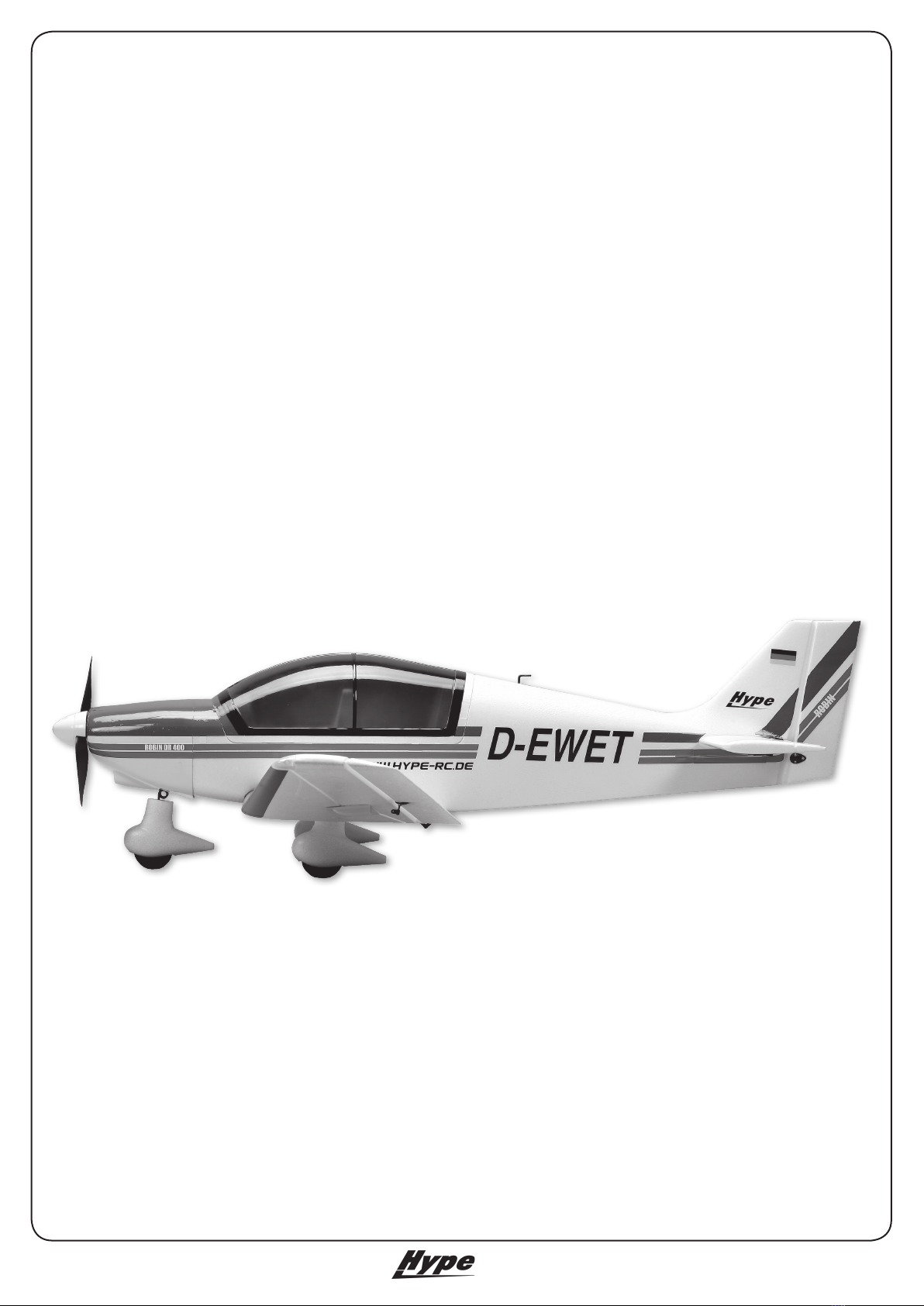
JODEL ROBIN
Technische Daten
Spannweite: 1.510 mm; Länge: 1.240 mm;
Gewicht ca.: 2.550 g; Akku: 4s 14,8V; Motor:
Brushless; Maßstab: 1:5,8
RC-Funktionen
Höhenruder, Seitenruder, Querruder, Motor,
Landeklappen, Schleppkupplung
Technical Data
Wingspan: 1.510 mm; Length: 1.240 mm;
Weight approx.: 2.550 g; Battery: 4s 14,8V;
Motor: Brushless; Scale: 1:5,8
RC-Functions
Elevator, Rudder, Aileron, Motor, Flaps, Tow
Release
Caratteristiche tecniche
Apertura alare: 1.510 mm; lunghezza: 1.240
mm; peso circa: 2.550 g; motore: brushless;
batteria: 4s 14,8V; scala: 1:5,8
funzioni radio
piano di quota, direzionale con ruotino, alet-
toni, aerofreni, gancio di traino, motore
Die Jodel Robin DR-400 ist in geschäumter Bauweise aufgebaut. Dabei kommt der besonders leichte und
haltbare Werkstoff HypoDur® zum Einsatz. Das mehrfarbige Dekor ist bereits auf Rumpf, Tragäche und Leit-
werk aufgebracht. Der Brushless-Direktantrieb wird von einem 4s-LiPo-Akku versorgt und verleiht dem Modell
einen kraftvollen Auftritt. So lassen sich mit der DR-400 leichte Segelugmodelle bis ca. 2.500mm Spannweite
vorbildgetreu auf Höhe bringen. Hierzu verfügt die DR-400 über eine fertig montierte Schleppkupplung, die
über ein Servo betätigt wird. Als weitere Besonderheit, verfügt die DR400 über Landeklappen, die das Modell
im Landeanug wirksam abbremsen und im Langsamug stabilisieren. Der Motor wird durch einen Skywalker
60A Regler made by Hobbywing geregelt. Die große Kabinenhaube ist mit vier SnapLock-Verschlüssen ge-
sichert. Über die große Rumpföffnung unterhalb der Kabinenhaube erfolgt der Wechsel des Antriebsakkus.
The Jodel Robin's fuselage, main wing and tail are made from the lightweight and strong material HypoDur®.
All parts are already painted and decorated in the shown design. The brushless direct drive is powered by a
4s LiPo battery and gives the model a most powerful ight performance. With this drive train the DR-400 can
tow lightweight gliders up to 2.500 mm wingspan into the air and release them once the desired ight level has
been reached. For doing so, the DR-400 is equipped with a servo controlled tow release behind the canopy
on the upper side of the fuselage. Furthermore the DR-400 is equipped with landing aps that slow down the
model during landing and take effect in slow ight stability. The motor is controlled by a Hobbywing Skywalker
60A ESC. The large canopy is secured with four SnapLock closures. Via the large opening below the canopy
the battery can be changed easily out on the aireld. The drive train is installed ready to y in the fuselage.
Il modello in scala ridotta HYPE DR-400 è realizzato in espanso HypoDur®, un innovativo materiale molto
leggero e nello stesso tempo robusto. Le decalcomanie a più colori sono già state applicate in fabbrica su
fusoliera, ala e coda. La motorizzazione diretta brushless viene alimentata da una batteria LIPO a 4 celle e
conferisce al modello un’enorme potenza. Con HYPE Jodel Robin DR-400 potete trainare alianti leggeri no
a 2.500 mm di apertura alare. Jodel Robin DR-400 è già dotato del gancio di traino preinstallato che viene
azionato da un servocomando. Inoltre il modello è dotato di aerofreni, che rallentano il modello efcacemente
durante l’atterraggio e stabilizzano il volo lento.
Seite 2 Best.-Nr. / Item-No. / art. 028-1040
1. Inhaltsverzeichnis / Content / Indice
1. Inhaltsverzeichnis / Content / indice
2. Die Montage des Modells / The Assembly / L'assemblaggio
3. Hinweise zur Bedienung / How To Use / l'utilizzo
4. Sicherheitshinweise / Safety Instructions / per la vostra sicurezza
5. Ersatzteile / Spare Parts / ricambi
6. Garantiebedingungen / Warranty / garanzia
• Entsorgung / Disposal / smaltimento
Bitte entsorgen Sie Elektronik ausschließlich in den dafür vorgesehenen Behältnissen.
Please dispose defective electronic parts in special marked containers.
I riuti elettronici vanno smaltiti negli appositi contenitori e seguendo le leggi del rispettivo paese.
Seite 3
Best.-Nr. / Item-No. / art. 028-1040
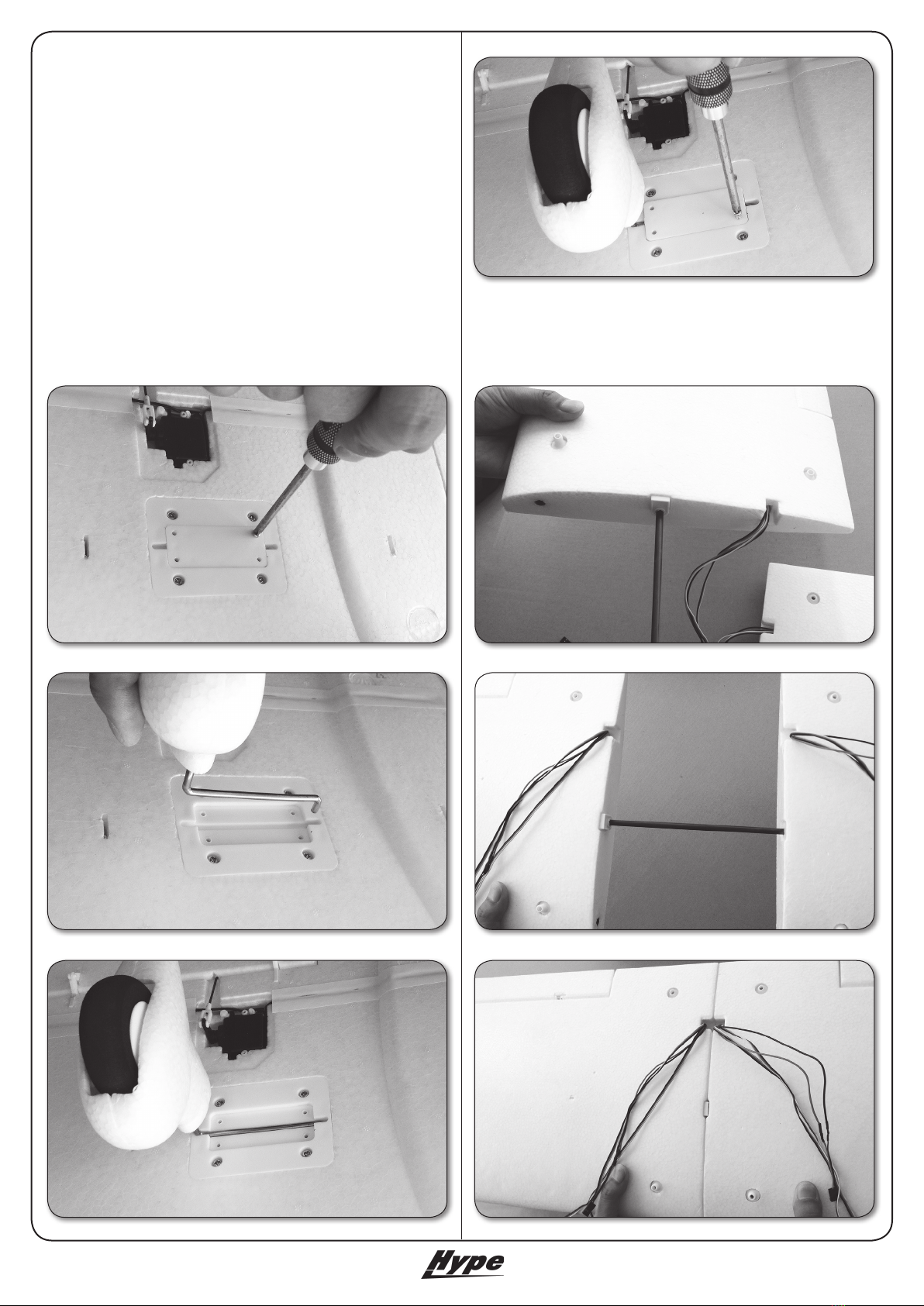
Nehmen Sie den Kohlefaserstab zur Hand und schieben
Sie die beiden Tragächenhälften auf. / Take the carbon
tube and put both wing halfs together. / Unire le due semi-
ali con il tondino in carbonio.
2. Die Montage des Modells / The Assembly /
L'assemblaggio
Nehmen Sie die linke Tragächenhälfte zur Hand und lö-
sen Sie die vier Schrauben der Fahrwerkshalterung. Mon-
tageplatte abnehmen und den Fahrwerksdraht mit dem
montierten Rad in die Halterung einsetzen. Abschließend
die Montageplatte mit den vier Schrauben wieder montie-
ren. Wiederholen Sie den Vorgang für die andere Seite. /
Take the left main wing and remove the four screws from
the landing gear holder. Remove the plate and install the
main gear. Finally install the plate with the foru screws
again. Repeat these steps for the right wing. / Prendere
la semiala sinistra e svitare le quattro viti del supporto del
carrello di atterraggio. Togliere il tappo di montaggio e
inserire il l di ferro del carrello con la ruota montata nel
supporto. Poi rimontare il tappo con le quattro viti. Ripete-
re analogamente per il lato opposto.
Seite 4 Best.-Nr. / Item-No. / art. 028-1040
Nehmen Sie die Kabinenhaube ab und drehen Sie den
Rumpf mit dem Tragächenausschnitt nach oben. Führen
Sie die Kabel der Tragäche in den Rumpf, wie darge-
stellt. / Remove the canopy and turn the fuselage upside
down. Lead the wires from the wing into the fuselage as
shown. / Rimuovere la cabina di pilotaggio e girare la
fusoliera con l'apertura della sede dell'ala in su, come
mostrato.
Setzen Sie die Tragäche auf den Rumpf auf und ver-
schrauben Sie sie mit den vier beiliegenden M4 Schrau-
ben. / Put the main wing on the fuselage and secure it with
four pieces M4 screws. / Appoggiare l'ala sulla fusoliera e
avvitarla con le quattro viti M4 incluse.
Seite 5
Best.-Nr. / Item-No. / art. 028-1040
Nehmen Sie den Rumpf und das Höhenleitwerk zur Hand
und rauhen Sie die Klebeächen ganz leicht auf. Schieben
Sie nun das Höhenleitwerk in den Rumpf und richten Sie
es exakt(!) gerade aus, wie dargestellt. / Take the fuselage
and the horizontal stabilizer at hands and sander slightly
the glueing areas. Slide the stabilizer into the fuselage and
center it correctly! / Prendere fusoliere e piano di quota e
cartavetrare le superci da incollare. Inlare ora il piano di
quota nella fusoliera e posizionarlo perfettamente diritto,
come mostrato.
Abschließend das Höhenleitwerk mit Styropor-Sekunden-
kleber oder 5-Minuten Epoxydharz ankleben. / Finally glue
the horizontal stabilizer with Styropor-Cyanoacrylat or 5
minute Epoxy to the fuselage. / Inne incollare il piano di
quota nella fusoliera con della colla ciano per polistirolo
oppure con della resina epossidica 5 minuti.
Klebestelle gut aushärten lassen! Anschließend die An-
lenkung für das Höhenruder einhängen, wie dargestellt. /
Let the glue harden before you continue! Afterthat connect
the linkage of the elevator to the horn. / Fare asciugare
bene gli incollaggi. Poi agganciare il comando del piano di
quota nella squadretta come mostrato.
A A’
B B’
A = A’
B = B’
Seite 6 Best.-Nr. / Item-No. / art. 028-1040
Nehmen Sie die Luftschraube mit dem Klemmkonus zur
Hand und schieben Sie sie vollständig auf die Motorwelle
auf. Anschließend die Mutter gut(!) festziehen. / Take the
propeller with the propeller joint and put it on the motor
shaft. Afterthat tighten the nut securely! / Inlare l'elica e il
cono di serraggio completamente sull'albero motore. Poi
serrare fortemente (!) il dado.
Setzen Sie den Spinner auf die Propellernabe auf und
sichern Sie ihn mit der beiligenden Schraube. / Take the
spinner and put it on the propeller base. Finally tighten
the screw securely. / Inlare l'ogiva sul mozzo dell'elica e
ssarla con la vite inclusa.
Schließen Sie die Servos am Empfänger an und verlegen
Sie anschließend die Empfängerantenne(n). Beachten
Sie hierzu auch die Herstelleranweisungen der RC-An-
lage! / Connect the servos to the receiver and install the
antenna(s) in the model. Please note the manual from the
radio manufacturer accordingly. / Collegare i servi alla ri-
cevente e poi estendere l'antenna(e) della ricevente. Fate
riferimento alle istruzioni del produttore della radio.
Setzen Sie nun den Antriebsakku (4s LiPo 14,8V /
5.000mAh) in das Akkufach ein. Akku jetzt noch nicht am
Regler anschließen! / Install the battery (4s LiPo 14,8V /
5.000mAh) in the lower front area of the fuselage. Do not
connect the battery with the speed controller now! / Ora
inserire la batteria (4s LiPo 14,8V / 5.000mAh) nella parte
anteriore della fusoliera, ma non collegarla ancora con il
regolatore!
Akku vollständig in den Schacht einschieben und seitlich
mit Schaumstoff gegen Verrutschen sichern. Die endgül-
tige Position des Akkus ergibt sich bei der Justierung des
Schwerpunktes. / Slide the battery fully into the battery
bay and x it securely with some foam material. The nal
position of the battery will be found when checking the
CG. / Inlare la batteria completamente nel vano batterie
e bloccarlo lateralmente con dell'espanso afnché non si
sposti. La posizione nale della batteria verrà determinata
nella fase di messa a punto del baricentro.
Seite 7
Best.-Nr. / Item-No. / art. 028-1040
Prüfen Sie nun, ob sich alle Ruder korrekt bewegen.
Zuerst(!) den Sender einschalten, danach den gelade-
nen Antriebsakku im Modell anschließen. Betätigen Sie
der Reihe nach alle Funktionen am Sender. Vorsicht im
Umgang mit dem drehenden Impeller! / Check the func-
tion of all rudders. Switch on the transmitter rst(!) and
connect then the LiPo-Battery to the speed controller in
the model. Move all rudders one by one. Attention! Be
careful with the rotating impeller! / Vericate ora che tutte
le parti mobili si muovano correttamente: accendere la
trasmittente e collegare la batteria caricata nel modello.
Ora provare tutte le funzioni radio. Attenzione a non ferirvi
con l'impeller in rotazione!
Beim Ausschalten stets zuerst das Modell und dann den
Sender ausschalten. / Always switch off the model rst,
then switch off the transmitter. / Per spegnere spegnete
sempre prima il modello e poi la trasmittente!
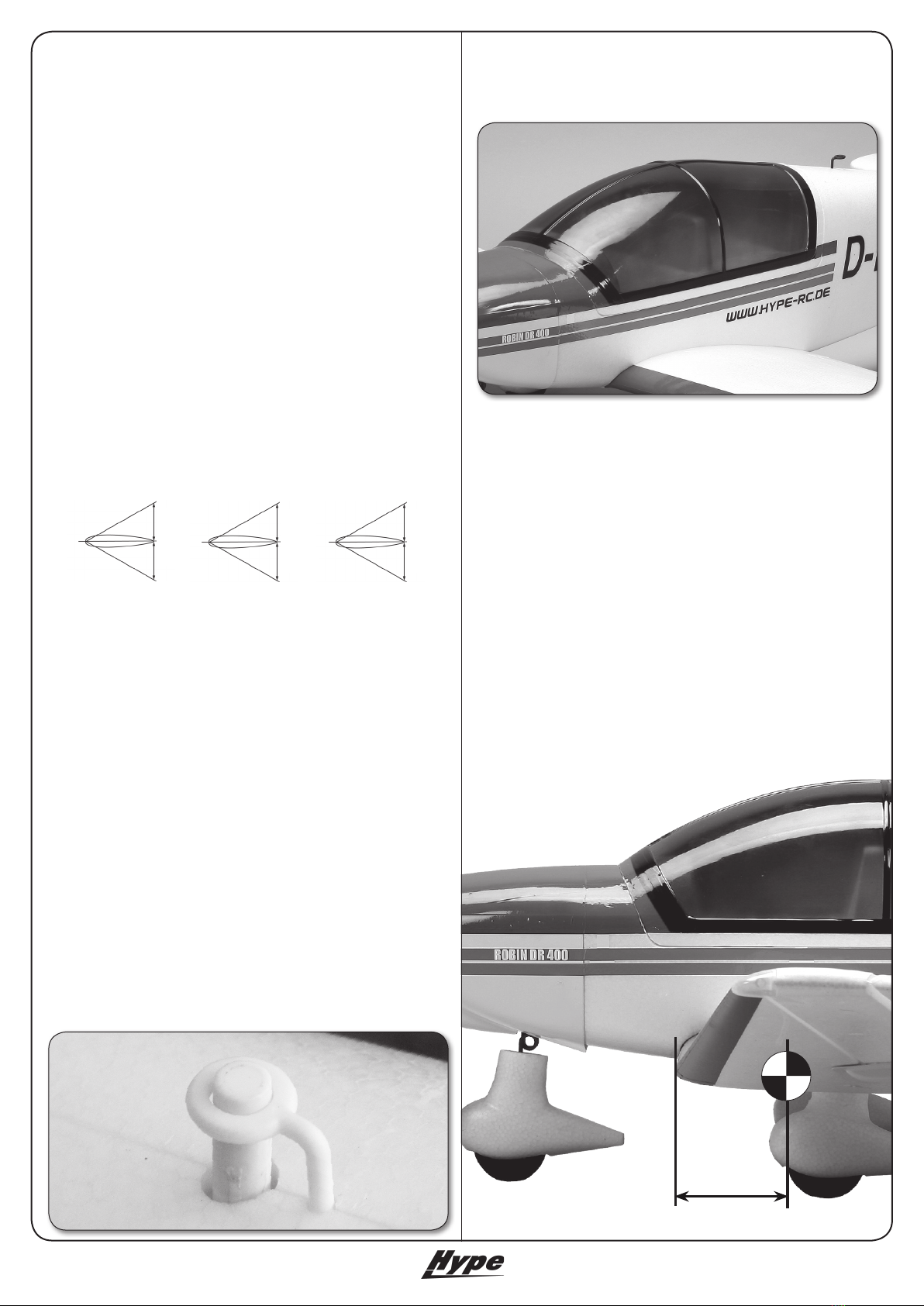
Stellen Sie die maximalen Ruderausschläge gemäß der
nachfolgenden Werte ein. / Adjust the maximum travel of
the control aps according to the sketch below. / regolare
le escursioni massime dei piani mobili come segue:
Die Werte werden an der inneren Hinterkante der Ruder
gemessen. Geben Sie auf das Höhenruder 35% Expo-
nential-Anteil. / The values are measured at the inner rear
edge of the aps. Set 35% Exponential on on the eleva-
tor. / si misura al bordo posteriore delle parti mobili. Date
35 % di esponenziale su piano di quota.
Die Landeklappen können bis zu einem Winkel von 70°
ausgefahren werden. / The aps can be lowered up to an
angle of 70°. / I aps possono essere aperti no ad un
angolo di 70°.
Achten Sie darauf, dass der Bolzen der Schleppkupplung
im verriegelten Zustand leicht über die Zugöse schaut,
damit die Zugkräfte in den Rumpf eingeleitet werden. Im
geöffneten Zustand muss der Bolzen vollständig im Rohr
verschwinden. / When the tow release is locked, the bolt
must be fully inserted into the towing ring! When opened,
the bolt must disappear completely into the tube. / Il per-
no del gancio di traino deve - quando è chiuso - sporgere
leggermente dall'asola di traino, in maniera tale da intro-
durre di forze trainanti all'interno della fusoliera. Quando
è aperto, il perno deve sparire totalmente nel tubo.
100 mm
Setzen Sie abschließend die Kabinenhaube auf den
Rumpf auf. / As the last step put the canopy on the fusela-
ge. / Ora mettere la cabina sulla fusoliera.
Abschließend muss der Schwerpunkt am Modell überprüft
werden. Dazu werden alle Komponenten (auch der Akku!)
im Modell montiert. Der Schwerpunkt liegt 100 mm
hinter der Nasenleiste der Tragäche. Unterstützen Sie
das Modell mit zwei Fingern exakt an diesen Punkten und
beobachten Sie, wie das Modell auspendelt. Die Nase
des Modells sollte sich leicht nach unten neigen. Dann ist
der Schwerpunkt optimal justiert. / Before the rst ight
you have to check the center of gravity. For doing so you
have to mount all components (also the battery!) in to
the model. The CG is placed 100 mm behind the nose
cone of the main wing. Support the model exactly at the
marked spots on the bottom side of the wing. Put the
model on two ngers and watch the fuselage. The nose
should point slightly to the ground. Then the CG is placed
correctly! / Vericare il centro di gravità. Dovrete usare il
modello completo della batteria! Il CG è a 100 mm dietro
il bordo d'entrata dell'ala. Tenere il modello tra due dita
come mostrato e guardate la fusoliera. Il muso dovrebbe
puntare leggermento verso il basso.
QUERRUDER
AILERON
ALETTONI 13mm
13mm
SEITENRUDER
RUDDER
DIREZIONALE 35mm
35mm
HÖHENRUDER
ELEVATOR
PIANO DI QUOTA 15mm
15mm

Seite 8 Best.-Nr. / Item-No. / art. 028-1040
3. Hinweise zur Bedienung / How To Use / istruzioni d'uso
3.1 Laufrichtung der Ruder / Steering Direction Of Flight Controls / direzione dei piani mobili
Vor dem Erstug des Modells muß unbedingt die Laufrichtung aller Ruder überprüft werden. / Before the rst ight of the model, the
steering direction must be checked carefully! / prima del primo volo dovrete controllare il senso di escursione dei piani mobili
Höhenruder / Elevator / piano di quota
Wird der Höhenruderknüppel am Sender nach hinten gezogen, muß das Höhenruder nach oben ausschlagen. Wird der Höhenru-
derknüppel nach vorn gedrückt, muß das Höhenruder nach unten ausschlagen. / When you pull the elevator stick, the elevator has
to move up, the model will climb. When you push the elevator stick, the elevator has to move down, the model will decline. / Tirando
lo stick del piano di quota, il piano mobile deve andare in sù, spingendolo in avanti, il piano deve andare giù.
Seitenruder / Rudder / direzionale
Das Modell wird von hinten betrachtet. Wird der Seitenruderknüppel am Sender nach links bewegt, muß das Seitenruder nach links
ausschlagen. Entsprechend umgekehrt erfolgt der Ausschlag für die andere Richtung. / Take a look to the model from behind. When
you move the rudder stick to the left, the rudder has to move to the left. For the right side it works accordingly. /Guardare il modello
da dietro: muovendo lo stick del direzionale a sinistra, il piano mobile si muove a sinistra e vice versa.
Querruder / Aileron / alettoni
Das Modell wird von hinten betrachtet. Wird der Querruderknüppel am Sender nach links bewegt, muß die linke Querruderklappe
nach oben und die rechte Querruderklappe nach unten ausschlagen. Entsprechend umgekehrt erfolgen die Ausschläge für die an-
dere Richtung. / Take a look to the model from behind. When you move the aileron stick to the left, the left ap has to move up and
the right ap has to move down. For the right side it works accordingly. / Guardando il modello da dietro e muovendo lo stick degli
alettoni a sinistra, l'alettone sinistra deve andare sù e quello destro in giù. E vice versa.
Motor / Motor / motore
Wird der Gasknüppel in die Leerlauf Position gebracht, muß der Motor stillstehen. Bei Vollgas muss der Motor seine maximale
Drehzahl erreichen. / When you move the throttle stick to idle, the motor has to stop completely. Putting the throttle stick to full pow-
er, the motor has to reach its maximum rpm. / Portando lo stick motore in posizione minimo, il motore si deve fermare, in posizione
massima invece deve andare ai massimi giri.
3.2 Startvorgang / Take Off / partenza
• Starten Sie prinzipiell immer gegen den Wind! / Alwas start the model against the wind! / Partite sempre contro il vento.
• Überprüfen Sie die Funktion aller Ruder vor jedem(!) Start. / Check all rudder controls before each(!) start. / Controllate tutti i piani
mobili prima della partenza.
• Geben Sie Vollgas und korrigieren Sie in Bodennähe nur mit kleinen Steuerausschlägen. / For take off always use maximum pow-
er. When you are near the ground only small control action is recommended. / Per la partenza accelerare al massimo.
• Steigen Sie in einem achen Winkel. / Climb in a smooth angle. / Salire in un angolo piatto.
3.3 Landevorgang / Landing Procedure / Atterraggio
• Drosseln Sie den Motor und iegen Sie in 30 m Entfernung mit Rückenwind parallel zur Landebahn. / Reduce motor power and
y parallel to the runway in a distance of 30 meters. / Diminuire i giri motore e volare a 30 m di distanza parallelamente alla pista di
atterraggio.
• Fliegen Sie eine 90° Kurve in Richtung Landebahn und bauen Sie Höhe ab. / Turn 90° to the runway and decline continously. /
Effettuate ora una virata a 90° in direzione della pista di atterraggio e diminuite la quota.
• Fliegen Sie erneut eine 90° Kurve, Sie iegen nun direkt auf die Landebahn zu. Turn again 90° to the runway and decline conti-
nously. You are now approaching the runway. / Effettuate un'ulteriore virata a 90° in direzione della pista e continuate a scendere.
• Lassen Sie das Modell weiter sinken bis das Modell 1 m über der Landebahn schwebt. / Decline until you are about 1 meter over
the runway. / Continuate la discesa no a librarvi 1 m sulla pista.
• Ziehen Sie den Höhenruderknüppel etwas stärker und halten Sie ihn gezogen. / Pull the elevator carefully and keep it pulled. /
Tirate lo stick del piano di quota un po' di più e tenetelo tirato.
• Je mehr sich das Modell dem Boden nähert, desto mehr muß der Höhenruderknüppel gezogen werden. Da das Modell ständig
langsamer wird, setzt es sich praktisch von allein auf die Landebahn. / The closer you come to the ground the more you have to pull
the elevator. As the model gets slower, it will land more or less automatically. / Più vi avvicinate al suolo, più dovrete tirare il piano di
quota. Il modello rallenta continuamente atterrando praticamente da solo sulla pista.
Seite 9
Best.-Nr. / Item-No. / art. 028-1040
4. Sicherheitshinweise / Safety Instructions / avviso di sicurezza
Allgemeine Sicherheitshinweise für Modelle mit Elektroantrieb
Dieses Modell ist kein Spielzeug, geeignet für Modellsportler ab 14 Jahren.
Verwenden Sie das fertige Modell ausschließlich gemäß seiner vorgesehenen Bestimmung, wie unter dem Kapitel
„Hinweise zur Bedienung“ in der Bauanleitung / Bedienungsanleitung erläutert.
 Montieren Sie das Modell grundsätzlich nur nach der Bauanleitung / Bedienungsanleitung zusammen. Nehmen Sie
Umbauten nur vor, unter Verwendung von empfohlenen original Ersatz- und Tuningteilen aus dem Hause
KYOSHO Deutschland.
Beachten Sie hierzu die Gebrauchsanweisung anderweitig zur Anwendung kommender
Komponenten (z.B. Fernsteuerungsanleitung).
Die Inbetriebnahme ist nicht eher gestattet, bis das Modell laut beiliegender Bauanleitung komplett montiert ist.
Überprüfen Sie vor der Inbetriebnahme des Modelles die Funktionssicherheit laut Checkliste und benutzen Sie
einen Frequenzkanal, der nicht bereits von anderen Modellsportlern belegt ist oder diese stört.
Betreiben Sie das Modell nur dort, wo sich keinerlei Personen oder Tiere aufhalten und eine Beschädigung
anderer Güter auszuschließen ist. Handeln Sie eigenverantwortlich und überprüfen Sie das gewählte Gelände
vor Inbetriebnahme des Modells auf seine Eignung.
 Stoppen Sie das Modell unverzüglich bei einer Störung und beseitigen Sie sofort die Ursache, falls Sie keine
Kontrolle mehr über das Modell haben.
 Berühren Sie keine rotierenden und/oder heißen Motorteile während des Betriebes oder der Abkühlphase.
Warten Sie Ihr Modell nach jedem Einsatz und ersetzen Sie Verschleißteile, um einen sicheren Betrieb zu gewährleisten.
Fassen Sie das Modell während und nach dem Betrieb stets so an, daß Sie keinesfalls mit Teilen des Antriebs
in Berührung kommen.
Bedenken Sie, daß Kunststoffteile bei niedrigen Außentemperaturen in Ihrer Schlagzähigkeit nachlassen können,
daß heißt, die Belastungsfähigkeit sinkt.
 Sofern Sie nicht über ausreichende Kentnisse im Umgang mit Funktionsmodellen verfügen, wenden Sie sich an
einen erfahrenen Modellsportler oder Modellbauclub.
Schützen Sie sich bei Testläufen vor, eventuell durch rotierende Teile, aufgewirbeltem Schmutz bzw. Steinchen.
Schützen Sie alle elektrischen Komponenten vor Wasser und Fremdkörpern.
Sorgen Sie dafür, daß der Motor nicht überlastet oder blockiert wird.
Lassen Sie den Motor nach dem Betrieb ausreichend abkühlen.
Laden und entladen Sie Ihre Akkus sorgfältig und achten Sie darauf, daß die Akkus und Anschlußkabel keinerlei
Beschädigungen aufweisen.
Schließen Sie den Akku niemals "kurz" durch Zusammenführen des Plus- und Minuspols.
Verlegen Sie die Kabel im und am Modell so, daß diese nicht in oder an rotierende oder heiße Teile geraten.
Stellen Sie sicher, daß der Fahrtenregler ungehindert funktionieren kann.
 CE-Zertizierung für Elektromotor; Angewandte Normen: EN 50081-1, IEC 1000-4-2, IEC 1000-4-3, EN 50082-1
 Bei technischen Rückfragen, wenden Sie sich bitte an unsere Service-Hotline: 04191-932678 (Mo.-Do.: 14.00-17.30 Uhr).
Seite 10 Best.-Nr. / Item-No. / art. 028-1040
General Safety Instructions For Electric Models
This model is not a toy. Allowed for children over 14 years.
 Use the model accordingly to chapter 5 "How To Use" in this instruction manual.
 Assemble the model accordingly to this instruction manual. Do not alter or modify the model. Only use parts that are ofcially
recommended by KYOSHO Deutschland.
Always pay close attention to the manuals that are included to accessory parts.
 Do not y the model before you have nished the assembly completely according to this manual.
 Before you y, check all functions of the model carefully. Check if your frequency is clear and not used by any
other pilots in your area. This may cause radio interference.
 Never y your model near other human beings, animals or other obstacles. You are responsible for ying the model, so
you have to check carefully your ight area.
 Stop ying immediately if you realize any radio interference. Check the system for the cuase and change the frequency
if necessary.
Do not touch any moving or hot motor parts during action! Let all components cool down before you handle them.
 Check your model carefully after each ight. Replace parts if they are worn out or if they are defective.
Keep your hands out of reach from rotating or hot parts of the model.
Keep in mind that plastic parts easily break under cold temperature conditions.
 If you are a novice in ying you should ask experienced pilots for assistance during your rst ights.
Protect yourself from dust and other small things when you test run your propeller drive on the ground.
Keep all electronic components dry and clean!
Take care that your motor does not get overload or gets blocked under full power.
Let the motor cool down after restarting the model again.
Charge your batteries carefully. Always watch the charging process and make sure all connectors are in good conditions.
Do not shorten the battery by connecting the pluspole with the minuspole directly!
Make sure that the wires do not touch rotating or hot parts of the model.
 CE-certication for electric motor: EN 50081-1, IEC 1000-4-2, IEC 1000-4-3, EN 50082-1
 In case of technical questions please contact our helpdesk by phone: +49-4191-932678 or by e-mail: [email protected]
5. Sicherheitshinweise / Safety Instructions / avviso di sicurezza