4
WARNING: Personal Injury/Property Damage.
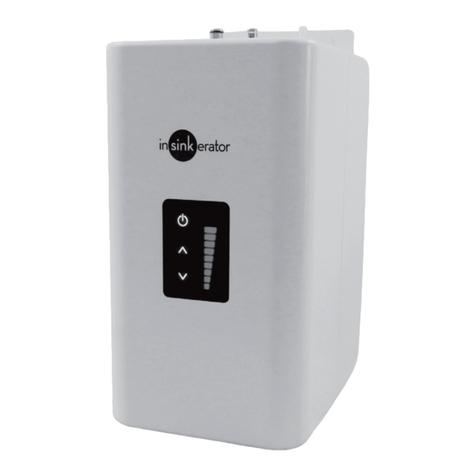
This tank is a pressurized tank. DO NOT modify
this system. DO NOT connect other types of
valves to the tank. Use only the InSinkErator faucet
supplied. Use only parts provided. Contact an
authorized InSinkErator Service agent for repairs or
replacement components.
WARNING: To reduce the risk associated with the
ingestion of contaminants: Do not use with water
that is microbiologically unsafe or of unknown
quality without adequate disinfection before or
after the system.
A water tank, like any water heater, has a limited life and
will eventually fail. To avoid possible property damage
and personal injury, this water tank should be regularly
examined for leakage and/or corrosion and replaced when
necessary. A drain pan, plumbed to an appropriate drain
must be used in those applications where any leakage
could cause property damage. A leak detection device
with water shutoff is recommended.
WARNING: Fire Hazard. To minimize possibility of
fire, DO NOT store flammable items such as rags,
paper or aerosol cans near the tank. DO NOT store
or use petrol or other flammable vapors and liquids
in the vicinity of this or any other appliance.
WARNING: Leak Hazard. Regularly inspect the
faucet and plumbing fittings for leaks, which
can cause property damage and could result in
personal injury.
NOTICE: Property Damage. To reduce the
risk associated with property damage due to
water leakage or flooding, and to ensure optimal
performance:
• Read and follow all instructions before
installation and use of system.
• Installation and use MUST comply with all state
and local plumbing codes.
NOTICE: Property Damage. Any water heater
should be installed in such a manner that if it
should leak, the resulting flow of water will not
cause damage to the area in which it is installed
and areas where the water could flow. National
plumbing codes require a drain pan for any water
heater installation. Failure to install one is the sole
responsibility of owner and/or installer. Reference
the latest version of the Uniform Plumbing Code
(UPC) for specific details and requirements.
IMPORTANT SAFETY INFORMATION
NOTICE: The maximum working pressure of 150
PSI refers to the rating of the temperature and
pressure relief valve. The pressure of the water
entering the water heater must be less than 70 PSI.
NOTICE: Property Damage. To avoid water
damage, replace any loose or split tubing.
Periodically inspect the unit for any sign of leakage
and immediately remove from service any unit
suspected of leaking.
NOTICE: T&P valves are typically designed and
manufactured to relieve pressure at 150PSI and
temperature at 210°F (98.9°C). ASME, ANSI and
CSA (AGA) approved relief valves protect the water
heater from excess pressures and temperatures by
discharging water.
When water is heated it expands. The extra volume
created by this expansion has to go somewhere or
pressure will dramatically increase, such as when
water is heated in a closed system.
In normal operation of the water heater and T&P
valve, no water should be discharged from the
valve. A relief valve functions by discharging water,
so it is essential that a discharge line be piped
from the valve in order to carry the overflow to a
safe place of disposal. This discharge line must be
the same size as the valve outlet and must pitch
downward from the valve. Discharge may indicate
that an unsafe temperature or pressure condition
exists which requires immediate attention by a
qualified service technician or licensed plumbing
contractor.
The T&P valve lever MUST be operated AT LEAST
ONCE A YEAR to ensure that the water-ways are
clear. Certain naturally occurring mineral deposits
may adhere to the valve, rendering it inoperative.
When manually operating the lever, water will
discharge and precautions must be taken to avoid
contact with hot water and to avoid water damage.
BEFORE operating lever, check to see that a
discharge line is connected to this valve directing
the flow of hot water from the valve to a proper
place of disposal, otherwise personal injury may
result. If no water flows, valve is inoperative. TURN
OFF THE WATER HEATER AND CALL A PLUMBER
IMMEDIATELY.