4
For terrestrial observation, such as land mark or bird viewing, you can buy an optional 45º
Erect Diagonal to have a correct image from your eyepiece.
3.2. Selecting an Eyepiece
The magnification of a telescope is defined by the focal lengths of the telescope and the
eyepiece. A formula can be used to determine the power of each eyepiece: Telescope focal length
divided by eyepiece focal length equals magnification.
For example, a Solar60 telescope has a focal length of 360mm. With a 25mm eyepiece, the
magnification will be
360mm ÷ 25mm = 14.4X (magnification)
If you want more magnification, you may order higher power eyepieces. Note: a 25 mm
focal length eyepiece has a lower power than a 10 mm one. Always start with the lowest power
eyepiece for easy locating the objects.
3.3. Focusing Telescope
Practice telescope focusing during the daytime to get familiar with the scope.
(1) Remove dust cap and unscrew the glass solar filter from the telescope.
Warning: once the solar filter is removed from the telescope, it will no longer be a
Solar Scope. Never aim the telescope at the sun if the solar filter is removed or damaged.
(2) After selecting the desired eyepiece aim the telescope tube at a land-based target at
least 200 yards away (e.g. A telephone pole or building). Fully retract focusing tube by turning the
focus knob.
(3) While looking through selected eyepiece, slowly extend focusing tube by turning
focusing knob until object comes into focus.
4. Specifications:
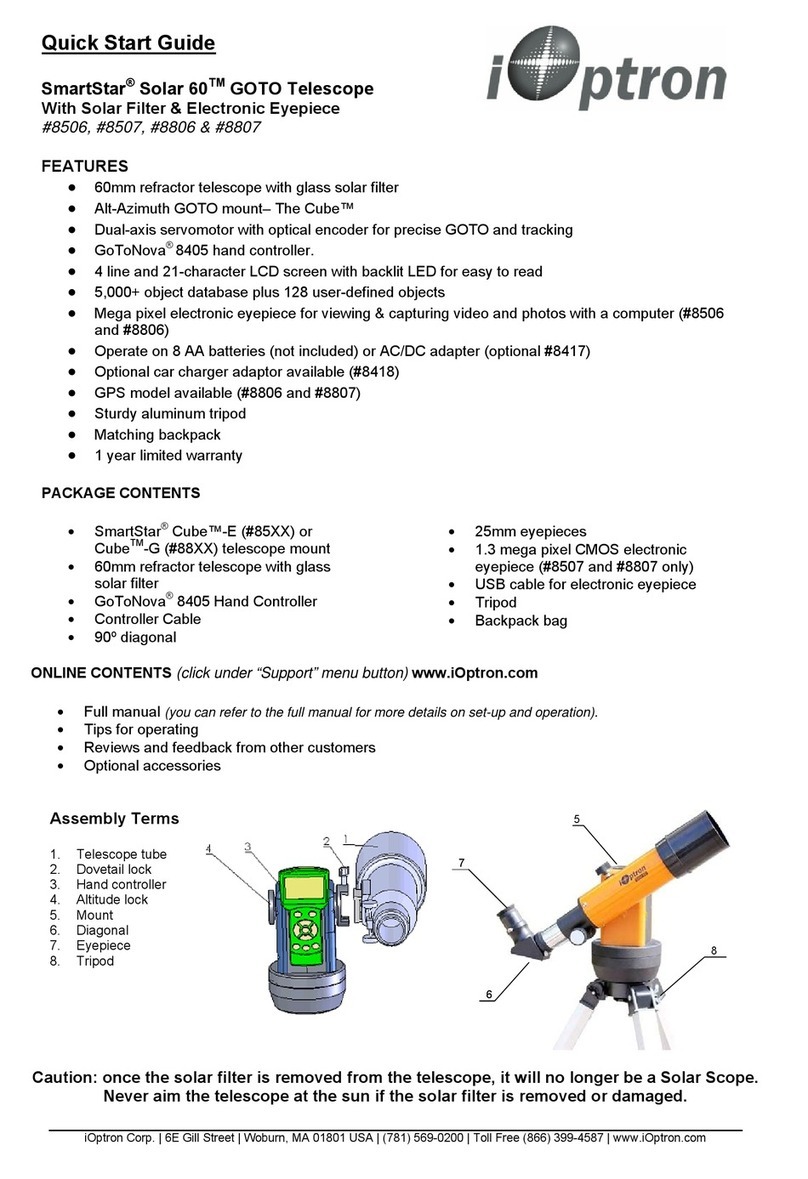
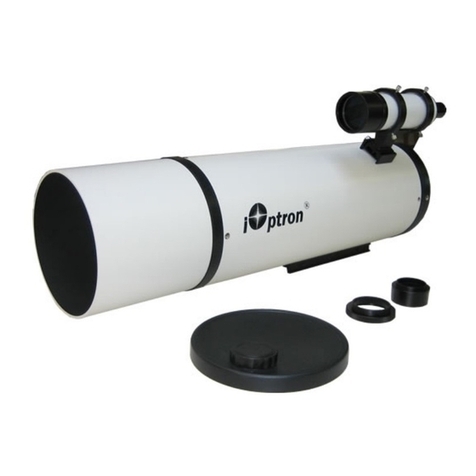
Product Name 60mm White Light Solar Scope (#8707)
Optical Design Air-Spaced Doublet Achromatic Refractor
Optical Coatings Fully Multi-Coated
Clear Aperture 60mm
Focal Length 360mm
Focal Ratio f/6
Resolving Power 1.93 arcsec
Limiting Visual Magnitude 10.7
Highest Useful Magnification 120
Focuser 1.25" rack-and-pinion
Eyepiece adapter 1.25 inch
Eyepiece 25 mm (14.4X)
Diagonal 90° star diagonal
Solar Filter High durability white light filter
Weight 1.7 lbs
Warranty One year limited