manuals.online logo
Brands
  1. Home
  2. •
  3. Brands
  4. •
  5. Kaller
  6. •
  7. Tools
  8. •
  9. Kaller CU4 740 Original operating manual

Kaller CU4 740 Original operating manual

This manual suits for next models

7

Other Kaller Tools manuals

Kaller CU 1800 User manual

Kaller

Kaller CU 1800 User manual

Kaller M2 Original operating manual

Kaller

Kaller M2 Original operating manual

Kaller CU4 1000 User manual

Kaller

Kaller CU4 1000 User manual

Kaller SPC 750 Original operating manual

Kaller

Kaller SPC 750 Original operating manual

Popular Tools manuals by other brands

AGI Westfield MKX16 Assembly manual

AGI

AGI Westfield MKX16 Assembly manual

GYS HAND-DUCTION 056923 Translation of the original instructions

GYS

GYS HAND-DUCTION 056923 Translation of the original instructions

Grizzly H7583 instruction manual

Grizzly

Grizzly H7583 instruction manual

Sealey VS0462.V2 instructions

Sealey

Sealey VS0462.V2 instructions

Makita HR2650 instruction manual

Makita

Makita HR2650 instruction manual

Forza 1100H Series manual

Forza

Forza 1100H Series manual

Aventics EBS-PI operating instructions

Aventics

Aventics EBS-PI operating instructions

Martor SECUNORM 175 quick start guide

Martor

Martor SECUNORM 175 quick start guide

jbc N4473 instruction manual

jbc

jbc N4473 instruction manual

FEINMETALL FZWZ-SET-001 quick start guide

FEINMETALL

FEINMETALL FZWZ-SET-001 quick start guide

Worx Professional Sonicrafter WU676 Original instructions

Worx Professional

Worx Professional Sonicrafter WU676 Original instructions

Gage Bilt GB713SH Original instructions

Gage Bilt

Gage Bilt GB713SH Original instructions

Hilti DX 9-ENP Original operating instructions

Hilti

Hilti DX 9-ENP Original operating instructions

norbar NORTRONIC 34399 Operator's manual

norbar

norbar NORTRONIC 34399 Operator's manual

BGS technic 8578 manual

BGS technic

BGS technic 8578 manual

axing BWZ 5-02 Operation instructions

axing

axing BWZ 5-02 Operation instructions

Makita DHR241 instruction manual

Makita

Makita DHR241 instruction manual

Motor Guard JMB-1250 instructions

Motor Guard

Motor Guard JMB-1250 instructions

manuals.online logo
manuals.online logoBrands
  • About & Mission
  • Contact us
  • Privacy Policy
  • Terms and Conditions

Copyright 2025 Manuals.Online. All Rights Reserved.

SERVICE INSTRUCTION
8200-1364-C
Gas Spring Models
CU4 740
CU4 1000
CU4 1800
CU4 2900
CU4 4700
CU4 7500
CU4 11800
CU4 18300
Strömsholmen AB
P.O. Box 216,
SE-573 23 Tranås, Sweden
Visiting Address:
Verkstadsgatan 16, Tranås
Phone: +46 140 571 00
Email: [email protected]
kaller.com
2
SERVICE INSTRUCTION
Please Note!
Actual gas spring design may appear different from what
shown here.
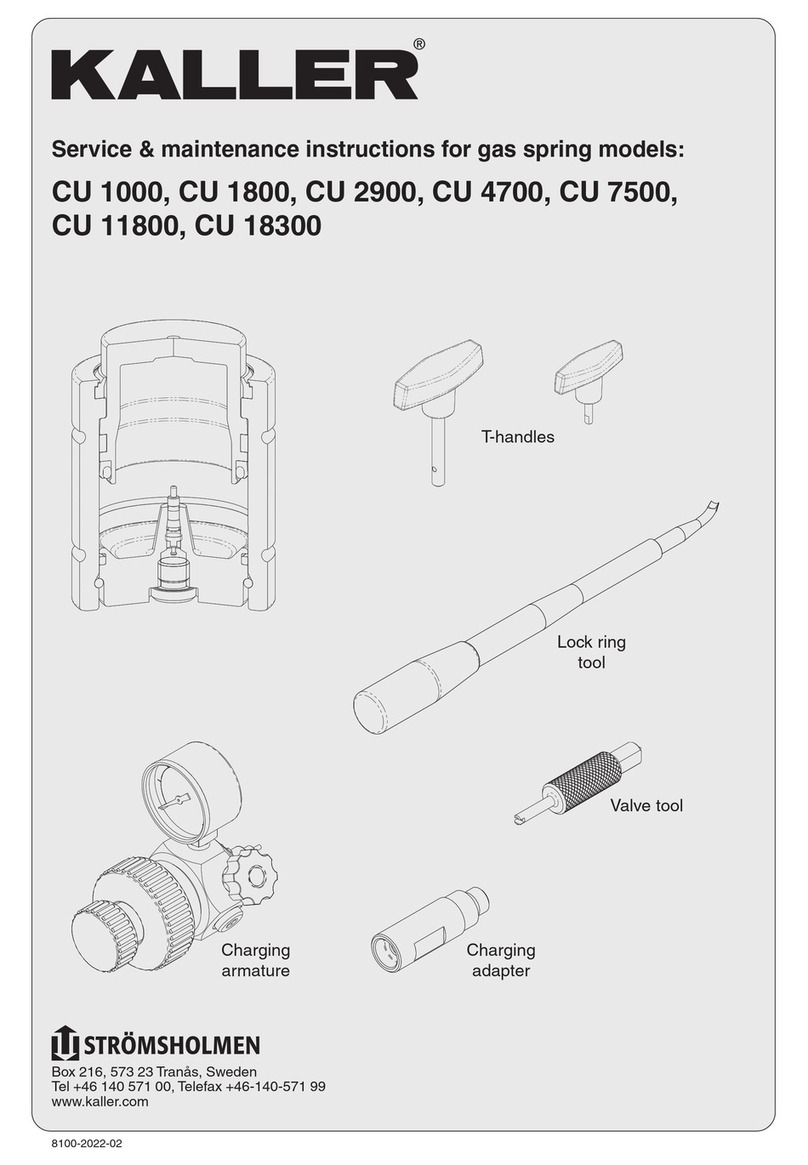
A) Piston
B)* Scraper
C)* Flex ring
D)* Piston seal with O-ring
E) Tube
F)*Valve
G)* O-ring (& backup ring)
H) Bottom
I) Lock ring
J)* Cover Screw
* = Parts included in
the repair kit.
Differs between
model and version.
Warning!
Always read the permanently marked information on
the side of the tube before service to make sure you
use the correct repair kit. NEVER mix new
components together with old gas spring
components when servicing the spring.
Failure to exhaust all gas pressure prior to disassembling
could result in serious injury.
The maximum charging pressure is 150 bar (2175 psi)
Use only pure nitrogen gas (N2) for charging.
Once the cover screw is removed, never lean directly
over the valve. Always direct the valve port away from
yourself and others.
Never use extreme force on the gas spring.
Charged gas springs are under high internal pressure
and should be protected against damage.
Always use protective jaws when clamping the spring in
a vice.
To achieve maximum service life, keep the gas spring
protected from dirt, drawing fluids, and grinding dust.
Always wear protective equipment incl. safety goggles
and rubber gloves, whilst servicing the gas spring in a
well ventilated area. Avoid direct contact with gas spring
lubricants and inhalation of any exhausting gases.
Only specially trained personnel with good knowledge of
the products should carry out the maintenance.
Disassembly
1) To obtain an easy working position, clamp the spring in a
vice (use protective jaws). Unscrew the G1/8" cover
screw (J) with a 5 mm Allen key. If there is no gas left in
the spring, the bottom (H) may rotate. If so, use the
threaded holes at the bottom (H) to prevent the rotation
and unscrew the G1/8"cover screw (J) slightly.
2) If there is still gas pressure in the spring, release it by
screwing the threaded end of the valve tool into the
charging port until the valve needle opens. The valve (F)
must not be unscrewed until the piston can be pushed in
by hand or be tapped in using a plastic mallet. Then
unscrew the valve and remove the valve.
3) Tap in the bottom (H) using a socket and mallet until the
lock ring (I) is exposed. Remove the lock ring with the
lock ring tool. Bend the lock ring upwards and inwards.
4) Pull out the bottom (H), using a T-handle and then pour
out the remaining oil.
5) Clamp the gas spring in the vise with the piston facing
upwards and tap out the piston (A) using socket and
mallet.
6) Remove the piston seal (D) and the Flex ring (C) from
the piston.
Note! Be careful not to damage the piston seal
groove when removing the seal.
On smaller models it can be difficult to remove the seal
by hand. If so, lift the seal and cut it loose using a sharp
knife.
7) Remove the scraper (B) from the tube.
Note! Replace the scraper (B) with a new one after
each disassembly as it will get damaged while
tapping out the Piston (A), see the figure below.
8) Remove the O-ring (G) and the back-up ring (where
applicable) from the bottom.
Note! Be careful not to damage the overpressure
protection groove while disassembling.

3
Inspection
9) Thoroughly clean the tube, the piston and the bottom.
10) Closely inspect the inside of the tube, the sealing
groove on the piston, the mechanical stop of the piston
(A) and bottom. There should be no scratches or dents
on the inside surface of the tube, the piston or the lock
ring grooves. If these parts are scratched or damaged
in any way then they should be replaced. Also never
use tubes with external pressure marks.
Assembly
11) Unpack the repair kit. Make sure the correct repair kit is
being used. Check to make sure that all parts are
contained in the kit by comparing the contents in the list
of page 2. If the repair kit contains 2 plastic bags, use
the one that pictures the bottom of your gas spring and
discard the other. Discard all parts that are to be
replaced with new ones from the repair kit.
12) First fit the scraper (B) into the top of the tube. Make
sure the scraper sits correctly in the groove with the lip
pointing upwards.
13) Mount the Flex ring (C) and the piston seal (D) with the
O-ring facing downwards (gas side).
14) Mount the O-ring (G) to the bottom. Make sure it is
fitted in the square groove. If backup ring is present in
the repair kit (see 11) it should be in the same groove
together with the O-ring, opposite of the O-ring gas
side.
15) Clamp the tube with the lock ring groove facing
upwards securely in the vise. Oil the seals on the
piston and upper part of the tube and then tapping it
down carefully, using a socket and mallet. Making sure
all of the stroke length becomes exposed.
16) Fill the spring with the appropriate oil volume (see table
to the right).
17) Oil the O-ring (G) on the bottom. Tap down the bottom
(H) carefully into the tube until the lock ring groove is
exposed using the socket and plastic mallet.
Note! Make sure not to pinch the O-ring while
tapping down the bottom.
18) Fit the lock ring (I) into the lock ring groove by pushing
one of the ends into the groove, then either press or hit
the other until it snaps into the groove.
Note! Use a T-handle to pull up the bottom in case
the bottom falls down into the tube. Use a T-handle
extension if needed.
19) Pull out the bottom (H) using a T-handle until the
bottom and the tube are flush.
Warning! If the bottom and the tube are not flush,
the assembly is incorrect. DO NOT charge the
spring. Charging an incorrectly assembled spring
could result in serious injury.
20) Mount the valve (F) into the charging port using the
valve tool. Tighten only finger tight. The gas spring is
now ready for charging.
For gas charging see Gas Charging Instruction
8200-1873 available at kaller.com
Model
Stroke Length [mm]
Oil [ml]
CU4 740
6 - 25
2
32 - 50
3
CU4 1000
6
1
10 - 32
2
40
4
50
6
CU4 1800
6 - 25
4
32 - 40
6
50 –65
10
CU4 2900
10 –16
4
25 –32
6
40 –65
10
CU4 4700
10 –25
6
32 –40
10
50 –65
15
CU4 7500
10 –25
10
32 –40
15
50 –65
20
CU4 11800
10 –25
20
32
30
40
40
50 –65
50
CU4 18300
10 –25
30
32
40
40 –50
50
65
60