8
INSTALLATION
Vibramounts
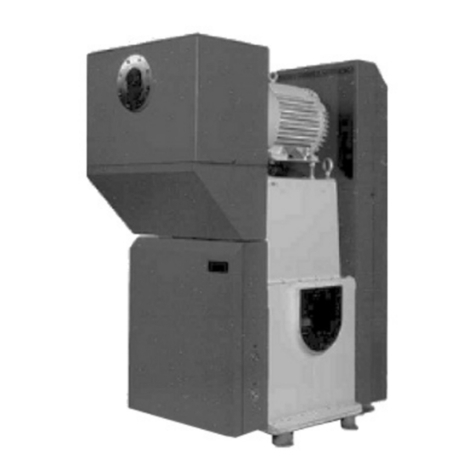
KTC pumps are supplied with vibramounts that enable them to run quietly and vibration free. The pump can be
operated on any floor that will support its weight. The pump must be installed on the vibramounts and flexible
connectors fitted in suction, discharge, water and electrical connections. It is not necessary to bolt the pump to the
floor.
Bolt the vibramounts to the four holes in the feet. On the KTC-112 all four vibramounts are the same. On the KTC-60,
install two green vibramounts at the beltguard end and two red vibramounts at the other end.
Care must be taken to set the pump down squarely on the mounts when installing the pump in operating position.
Suction Manifolding
Inlet manifolding should be sized and designed with three objectives in mind:
1) To avoid gas flow restrictions
2) To prevent pump fluids from entering the process chamber
3) To protect the pump from the ingestion of particulate matter
Under normal conditions, the diameter of the manifolding should not be less that the diameter of the pump
connection and the pipe length should be kept to a minimum.
Oil may splash from inside the pump through the suction port. Therefore, the suction line must be designed to
prevent oil from collecting there, and draining back to the system or process.
A flexible connection should be installed in the suction manifold to provide freedom for the vibramounts. The vacuum
piping must be well aligned with the pump connections as not to place a strain on the piping.
Provisions for gauge installation and any other drilling in the piping must be made prior to piping installation;
otherwise, drilling particles entering the piping could be entrained into the pump.
A vacuum isolation valve should be installed adjacent to the suction port to be used for leak checking, shutting down
the system, or blanking off the pump.
Before connection the suction manifolding, distribute 4 quarts of oil over the two high vacuum slide pins. This will
necessitate reaching through the suction port with a container and pouring oil directly onto the slide pins. Then rotate
the pump by hand a minimum of two revolutions to distribute the oil throughout the pump interior.
Discharge Manifolding
During the initial operation and as long thereafter as necessary, a fine mesh screen should be installed across the
inlet connection to prevent abrasive or solid particles left in the line from being sucked into the pump. This screen
can be removed when particles no longer accumulate. If particles continue to accumulate, a filter should be installed
in the line.
Discharge manifolding should be sized and designed to prevent the following:
A. Return of oil mist condensate to the pump
B. Oil loss
C. Oil mist in the discharged gas
Under the normal conditions, the diameter of the manifolding should not be less than the diameter of the pump
connection and the pipe length should be kept to a minimum.
The installation of a Kinney oil mist eliminator on the discharge is recommended for all applications. Oil that collects in
the eliminator should be returned to the pump. The optional oil return kit will allow oil to drain back into the separator
housing when the pump is operating a low pressure or when the pump is stopped. If the pump is to operate
continuously, or normal operating pressure is 10 Torr or higher consult Kinney for special recommendations on oil
return.
It may be necessary to pipe the pump exhaust fumes away from the pump area, such as out of doors. If this is done,
the piping must be arranged to prevent line condensation from returning to the pump. A flexible connector should be
fitted in the discharge line to provide freedom for the vibramounts.
Cooling Water
The KTC-60 is air-cooled and does not require cooling water.
On the KTC-112 the lubricating oil is cooled by a shell and tube heat exchanger mounted adjacent to the oil pump on
the KTC-112.
DO NOT ALLOW THE COOLING WATER TO FREEZE IN THE HEAT EXCHANGER.
Connect a water supply line with “on-off” valve to the water inlet, and an open drain to air the water outlet. The inlet