9
2INTRODUCTION
By adding a Geovane to your wind measurement campaign or to your wind turbine
nacelle you are guaranteed to get the most accurate True North orientation
measurement available on the market today.
There are two different models of the Geovane currently available: the Geovane for
met mast (Geovane MM) and the Geovane for wind turbine (Geovane WT).
Thanks to the Geovane MM, it has now become possible for wind farm developers to
get rid of the (up to now) greater uncertainty in traditional wind direction
measurements: the wind vane mounting bias.
The Geovane WT, for its part, allows for high precision yaw adjustment of wind turbines
with respect to True North. Aligning all your wind turbines towards the same reference
point enables the wind farm operator to compare yaw alignment during operation and
determine underperformance due to yaw misalignment.
Throughout this user guide, unless otherwise specified, the term “Geovane” will refer
indistinctly to both Geovane MM and Geovane WT.
2.1 About the Geovane
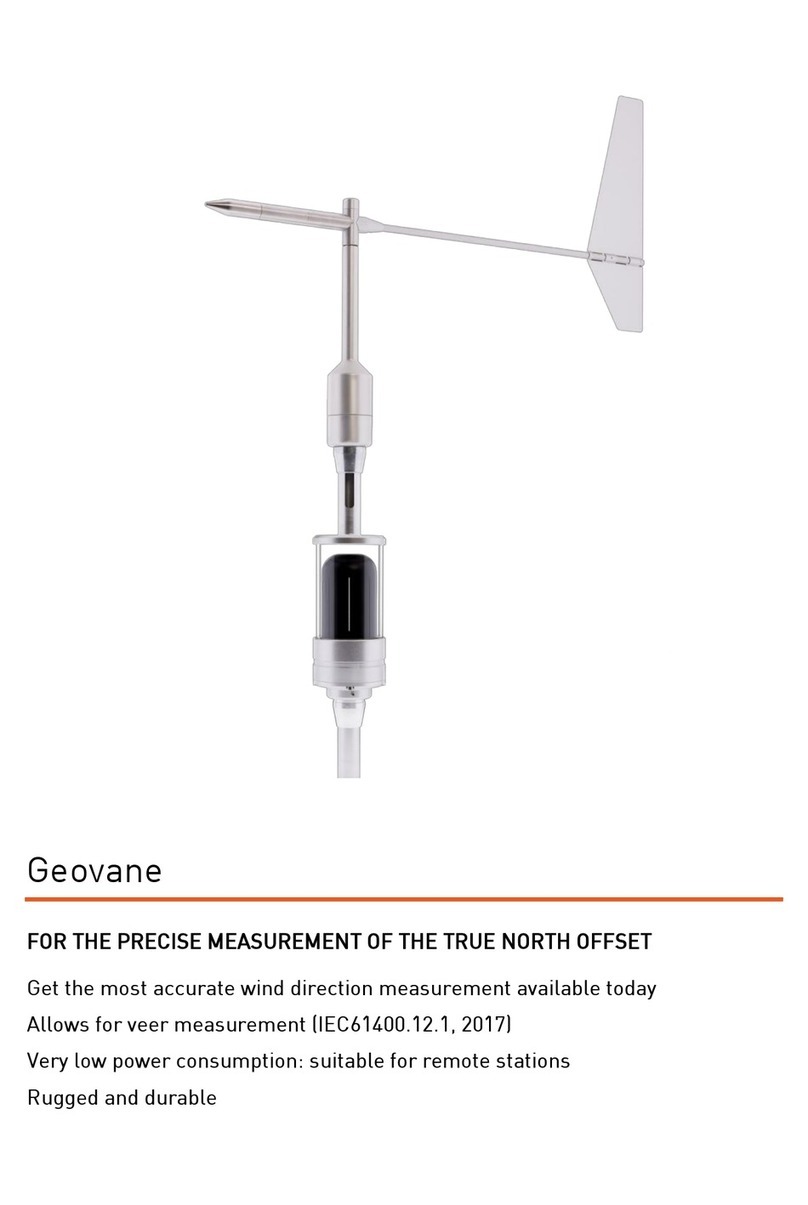
The Geovane is not a wind vane; therefore, it does not provide a wind direction
measurement. The Geovane is a solar compass, specifically designed to work in
conjunction with wind vanes, ultrasonic anemometers and remote sensing devices; and
to be permanently installed in any wind turbine’s nacelle.
Being equipped with high-resolution optoelectronic sensors, composed of 1024
photosensing pixels, the Geovane uses the Sun to measure the geographical orientation
from True North of the sensor/turbine coupled to it (refer to chapter 3 “Understanding
the True North orientation measurement output”).
The True North orientation is obtained by comparing the theoretical solar azimuth angle
calculated by the Geovane’s embedded processing unit with the observed azimuth value
read by its built-in photosensing pixels.
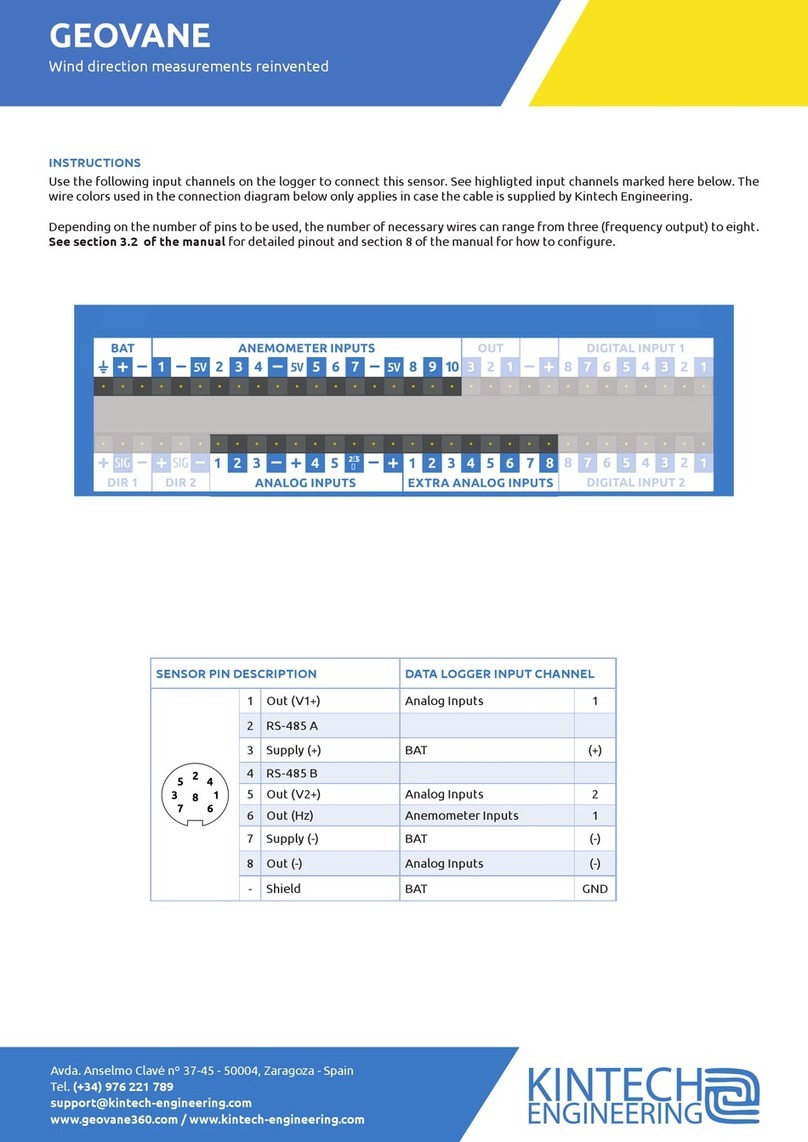
The Geovane offers three type of outputs: frequency, analog voltage and digital over a
RS-485 serial interface.
2.2 Geovane MM (for met mast)
The Geovane MMTM has been designed and engineered for its installation on wind
resource assessment met mast. It can be installed on existing met masts to
correct/verify previous wind direction datasets, in new installations for upcoming wind
measurement campaigns, power performance tests, site calibrations, etc.