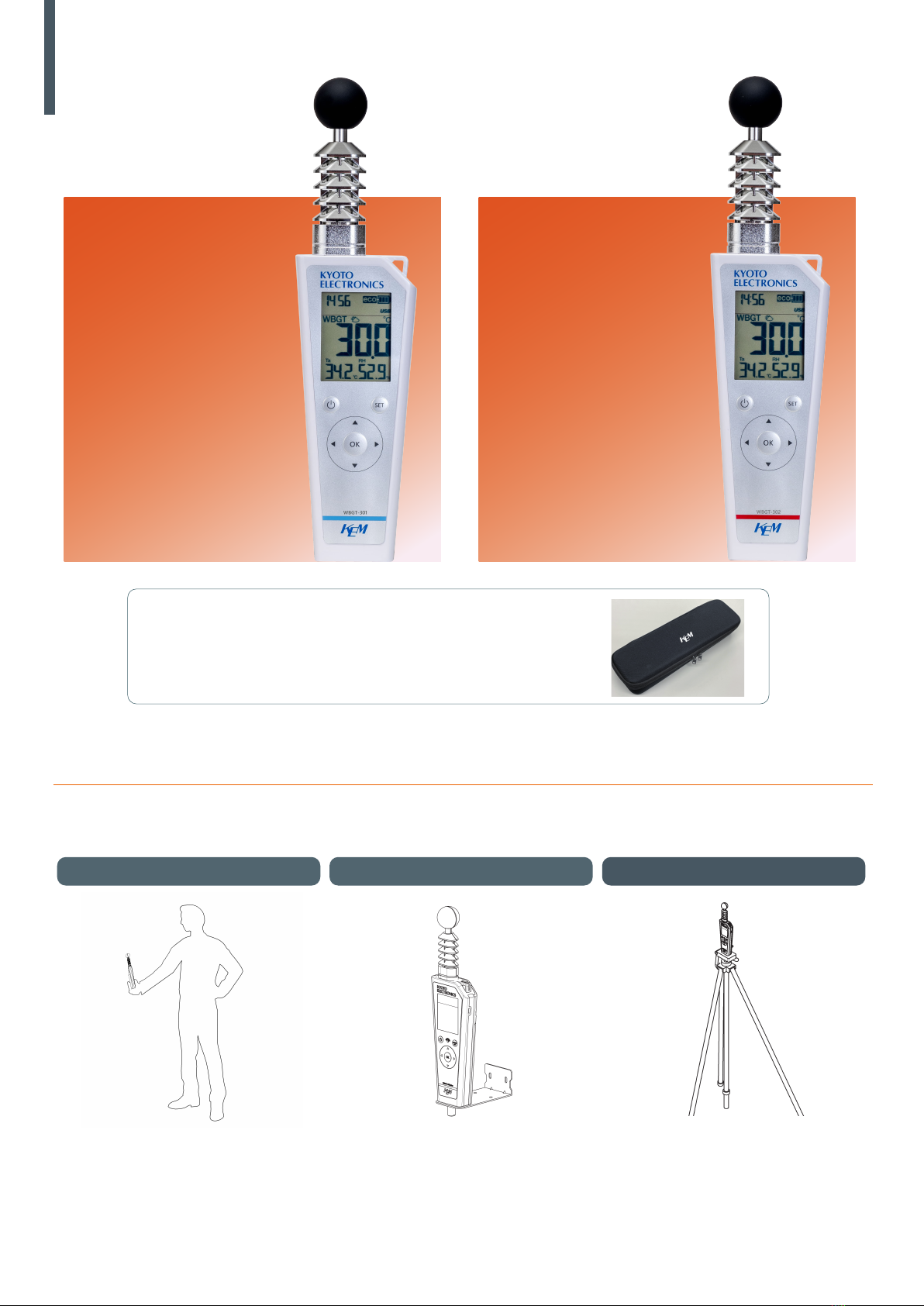
WBGT stands for “Wet Bulb Globe Temperature”, an index for predicting heat exchange between the human body
and the environment to understand the risk of heat stress. The index is calculated based on the relative humidity, air
temperature and radiant temperature of the environment and can be ascertained in both indoor and outdoor settings.
The WBGT index is widely applied in heat stress risk assessment, with its standards for measurement being outlined by
bodies such as the ISO and JIS.
What does “WBGT” mean?
Calculation of WBGT
WBGT values are calculated automatically by WBGT-300 series instruments according to the following formulae:
Assessing heat stress risk is quick & easy
with the WBGT-300 series meters
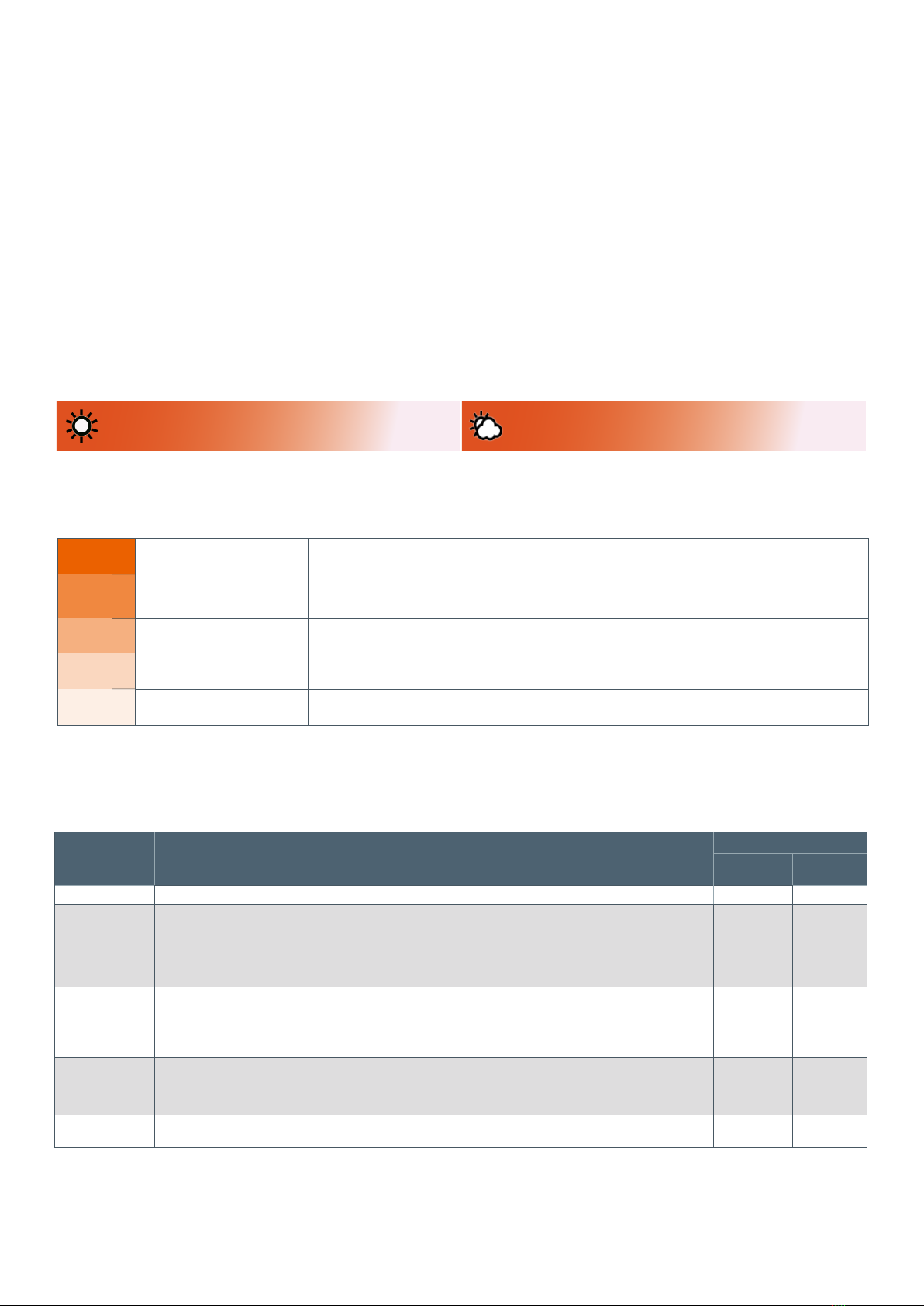
Acceptable Physical Work Intensity By WBGT*1
Heat Stress Prevention Guidelines For Exercise
Cancel All Exercise Outside special circumstances, all exercise and sporting activities should be canceled, especially those
involving children.
Strong Caution
(cease strenuous exercise)
The risk of heat stress is high, so refrain from activities that easily raise body temperature such as
strenuous exercise and endurance training. Rest and replenish fluids and electrolytes every 10-20
minutes. Persons with higher sensitivity to the heat*1are to lighten or cease activities.
Moderate Caution
(take periodic rests)
Heat stress risk increases in this range, so be assertive in taking periodic rests and replenishing fluids and
electrolytes. For strenuous exercise, rest every 30 minutes.
Low Caution
(proactively replenish fluids)
Death due to heat stress becomes possible from approximately WBGT 21°C.
Stay mindful of indicators of heat stroke and replenish fluids and electrolytes.
Safe Conditions
(replenish fluids when needed)
Under normal conditions, the risk of heat stress is low, but make sure to replenish fluids and electrolytes.
Heat stress can still occur in participants of non-professional “Public” marathons, so exercise caution.
Formula for environments exposed to sunlight
WBGT= 0.7Tw
+ 0.2Tg + 0.1Td
Tw = wet bulb temperature Tg = globe temperature Td = dry bulb temperature (ambient air temperature)
Formula for environments not exposed to sunlight
WBGT= 0.7Tw
+ 0.3Tg
WBGT °C
31
28
25
21
Category Example Physical Activities By Intensity Level
(Categories 0-4)
WBGT °C
Heat
acclimated*2 Not heat
acclimated
0: At Rest At rest, sitting in comfort ≤ 33 ≤ 32
1: Low
Metabolic Rate
Light manual labour (e.g. writing, typing, drawing, sewing, bookkeeping, etc.); labour using arms and
hands (e.g. use of small pliers, physical inspection, assembly, sorting light materials, etc.); labour using
arms and legs (e.g. operating a vehicle under normal conditions, footswitch and pedal operation, etc.).
Drilling small articles while standing; milling machine operation (small articles); coil wrapping (including
for small armatures); machine operation requiring light physical force; walking at or below 2.5km/h on
level ground.
≤ 30 ≤ 29
2: Medium
Metabolic Rate
Continuous hand and arm movement (e.g. hammering, filling ground, etc.); arm and leg movement
(e.g. driving a truck off-road, operation of a tractor or construction vehicle, etc.), use of arms and torso
(e.g. pneumatic hammer operation, tractor assembly, plastering, intermittent moderate lifting work,
weeding, harvesting produce, etc.); pushing and pulling a wheelbarrow or other cart type with a light
load; smithing/forging; walking between 2.5-5.5km/h on level ground.
≤ 28 ≤ 26
3: High
Metabolic Rate
Use of arms and torso with high intensity (e.g. carrying heavy objects, using a heavy hammer, shoveling,
sawing, planing or chiseling hard wood, mowing, digging, etc.); walking between 5.5-7.0km/h on level
ground. Pushing and pulling a wheelbarrow or other cart type with a heavy load, grinding metal, and
stacking concrete blocks.
≤ 26 ≤ 23
4: Very High
Metabolic Rate
Working at a very high intensity (e.g. swinging an axe, shoveling heavy loads/digging hard ground,
climbing stairs); running on level ground at 7km/h or faster. ≤ 25 ≤ 20
Adapted from “Table 1-1: Outline of basic measures for preventing heatstroke in the workplace” published by the Ministry of Health, Labour and Welfare (Japan) and
“Table of WBGT Heat Stress Index Reference Values” appearing in Appendix A of JIS (Japan Industry Standards) Z 8504, inserting concrete examples of physical activities
in place of metabolic rate data.
*1 This table intends to provide a reference for the maximum allowable WBGT for dierent work intensities to prevent heat stress.
It is not a guarantee of safety, so always consult your physician and workplace health and safety ocer to best understand individual risks in your work environment.
*2 “Heat Acclimated” refers to persons that within one week prior to assessment were deemed to be acclimated to working in an equivalent or harsher thermal
environment to that used in the test.
Adapted from content appearing on the ocial Japanese Sports Association website
*1 Persons who are obese, have a below-average tolerance of typical outdoor heat, and/or have low physical endurance