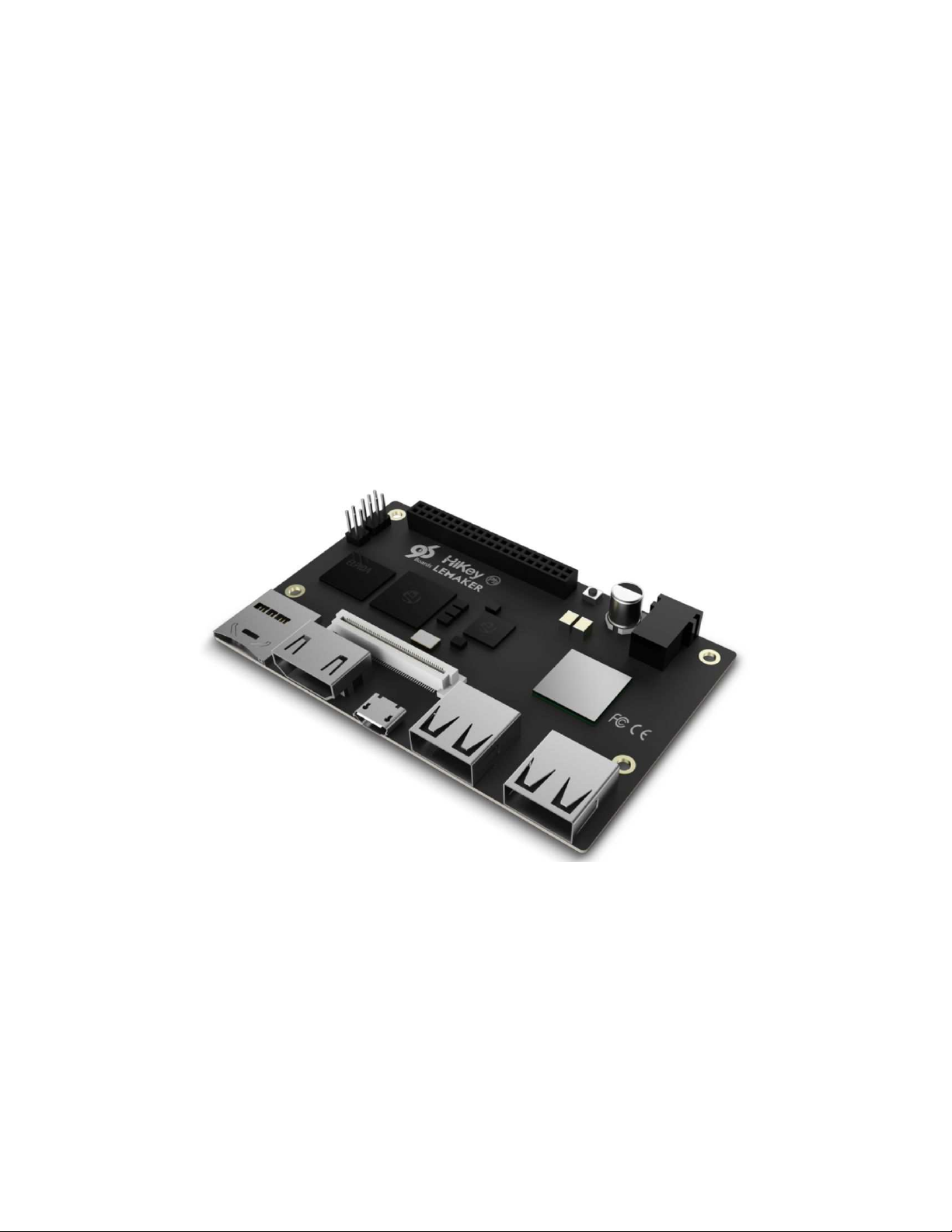
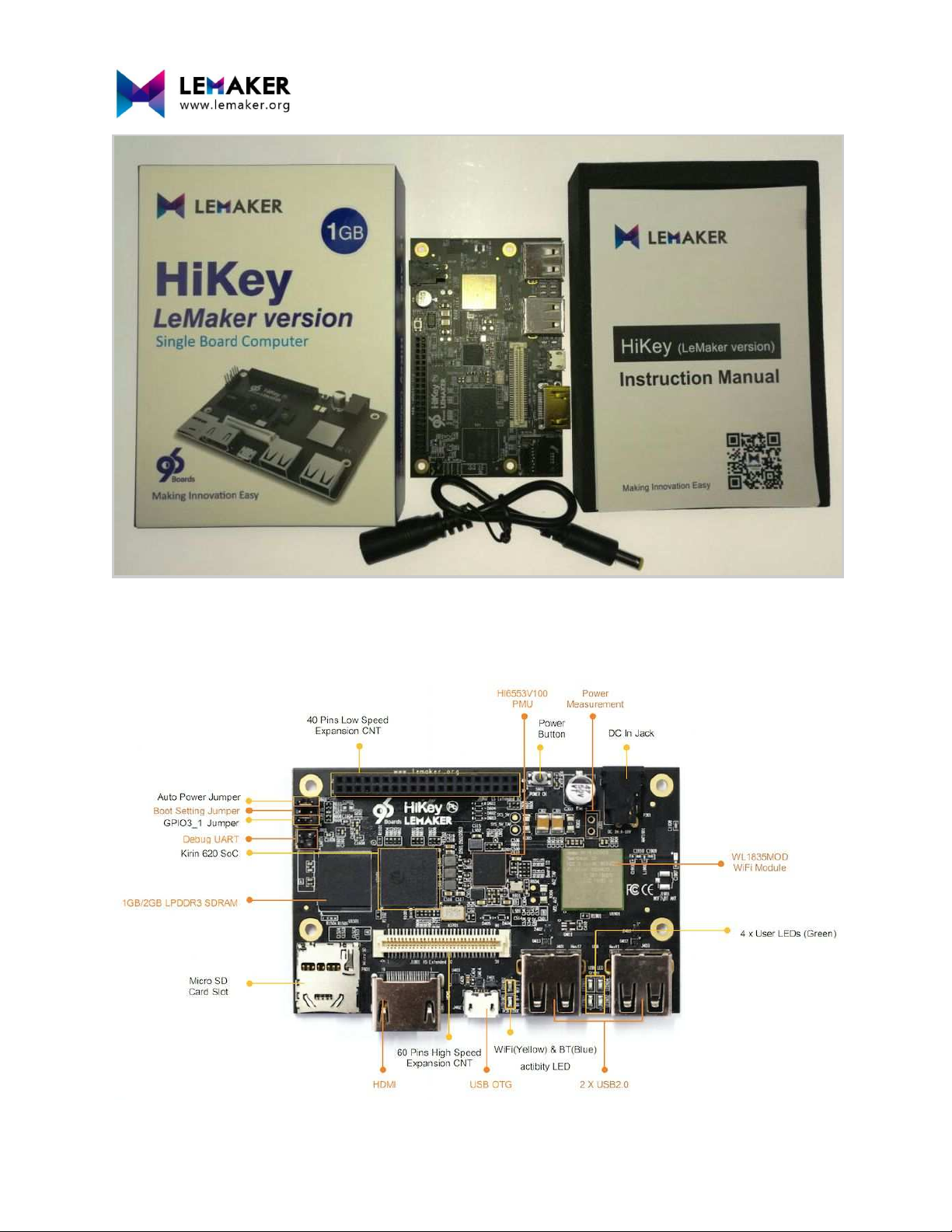
into the OTG port then the Type A ports and the expansion bus port will be
automatically disabled.
For the microUSB OTG port a single Low Speed (1.5Mbit/sec), Full Speed
(12Mbit/sec) or High Speed (480Mbit/sec) device is supported.
For the USB host ports all attached USB devices must be one of the following three
options:
Low Speed (1.5Mbit/sec) and Full Speed (12Mbit/sec) devices, or
High Speed devices (480Mbit/sec).
If a mixture of High Speed and Low/Full speed devices are attached the devices will not
operate correctly. This also applies if any hubs are attached to the ports.
First Power ON
To start the board, follow these simple steps:
step 1.Connect the HDMI cable to the HiKey HDMI connector and to the LCD
Monitor.
step 2.Connect the keyboard to the boards USB connector and the mouse to the USB
connector.
step 3.Closed the auto power jumper, please see the “Jumpers/Switch
Configuration”.
step 4.Connect the power supply to power connector P301.
Once you plug the power supply into a power outlet the board will start the booting
process, and you should see Debian/Android boot up.
Component Details
Processor
The HiSilicon Kirin 620 SoC is an Integrated octa-core 64-bit ARM Cortex-A53 application
processor, supports 533MHz LPDDR2, 667MHz LPDDR3, and 800MHz LPDDR3 interface,
MIPI camera serial interface, embedded Mali450-MP4 GPU,1080p video encode/decode,
GPS, WIFI, Bluetooth 4.1, OpenGL ES 1.1/2.0,OpenVG 1.1, ARM TrustZone security
mechanism.
PMIC
HI6553V100 is a power management chip, with integrated 4-channel BUCK, 24 LDO, 1 LVS
(Low Voltage Switch), a 12-channel HKADC, and 5-channel LED current driver ports. It
supports under-voltage, over-voltage, over-heat, over-current protection.
BUCK1 supports 3.5A output capacity, BUCK2 has 3A output capacity, while BUCK3 and
BUCK4 have 1A output capability.
9/22