Leonics Explorer User manual

If the EXPLORER UPS does not operate properly and you cannot
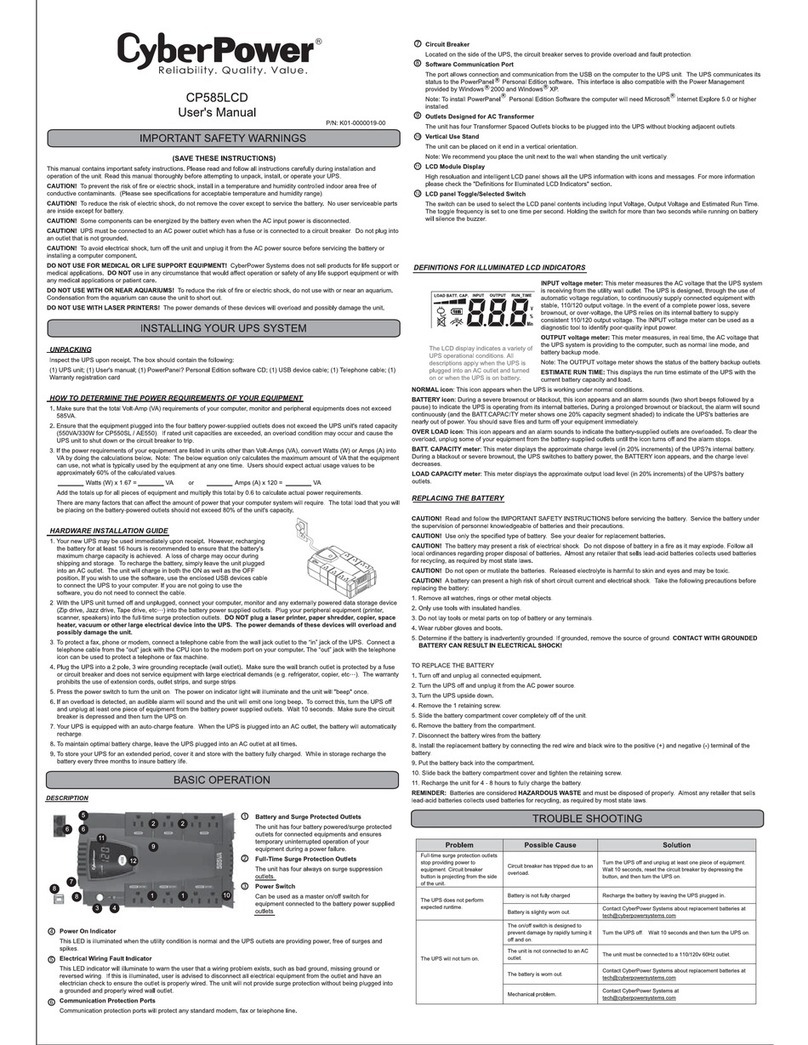
solve the problem using the troubleshooting information in this user’s
guide, please contact your LEONICS local distributors,LEONICS
LEN.MAN.UPS.114 Rev.3.00/2010
USER'S GUIDE
■
www.leonics.com
■

2.4 Remote port: The port to connect to a remote control (optional).
2.5 Surge Protection for Telephone Line / Modem / ADSL (available in specific model only):
The ports to plug in telephone jacks before fax machine, modem, telephone, computer or
ADSL equipment in order to protect them from surge.
2.6 No load shutdown setting switch (available in specific model only): The switch to enable
automatic shutdown when there is no load and power fails (No load means the total power of
all loads are lower than 60 W. The factory default setting is OFF or disabled).
2.7 USB port (available in specific model only): The communication port for connecting the
UPS to PC to transmit the signal via Easy-Mon X software.
2.8 AC input power cord: The input power cord to connect to utility line;user can place the input
power cord to the EXPLORER UPS either top direction or left direction in the power cord tray.
2.9 Overload breaker: Over current or short circuit protection component.
2.10 Battery cover: Slide this cover to replace the battery.
2.11 UPS BACKUP outlet: The output outlets for connecting the equipment such as computers,
monitors, modem, printer and fax machine to the UPS backup power system.
2.12 SURGE ONLY outlet: The extra outlets which are connected to the surge protection system
for the equipment that do not require backup power such as laser printer. These output
outlet do not supply (backup) power when utility line fails.
3.1 Connect a USB signal cable to PC at USB port of the UPS and
communicate with the PC via Easy-Mon X software.
Note: User can find Easy-Mon X software from the CD-ROM or
download section of www.leonics.com.
3.2 Connect a remote control jack (option) at "Remote" port. If there is
no remote control to be connected, user can connect a cable from
telephone, fax machine, modem or ADSL equipment to protect them
from surge.
The EXPLORER UPS is a compact uninterruptible power supply for office automation
equipment (computers and peripherals such as monitors, modem, printers, fax machines, etc.). Its
major function is to eliminate any power problems such as a blackout,brown out,surge,spike,noise,
etc. that might cause malfunction of the load causing work interruption. With its Advanced Micro-
processor Control, when the UPS detects any abnormal conditions, it will respond
instantaneously. It also has special features: AVR (Automatic Voltage Regulator or stabilizer), Surge
Suppression and Backup power supply system.
INTRODUCTION
PHYSICAL DESCRIPTION
2.1POWER button:The button to turn on and turn
off the UPS.
2.2 LINE indicator: Indicates that the UPS is
operating under normal condition.
2.3ALARM indicator: Indicates the UPS operating
status when power fails or there is fault. The
following tables show the meaning of the
indicators and alarm.
LINE ALARM Light condition Audible alarm UPS status
When user starts the UPS or the UPS starts automatically after the utility power returns to normal.
Green Red Blink 1 times - Battery is in a good condition.
-Red Lit for 2 seconds Long beep for 2 seconds. Battery voltage is very low.
When the UPS operating.
Green - Lit - The UPS is operating normally.
Green - Blink - The UPS received the shutdown
command from the computer and
it will shut down in 2 minutes (option).
-Red Lit 1 second Beep every 3 seconds Black out or Power fails.The UPS is
off 3 seconds supplying backup power from battery.
-Red Lit 0.5 second Beep every 0.5 seconds Battery backup power
off 0.5 seconds is going to run out.
-Red Lit Long beep UPS output is short circuit.
The UPS will automatically shut down.
INSTALLATION AND OPERATION
3.3 Connect a telephone cable at Surge Protection for Tel. / Modem / ADSL port.
IN : Connect telephone line to the UPS.
OUT : Connect telephone line from the UPS to the input socket of telephone, fax machine,
modem or ADSL equipment.

Note: To gain proper benefit from telephone line surge protection,
your electricity system should have an electric ground system.
If there is no electric ground, there can be data transferring
problems and loss of protection of the connecting devices.
3.4 Set the NOLOAD SHUTDOWN switch at ‘ ON ‘ as shown
( available in specific model only ) , if you want the UPS to shutdown
itself automatically in backup mode when the total load power
consumption is less than 60 Watt in order to save energy and prolong
battery life (The factory default setting is OFF).
If your load is a PABX which consumes power less than 60 W,
set the NO LOAD SHUTDOWN switch at 'OFF'.
3.5 Plug the loads such as computers, printers, modem and etc. to UPS BACKUP outlets.
Caution : Total Load Power consumption should not exceed UPS rated power.
3.6 Plug in the non-required backup power loads such as laser printer at SURGE ONLY outlet which
are connected surge protection circuit. These outlet do not supply backup power when
utility power fails.
3.7 Plug in AC input power cord of the UPS to utility power.
3.8 Press power button to turn on the UPS and then turn on the loads.
Note: Once Power button is turned on ,user can turn on and turn off the UPS by remote
control (Optional).
3.9 When the battery is already charged, user can test the UPS as follow
3.9.1 Turn on the UPS and wait until the LINE indicator is lit.
3.9.2 Turn on the loads.
3.9.3 Unplug the UPS power cord from utility line to simulate blackout.
3.9.4 UPS supplies backup power to the loads automatically. LINE indicator is OFF, alarm
sounds and ALARM indicator blinks slowly simultaneously. Loads consume power
from the UPS.
3.9.5 Plug in the UPS power cord to utility power.
3.9.6 No alarm sound,ALARM indicator is OFF and LINE indicator is lit. Make sure that the
loads operate normally when power fails and is normal.
3.10 After finishing your work, turn off all loads and turn off the UPS to prevent the UPS from
supplying backup power when there is no load and power fails.
3.11 If you have to store UPS for a long period of time, the UPS need to be recharged every three
months to preserve the condition of the internal battery as follow
If the EXPLORER UPS does not operate properly and you cannot solve the problem using
the troubleshooting information in this user’s guide,please contact your LEONICS local distributors,
TROUBLESHOOTING
3.11.1 Plug in the UPS power cord to utility line.
3.11.2 Turn on the POWER button
3.11.3 Leave the UPS connected to utility power for at least 8 hours.
UPS power cord is not properly
plugged into utility outlet
socket.
power supplies to AC input
power cord.
Overload breaker tripped.
UPS power cord is not properly
plugged into utility outlet
socket.
Main AC breaker is tripped.
UPS is overloaded or short
circuit.
The UPS is overloaded.
Symptoms Possible causes Solutions
Properly plug the UPSpower
cord.
Move the UPS to another wall
outlet. If the symptom persists,
please contact us.
Press the overload breaker to
reset. If the symptom persists,
please contact us.
Properly plug the UPS power
cord.
Reduce the loads that connect
to the same wall outlet as the
UPS or move the UPS to another
wall outlet.
1. Turn off the UPS and reduce
some loads until the total
power consumption of all
loads is less than UPS
power rating.
2. Press the overload breaker
to reset.
Turn off the UPS and reduce
some loads until the total load
power consumption is less than
UPS power rating.
Turned on power buttons. LINE
indicator is off and UPS alarm
sounds. But the UPS operates
normally.
ALARM indicator blinks and
alarm sounds simultaneously.
Overload breaker does not trip.
ALARM indicator is lit and alarm
sound long beep.The UPS does
not operate. Overload breaker
tripped.
During blackout, ALARM
indicator and alarm sound are
still ON until the UPS shutdown
itself automatically. Overload
breaker does not trip .

The UPS runs out of backup
power.
The UPS is overloaded.
Battery deteriorates.
-The USB cable is
disconnected and
reconnected while the
software is running.
-The USB cable is not properly
plugged.
Symptoms Possible causes Solutions
When black out, LINE indicator,
ALARM indicator and alarm
sound are OFF. The UPS does
not supply backup power.
UPS supplies backup power
shorter than specific time or
very short time.
Easy-Mon X software cannot
communicate with the UPS or
the software shows
"Communication Error".
Once the utility power turns
back to normal,turn on the UPS
at least 8 hours to recharge its
battery.
Reduce some loads until the
total load power consumption
is less than UPS power rating.
Turn on the UPS at least 8 hours
to recharge its battery, then test
backup power If the symptom
persists, please contact us.
Exit Easy-Mon X software
and reconnect the USB cable
properly. Then, restart the
computer and reload the
software.
BATTERY REPLACEMENT
Caution: Although battery replacement can be made when the UPS is operating, we
recommend you to turn off all loads and the UPS before replace the battery
for your own safety.
5.1 Press and slide down the battery cover to open to battery compartment. Then, lift another
end of the UPS to let the battery come out.
5.2 Disconnect the black and red wires from the battery terminals.Then
pull the battery out and replace with a new one.
Note: Battery can be recycled and needs proper elimination.
It consists of lead which harms to our environment and
healths. Please return the battery to us or our service
center.
5.3 Reconnect the black (-) wire to the black terminal and red (+) wire to the red terminal.
Caution : - Keep the red and black wire terminals apart, they might short circuit.
-The replacement battery must be same type and same rating as original.
5.4 Replace the battery cover and continue using the UPS normally.
SOFTWARE INSTALLATION
The Easy-Mon X software is contained in the CD-ROM which bundles with the product
(available in specific model only). It is also available to download at www.leonics.com.
Note: Connect the USB cable first. Then, turn on the UPS and computer to install
the Easy-Mon X software.
6.1 In case install the Easy-Mon X software from CD-ROM: Insert the Easy-Mon X Software CD into
CD-ROM drive. LEONICS presentation will show on the computer monitor. Press ESC button
on the keyboard to exit the Presentation. The Easy-Mon CD window will show on screen. Click
"Easy-Mon X Install for USB only" button, then select "How to install USB driver" to view USB
driver installation procedure and then follow the instruction guided on screen to install
USB driver and restart the computer.
6.2 In case download the Easy-Mon X software from internet: Click Download menu and click
UPS link under Power Quality Products. You will reach software download page. Select the
UPS model and follow the instruction guided on screen to download the USB driver and
Easy- Mon X software . after than install Easy - Mon X and restart the computer.
6.3 When Easy-Mon X is completely installed, go to Start > All Programs > Easy-Mon X > Setup
Easy-Mon X and click the “Detect“ button to search for UPS and communication port
automatically.
6.4 The location of UPS communication port has been found. Set UPS shutdown time to
shutdown when the battery level is low or utility power fails, then click OK. Save the setting
and exit Set up Easy-Mon X .
6.5 Run the Easy-Mon X Spy program to monitor power data.
Other Leonics UPS manuals