manuals.online logo
Brands
  1. Home
  2. •
  3. Brands
  4. •
  5. LEYBOLD
  6. •
  7. Test Equipment
  8. •
  9. LEYBOLD 451281 User manual

LEYBOLD 451281 User manual

This manual suits for next models

1

Popular Test Equipment manuals by other brands

Ambit P.F. Series instruction manual

Ambit

Ambit P.F. Series instruction manual

Megger BMM500 Series user guide

Megger

Megger BMM500 Series user guide

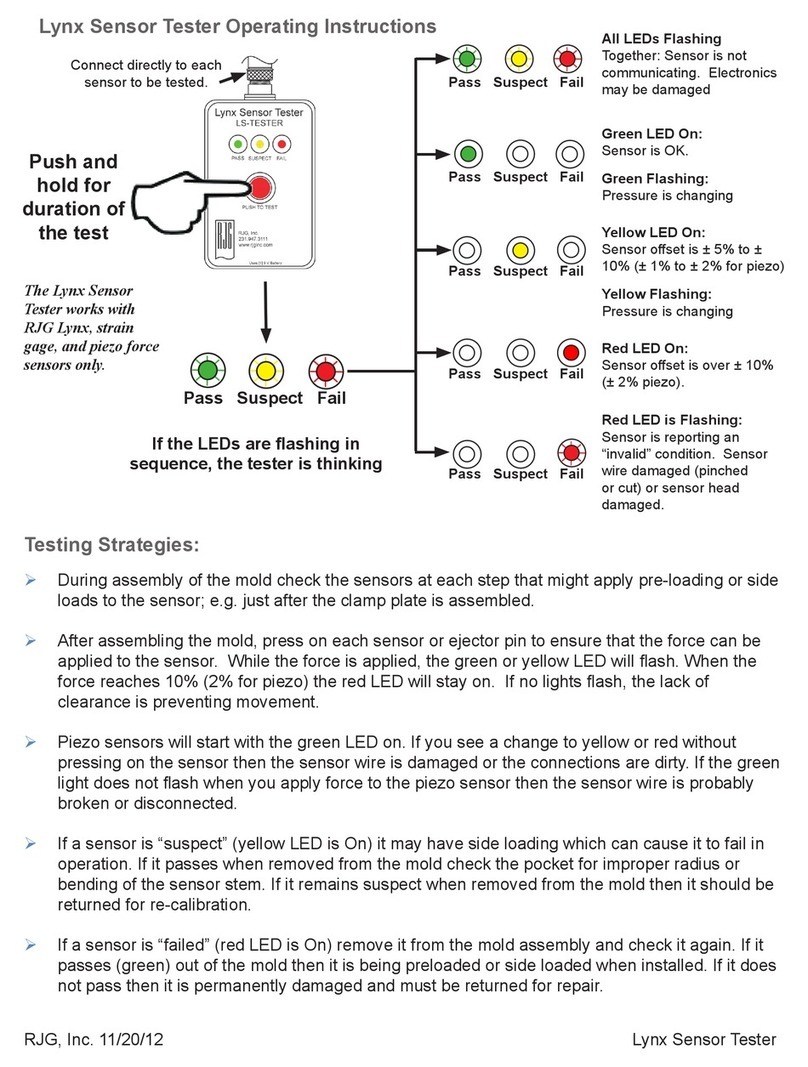
RJG Lynx Sensor Tester operating instructions

RJG

RJG Lynx Sensor Tester operating instructions

Mark-10 TT02 Series user guide

Mark-10

Mark-10 TT02 Series user guide

Martel 3001 Operator's manual

Martel

Martel 3001 Operator's manual

ElproSys DiagProg4 instruction manual

ElproSys

ElproSys DiagProg4 instruction manual

Redtech TRAILERteck T05 user manual

Redtech

Redtech TRAILERteck T05 user manual

Venmar AVS Constructo 1.0 HRV user guide

Venmar

Venmar AVS Constructo 1.0 HRV user guide

Test Instrument Solutions SafetyPAT operating manual

Test Instrument Solutions

Test Instrument Solutions SafetyPAT operating manual

Hanna Instruments HI 38078 instruction manual

Hanna Instruments

Hanna Instruments HI 38078 instruction manual

Kistler 5495C Series instruction manual

Kistler

Kistler 5495C Series instruction manual

Waygate Technologies DM5E Basic quick start guide

Waygate Technologies

Waygate Technologies DM5E Basic quick start guide

StoneL DeviceNet CK464002A manual

StoneL

StoneL DeviceNet CK464002A manual

Seica RAPID 220 Site preparation guide

Seica

Seica RAPID 220 Site preparation guide

Kingfisher KI7400 Series Training manual

Kingfisher

Kingfisher KI7400 Series Training manual

Kurth Electronic CCTS-03 operating manual

Kurth Electronic

Kurth Electronic CCTS-03 operating manual

SMART KANAAD SBT XTREME 3G Series user manual

SMART

SMART KANAAD SBT XTREME 3G Series user manual

Agilent Technologies BERT Serial Getting started

Agilent Technologies

Agilent Technologies BERT Serial Getting started

manuals.online logo
manuals.online logoBrands
  • About & Mission
  • Contact us
  • Privacy Policy
  • Terms and Conditions

Copyright 2025 Manuals.Online. All Rights Reserved.

Physics Chemistry ⋅Biology Technics LEYBOLD DIDACTIC GMBH
11/97-kem-
Instruction sheet 451 281
451 292
The stroboscope with microprocessor-controlled xenon flash
tube can be used
•to observe rapid periodic motions, e.g. oscillations of a string,
as a stationary image
•to measure the frequency of periodic mechanical phenomena
(1 ... 330 Hz) and for speed measurements (60 ... 19,800 rpm)
•to observe a rapid motion process at different points in time,
e.g. during projection.
The stroboscope is designed to permit shifting of the flash pha-
se. This allows you to vary the observation point during a peri-
odic motion. The frequency and phase angle can be read off in
a display.
1 Safety notes
2 Description, scope of supply, technical data
1
-
7
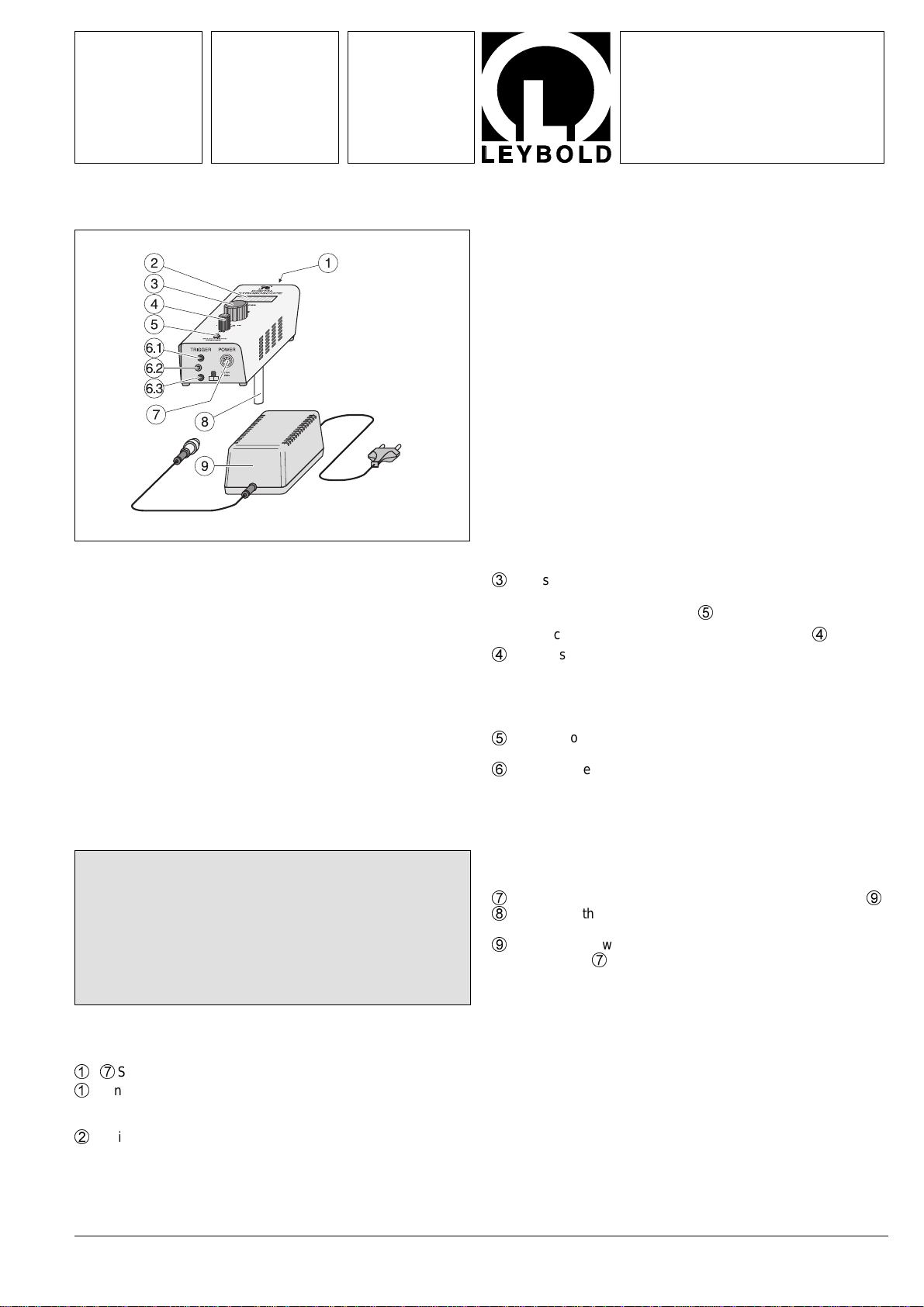
Stroboscope
1
Xenon flash tube, XSU 40, mounted in reflector;
behind removable plastic window,
Replacement: spare flash tube (451 292)
2
Digital display, 5-digit, for frequency and phase angle
3
Adjusting knob for continuous adjustment of frequency and
phase angle, ranges selectable
- Select the quantity with key
5
- Select the measuringrange with rotary switch
4
4
Rotary switch FPS (flashes per second):
1 - 1001...100 Hz
30 - 33030...330 Hz
OFF: switch off device
5
Pushbutton for toggling display between frequency and
phase angle
6
4-mm sockets for external control
(6.1) Output: 12 V DC (with respect to ground (6.3))
for connection to (6.2) via external switch (e.g. light
barrier 337 46)
(6.2) Signal input for external triggering of light flashes
connection voltage with respect to ground (6.3):
3...20 V
(6.3) Ground (0 V)
7
Connection socket for supply voltage from power supply
9
8
Stand rod, threaded
length: 125 mm, diameter: 10 mm, thread M6
9
Power supply with mains cable and connecting lead with
DIN plug for
7
Mains voltage: 85...250 V , 50/60 Hz, 30 W
Output voltage: 24 V DC, 1 A
Not shown: carrier bag
Dimensions:
Stroboscope: 81mm x 56 mm x 194mm
Power supply: 14 mm x 7 mm x 8 mm
Total weight: 0.6 kg
Stroboscope, 1...330 Hz
Spare Flash Tube
Fig. 1
•During operation, interference may occur in transmitting
and receiving devices or components. In this case, discon-
tinue using the stroboscope immediately.
Never leave the stroboscope on longer than is required to
carry out the measurement, and keep this period as short
as possible.
•Do not touch the spare flash tube with your bare fingers.

LEYBOLD DIDACTIC GMBH ⋅Leyboldstrasse 1 ⋅D-50354 Hürth ⋅Phone (02233) 604-0 ⋅Telefax (02233) 604-222 ⋅e-mail: [email protected]
©byLeyboldDidacticGmbH PrintedintheFederalRepublicof Germany
Technical alterations reserved
3Operation
Set the stroboscope to the desired range using the rotary switch
4
. Following a brief self-test (approx.2 s), the display
2
shows
the last frequency selected with knob
3
and the stroboscope
begins to flash at this frequency.
To change the flash frequency, turn knob
3
:
to change the flash rate in small steps (0.01 Hz)
– turn slowly
to change the flash rate in large steps
– turn rapidly.
To measure frequencies of periodic motions, begin with a low
frequency and increase this until you can observe a recogniza-
ble or marked position in the moving system as stationary with
respect to two (opposing) points. Then reduce the frequency by
one half and carefully adjust it until you once again obtain a
stationary image.
For rotational motions, the rotational speed can be calculated
as: 1 Hz
=
1 rps = 60 rpm.
Flash phase:
To shift the flashing point while observing a stationary image,
you can vary the blitz phase. To do this, press pushbutton
5
.
The message “PH.A” briefly appears in the display
2
, followed
by the last phase angle selected. Turn knob
3
to select the
phase angle:
to change the phase angle in small steps (0.1°)
– turn slowly
to change the phase angle in large steps
– turn rapidly
To toggle to the frequency, press pushbutton
5
again. The
message “Fr.E” briefly appears in the display
2
, followed by
the frequency.
External triggering:
To externally trigger flashes, connect signal input socket (6.2).
You can do this by connecting a voltage source, ideally a
function generator, to sockets (6.2) and (6.3) or by connecting
socket (6.1) to (6.2) using a switch or a forked light barrier (Fig.
2).
The external frequency appears in display
2
. Flashing of dis-
play
2
indicates that the applied frequency is out of the range
set using rotary switch
4
.
The device automatically switches to the external timing as
soon as a timing signal (voltage) is present. To reset the device
to internal timing (when no external signal is present), manipu-
late knob
3
; after a brief interval the last set flash frequency is
restored.
4 Replacing the flash tube
Remove the plastic window and take out the defective flash
tube. Carefully insert the spare flash tube; do not touch the flash
tube directly with your fingers, to prevent contamination of the
tube. Then remount the plastic window.
Fig. 2