10 | P a g e
IOM Motomouth 2017 rev 5
www.limaflo.com
MOTOMOUTH CONTROL CONCEPT
The first Synthesizers for commercial use were monophonic and designed to be played from a
monophonic voltage generating keyboard. The keyboards basically used a ‘resistor ladder’ for
the keys to generate an oscillator control voltage for each note. This method, of course, was
adequate to play a monophonic oscillator. However, it was important to have a note-on gate, so
that envelope generators could be triggered for the various amplifiers and filters. Each time the
key is pressed, a gate voltage goes high (or low), where this is also used for setting things like
the sustain level. When the key is released, the gate voltage goes low, which is useful for
instigating the ‘Release’ part of the envelope. The gate trigger is simply a switch (or a change in
voltage detector) on each key that is made (or broken) when the key is pressed, and this is
configured as OR logic. As long as the note is held, the gate remains ON. When one key is
pressed, the gate is ON, when the key is released, the gate is OFF. However, when one note is
pressed, the gate is ON, and if another note is pressed without releasing the first note, the gate
remains ON. So you can see that the envelopes will not be retriggered, and it remains at the
Sustain point in the envelope, for this type of transition. This is a particularly useful method for
adding expression into the music –by default. If you want to trigger the envelopes on each key
press, then simply play each note with a gap (OFF) in between each note.
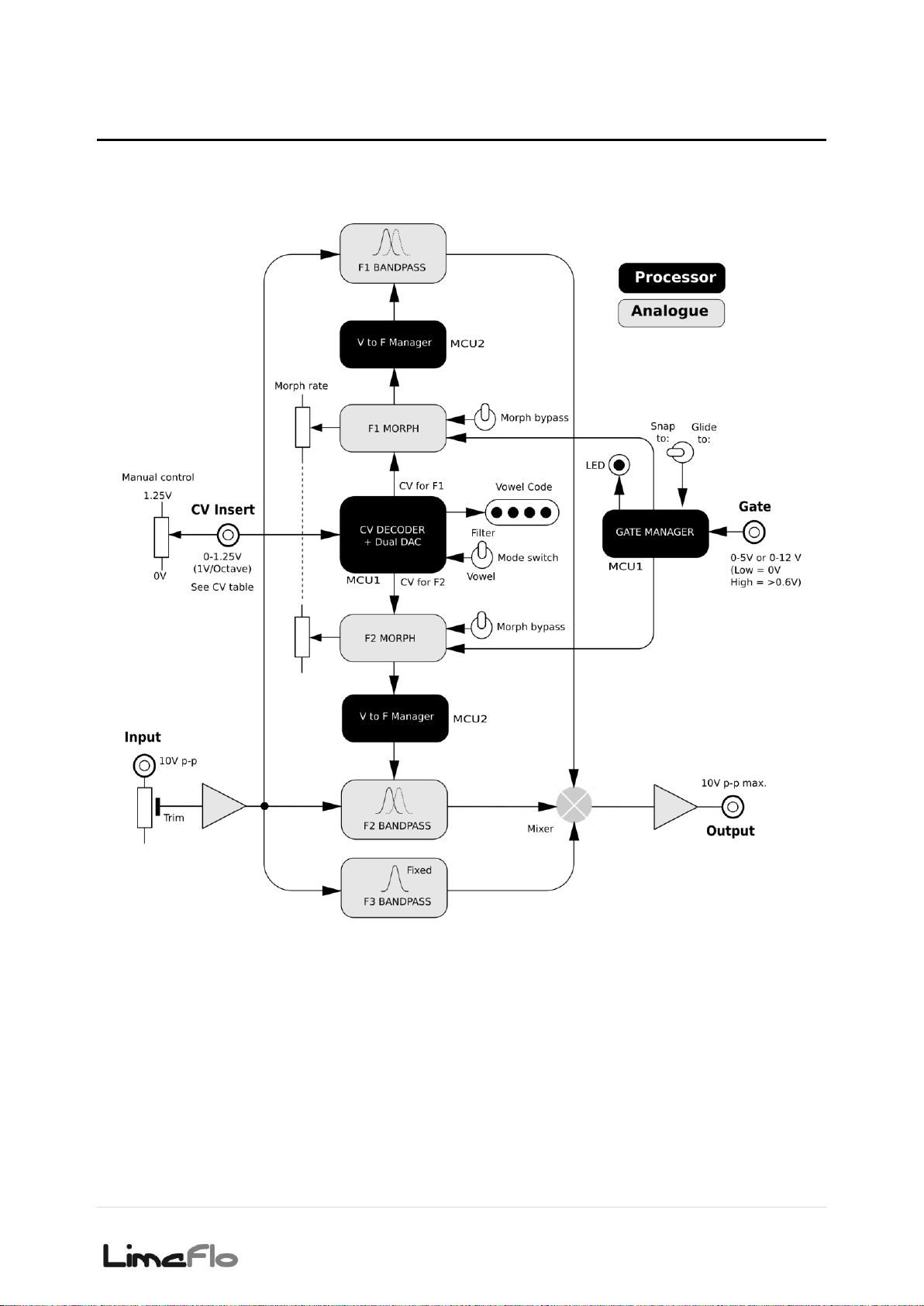
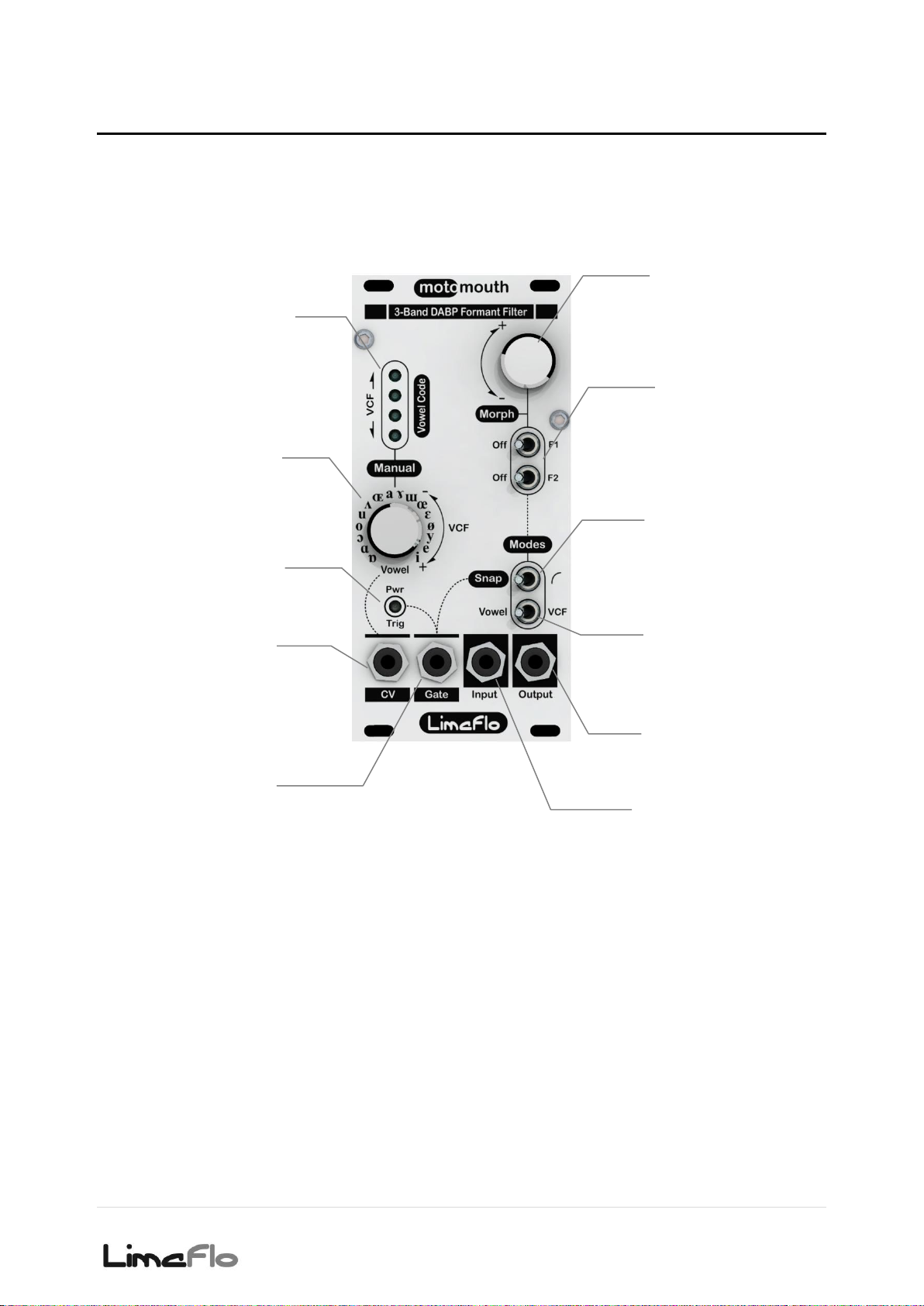
Motomouth uses this principle too, in a rather useful way, because it uses a gate trigger (leading
edge) to bypass the morphing function, so that is ‘Snaps’ to the current input voltage (CV).
Having a slewed ‘morph’ to each vowel makes the transition sound more natural and realistic.
However, from one vowel that may be off, due to the VCA being off, as soon as you go to
another vowel, you often don’t want it to slew, you want it to instantly start at that vowel, and this
is achieved by the ‘snap’ function.
Timing example