Luma 300 Series Cube User manual

300 Series Cube
Wireless HD Surveillance Camera
with Microphone
Installation
Manual
®
Important!
Ensure your NVR
has the latest
firmware!

2
Luma 300 Series Wi-Fi Cube IP Camera
Read this page before you go to the job site!
For maximum control and convenience, install your camera with a connection to the Internet via your NVR
or through a local network router. This allows you to use OvrC, a powerful remote maintenance tool. See
OvrC.com for details. In addition, your client can use the Luma Surveillance mobile app to check on the camera
from anywhere.
For installation using this guide, you must be able to access this camera through a personal computer. If your
surveillance system is not on a network, you’ll have to use the NVR’s local interface for installation. See the NVR
user’s manual for details.
Required Equipment
}A network connection (and an NVR, if desired)
}Admin rights to a computer that can access the network
}Mobile phone with the Luma Surveillance mobile app (recommended) or CCTV tester
}Power source: either PoE or standard wall outlet
}Phillips screwdriver
Additional Resources
If desired, you can add an SD card (up to 128 GB) to the camera. An SD card or a network drive is required if you
want to keep a log of the camera’s activities.
You can acquire a PDF of the web interface manual and other materials from the product page at SnapAV.com.

3
Luma 300 Series Wi-Fi Cube IP Camera
Safety Tips
}Handle this device with care.
}Do not strike or shake this device.
}Do not operate this device beyond its specified power source ratings.
}Protect the power cord from being stepped on or pinched, particularly where it connects to the device and
to the power outlet.
}Do not use this device near any heat sources such as radiators, heat registers, stoves, or other such heat-
generating equipment.
}The performance and lifespan of the SD card (if used) is affected by temperature. For best results, use this
device in temperatures ranging from -14–140 °F.
}Clean this device with a dry lens cloth. Do not use strong or abrasive detergents when cleaning the device,
especially the lens. If dirt is hard to remove, use a mild detergent and wipe gently.
}Make a note of the configuration settings and save them. This helps when changing the configuration,
when upgrading the device, or with recovery if unexpected failure or trouble occurs.

4
Luma 300 Series Wi-Fi Cube IP Camera
Installation
Before you start, ensure that the device is in good condition and all the assembly parts are included. Also ensure
that your recorder (if you are using one) has the very latest firmware. Use OvrC to update the firmware, or
consult your NVR manual.
}Ensure the mounting surface is strong enough to hold three times the weight of the camera and the mount.
}If the mounting surface is cement, use the included expansion screws to install the camera. If mounting to
a wood surface, use self-tapping wood screws (not included) to secure the camera.
}If the product does not function properly, please contact technical support. Do not disassemble the camera
for repair or maintenance.
Box Contents
}Camera
}Stand
}Self-adhesive mounting template
}Power supply
}3 x camera mount screws with anchors
(1 set is a spare)
®
Important!
Before attaching this to
your Luma NVR, update
the recorder to the latest
firmware! If you don’t,
essential features of your
camera may not function.

5
Luma 300 Series Wi-Fi Cube IP Camera
Your Camera
Before installing, familiarize yourself with the parts of your camera.
Front Rear Stand
SD Card
Slot
Alarm
Terminal
Lens
IR
Emitter
Passive
Infrared
Sensor
12V DC
Power
Input
Ethernet
Port
Reset
Button
Microphone
Indicator
Lights
Light
Sensor

6
Luma 300 Series Wi-Fi Cube IP Camera
Wired Installation (with an NVR)
If you are installing with an NVR, follow these instructions. Otherwise, follow the instructions starting on the
next page.
1. Ensure your NVR has the latest firmware. If it does not, your NVR may be unable to locate and activate
your camera.
2. Perform the physical installation of your camera by following the instructions given on pages 14–17.
3. Plug your camera into your recorder. The NVR autodetects your camera, activates it (giving it the same
admin password that it has), and assigns it an IP address.
4. Complete the installation using the instructions given in your NVR manual. You do not need to continue
using this guide. Where possible, we recommend changing settings using your NVR.
Optional Extra Setup
This camera has advanced detection features that are not available on your NVR: line crossing and area intrusion.
After completing installation, see the camera’s web interface manual to set these up.

7
Luma 300 Series Wi-Fi Cube IP Camera
Installation Without Direct Connection to an NVR
Use these steps if you have no NVR, or if you are connecting your camera to a network switch.
Install and Run the Luma Utility
Use the Luma Utility to locate your camera and set it up.
Visit your product page at SnapAV.com and download the Luma Utility installer from the
Support tab. You must use v3.0.0.53 build 20170209 or later! Earlier versions of the utility
will not work!
Run the installer. You can click through and accept the defaults.
Pre-Installation Camera Configuration
You’ll find installation to be easiest if you connect the camera to your PC prior to physical
installation, making most adjustments to the camera from the convenience of your table,
rather than from atop a ladder.
Use a network cable to connect your camera to a PoE port on your switch (the network should
consist of a router, a switch, your laptop and of course the IP camera). Run the Luma Utility
on your PC. The Luma Utility searches for attached Luma Surveillance devices. If your camera
does not appear, check the connection, ensure the camera is powered up, then click the
Refresh button.

8
Luma 300 Series Wi-Fi Cube IP Camera
Activate the Camera
Click on the entry for your camera to view its details. If the camera is inactive, use the text boxes at the lower right
of the Luma utility window to activate the camera by creating a new secure password.
Alternatively, double-click on the IP address in your camera’s entry (or copy the address in your browser) to
launch the web interface. Since the camera is still inactive, the window prompts you for a new secure password.
}Passwords cannot be longer than 16 characters. To ensure compatibility with the local interface, only use
numbers, letters, spaces, and the following special characters: . , : - /
}Use a password that is long and easy to remember. A password like parisinthespring is more secure and
easier to remember than a password like D3x-7b.

9
Luma 300 Series Wi-Fi Cube IP Camera
Adding the Camera to OvrC
On your OvrC home page, go to the account in question, then click the Add Devices button. It searches for any
unclaimed devices on the network, so you should see a +at the right side of the highlighted entry for surveillance.
Click that, and OvrC displays your Wi-Fi Cube as an unclaimed device available to add. Click the checkbox to
select it, add a name, and press Save.
Note: If you opt to add the camera’s MAC address manually, you must retrieve the MAC address for your camera
while it is hardwired to your network. If the camera is connected only to the wireless, the system page in the web
interface shows the MAC address of the wireless interface card, not the camera.

10
Luma 300 Series Wi-Fi Cube IP Camera
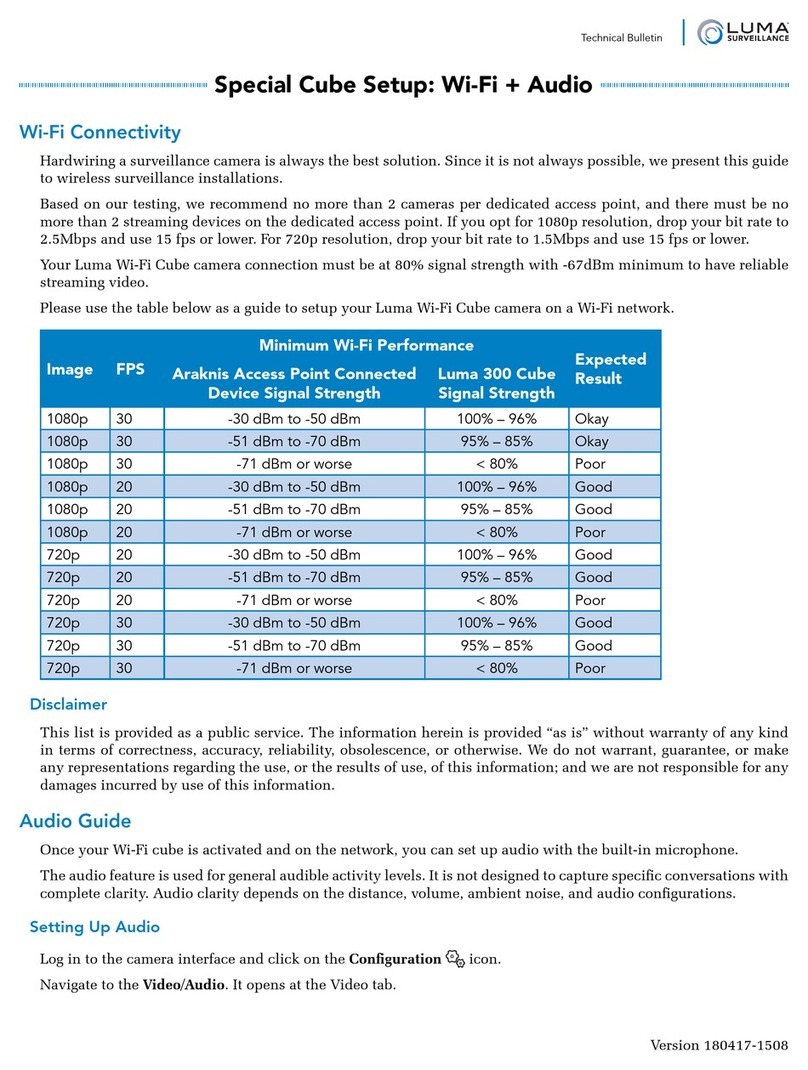
Connecting the Wi-Fi
With access to the camera’s web interface, you can set up the Wi-Fi connection.
1. Go to Basic Network Settings > TCP/IP and ensure that you set the IPv4 address to DHCP under the LAN
section as well as the WLAN tabs. Under WLAN, make sure you set entries for Subnet mask (typically
255.255.255.0) and default gateway (typically your router IP).
2. Go to Advanced Network Settings > Wi-Fi. Ensure it is enabled, and that the Network Mode option is set
to Manage.
3. Select your SSID from the Wireless List. Ensure the signal strength is 80% or better to prevent packet loss.
4. Select your router or access point’s Security Mode and encryption type from the dropdown menu.
5. Enter your router or access point’s password in the Key1 text field.
6. Save your settings.
Confirm and Lock the Settings
7. In the Wireless List, check the connection status to ensure that you are connected to the SSID you chose.
Run the Luma utility and confirm that you can navigate to both of the cube camera’s valid IP addresses.
8. With the Wi-Fi connection established, remove the Ethernet cable. Reboot the cube camera by unplugging
the power supply and plugging it back in.
9. After the camera boots up, navigate to the camera using the IP address indicated by the Luma utility. Go
to Configure This Computer > Basic Network Settings and set the IPv4 addresses to Static under the LAN
section as well as the WLAN section.
Be sure to save its address as a favorite on your web browser.
Table of contents
Other Luma Security Camera manuals