Maui Xaphoon •PO Box 1163 •Paia, HI 96779
Page 3
reed to vibrate freely. Your tongue should be out of the way and not touching
any part of the instrument.
Your lower lip should come into contact with the reed
approximately where the line is at the right. Everything
above the line should be free of obstruction.
As you become experienced, you will find that moving
your lower lip above and below this line as you play
will enable easier playing of the lower and higher
registers, respectively.
How Reed Instruments Produce
Sound
If you examine the Xaphoon’s mouthpiece from the side carefully, you’ll find
that there is a small gap between the tip of the reed and the mouthpiece. This
gap gives room for the reed to vibrate when you blow through it. As it vibrates,
it will alternately bend toward the mouthpiece (forming a perfect seal and
stopping all air) and then move away from the mouthpiece (allowing your breath
to flow once more). If this open-close-open-close activity happens 440 times
per second, the Xaphoon will produce a frequency corresponding to the note
“A”. This is how all reed instruments work; vibrating at the desired frequency,
all the while alternately allowing and blocking the wind from entering the
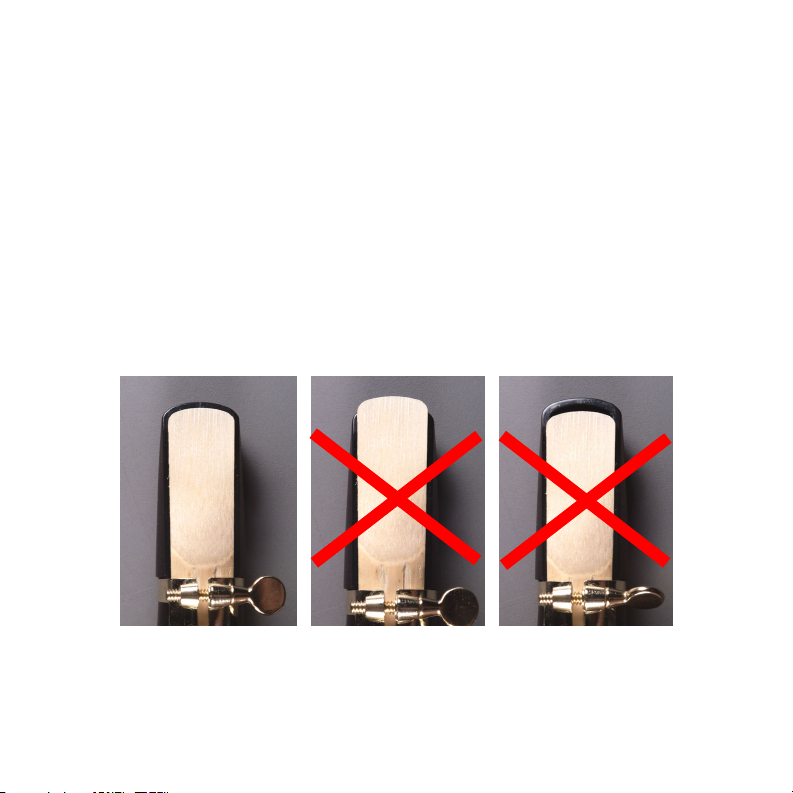
instrument. It is very important, then, that the reed be positioned to allow it to
form a perfect seal when it bends; it is also important that the instrument be
placed far enough in the mouth to allow the tip of the reed to vibrate freely
without touching the lips, teeth, tongue, or any other part of the mouth; but not
so far in the mouth that it prevents you from producing the lower notes.