www.SteamPoweredRadio.Com
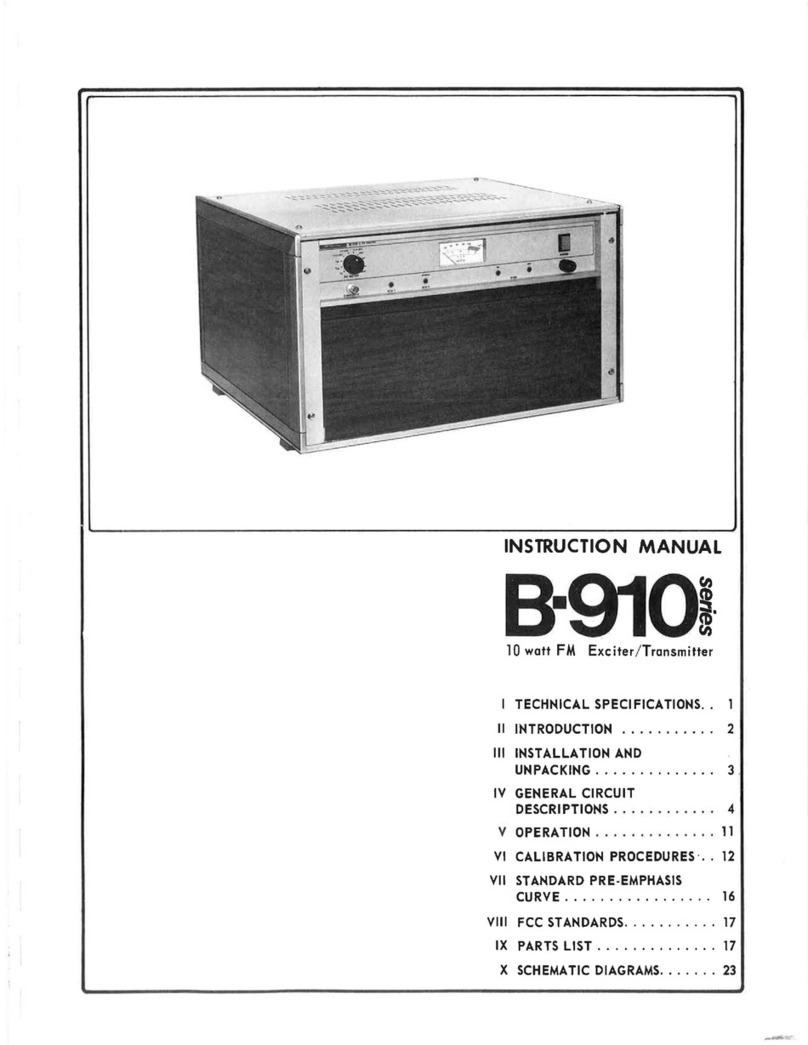
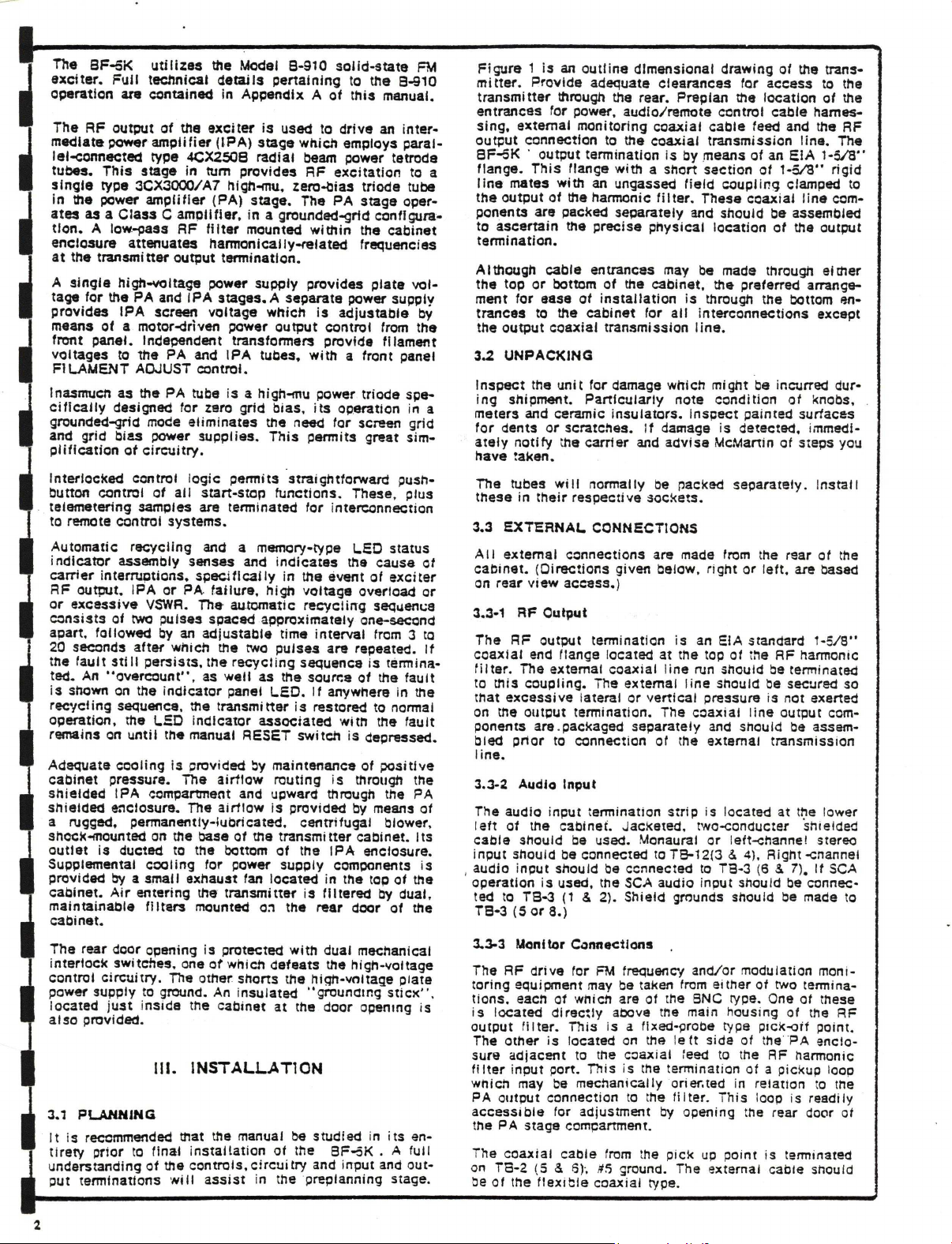
The
BF-SK
utilizes
the Model
8-910
solid-state
FM
exciter.
Full
technical
details
pertaining
to
the
8-910
operation are contained in Appendix A ot
this
manual.
The
RF
output
of
the
exciter
is
used to
drive
an
inter-
mediate power
amplifier
(IPA)
stage wl'lic:h employs
paral-
lel-connected type 4CX2508 radial
beam
power tetrode
tubes.
This
stage in tum provides
RF
excitation
to a
single
type
3CX3000/A7
high-mu, zero-bias triode tube
in
the power
amplifier
(PA)
stage. The
PA
stage oper-
ates
as
a
Class
C
ampllfler,
in a grounded-grid configura-
tion.
A low.-pass
AF
filter
mounted
within
the cabinet
enclosure attenuates hannonicaily-f'elated frequencies
at
the
transmitter
output termination.
A
single
high-voltage
power supply provides
plate
vol•
tage for the
PA
and
IPA
stages.A
sei,arate power supply
provides
IPA
screen voltage
which
is
adjustable
by
means
of
a
motor~riven
power
output
control from the
front
panel. Independent transfonners provide fl lament
voltages
to
the
PA
and
IPA
tubes,
with
a front panel
FlLAMENT ADJUST
control.
lnasmucn as the
PA
tube
is
a
high-mu power triode spe-
ciflcally
designed tor zero grid bias,
its
operation in a
grounded-grid mode
eliminates
the need tor screen grid
and grid bias power
supplies.
This
permits great
sim-
plification
of
circuitry.
Interlocked
control
logic
permits straightforward push-
button CQntrol
at
all
start-stop
functions.
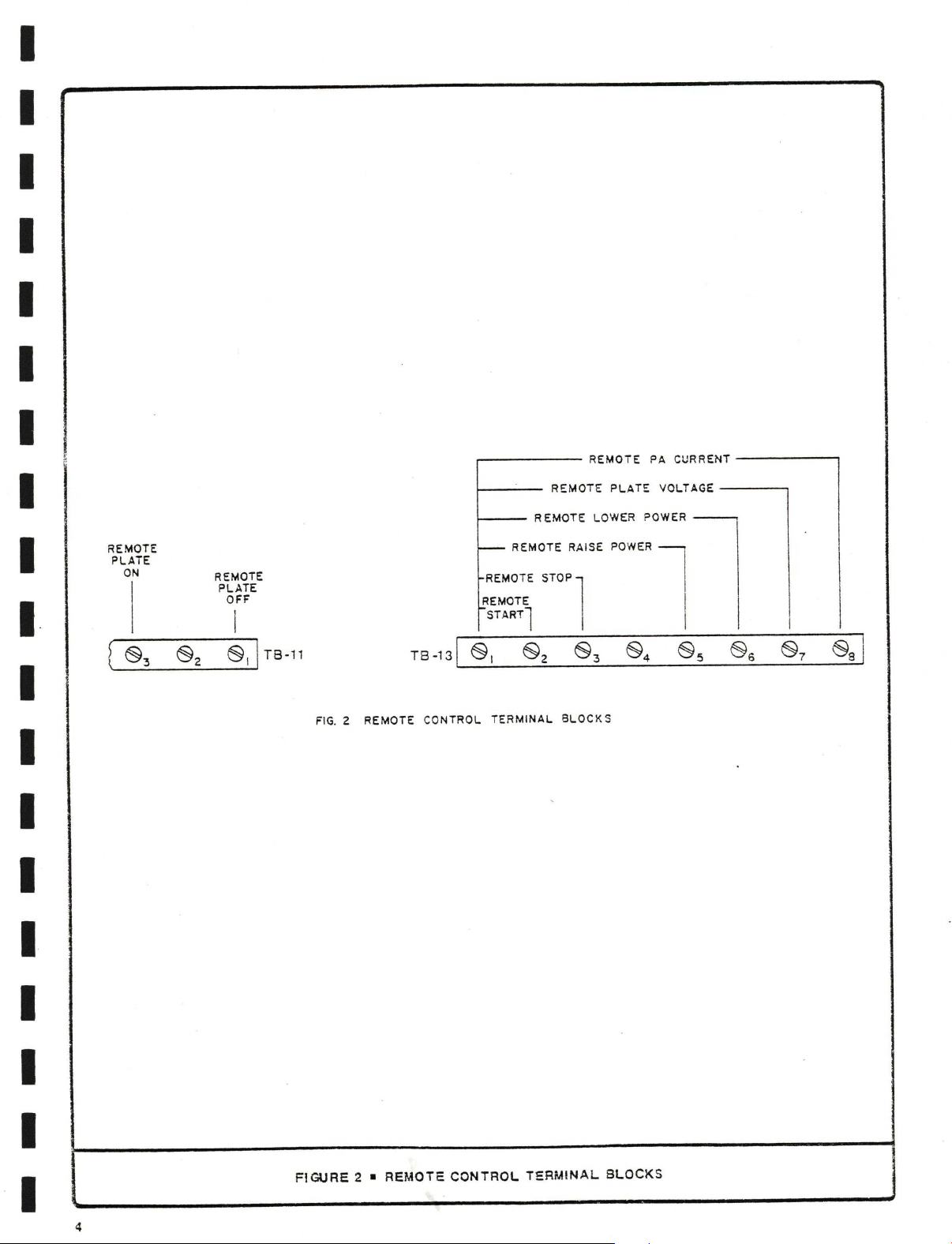
These, plus
telemetering
sampl~
are terminated tor interconnection
to remote control systems.
Automatic
recycling
and a memory-type
LEO
status
i
ndlcator
assembly
senses
and
indicates
the cause ot
carrier
interruptions.
speciflc:ally
in
the event
of
exciter
RF
output.
IPA
or
PA
failure,
high
voltage
overload
or
or
excessive
VSWR.
The
automatic
recycling
sequence
~nsists
of two pulses spaced approximately one-second
apart. followed
by
an
adjustable
time
interval
from 3
to
20
sectlnds
after
which the two
pulses
are repeated.
It
the
fault
still
persists.
the
recycling
sequence
is
termina-
ted.
An
"overcount"
.
as
well
as the soun:e
of
the
fault
is
shown
on
the
indicator
panel
LED.
If anywhere in the
recycling
sequence, the
transmitter
is
restored to normal
operation, the
LEO
indicator
associated
witn
the
fault
remains
on
until
the manual
RESET
switch
is depressed.
Adequate
cooling
is
provided
oy
maintenance of
positive
cabinet
pressure. The
airflow
routing
is
through
the
shielded
IPA
compartment and upward through the PA
shielded
e:,ctosure. The
airtlow
Is provided
by
means
of
a rugged, permanently-lubricated.
centrifugal
blower,
shock-mounted on the base
of
the
transmitter
cabinet. Its
outlet
is
ducted to the bottom
of
the I
PA
enclosure.
Supplemental
cooling
tor power supply components
is
provided
by
a small exhaust
tan
located in the top
of
the
~
cabinet.
Air
entering the
transmitter
is
filtered
by
dual,
maintainable
fl
lters
mounted
0:1
the rear door
of
the
cabinet.
The
rear door opening
is
prote<:ted
with
dual mechanical
intertocl<
switches.
one
ot
which
defeats
the
high-voltage
2
control
circuitry.
The other shorts the hiqh-vnltage plate
power
supply to ground.
An
insulated "grounair.g
stic,c".
located
just
inside
the cabinet
at
the door openmg
is
also
provided.
111.
INSTALl.ATlON
3.1
PLAHHING
It
is
recommended tnat the manual
be
studied in
its
en-
tirety
prior
to
final
instattatio~
ot
the
8F-5K
. A
full
understanding
of
the
controls,
c2rcuI try and input
and
out-
put
terminations 'Nill
assist
in the preplanning stage.
Figure
1
is
an
outline
dlmensional drawing of the trans-
mitter.
Provide
adequate clearances tor access to the
transmitter
through the rear. Preplan the location
of
the
entrances for power,
audio/remote
control cable harnes-
sing,
external monitoring
coaxial
cable
teed and the
RF
output connection to the
coaxial
transmission
line.
The
BF-SK ·
output termination
is
by .means
of
an
EIA
1
·5/8"
flange.
This
flange
with
a short
section
of
1-5/8"
rigid
line
mates
with
an
ungassed
field
coui,ling
clamped to
the
output
of
the harmonic
filter.
These
coaxial
line
com-
ponents are
pacl<ed
separately and should be assembled
to
ascertain
the
precise
physical
location
ot
the output
termination.
AI
though cable entrances
may
be
made through ei
mer
the top
or
bottom
of
the cabinet, the preferred arrange-
ment tor
ease
ot
installation
is
through the bottom ~n-
trances to the
cabinet
for
all
interconnections except
the
output
coaxial
transmission
line.
3.2 UNPACKING
Inspect
the
unit
for damage which might be incurred dur•
ing
shipment.
Particularly
note
condition
of
knobs, .
meters and ceramic
insulators.
Inspect
painted surfaces
for
dents
or
scratches.
If
damage is detected, immedi-
ately
notify
the
earner
and
advise
McMartin ot steps you
have taken.
The tubes
will
normally
be
packed separately.
Install
these in
their
respective
sockets.
3.3
EXTERNAL
CONNECTIONS
A
11
external connections are made from the rear
at
the
cabinet.
(Directions
given below,
right
or
left,
are
based
on
rear
view
access.)
3.3•1
RF
Output
The
RF
output termination
is
an
EIA
standard
1·5/8"
coaxial
end flange located at the top
of
the RF harmonic
tiIter. The external coaxial Iine
run
should be terminated
to
this
coupling.
The external
line
should be secured so
tnat
excessive
lateral or
vertical
pressure is not exerted
on
tne output termination. The
coaxial
line
output com-
ponents are .packaged separately
and
should
be
assem-
bled
prior
to connection
of
the external transmission
line.
3.3-2
Audio Input
The audio input termination
strip
is located
at
t~e lower
left
of
the cabinet. Jacketed, two-conducter shielded
cable
should
be
used. Monaural
or
lett-cnanne! stereo
input
should
be
connected
to
TS-12(3
&
4),
Right-cnannel
, audio input should
be
ccnnected
to
T8•3
(6
&
7).
If
SCA
operation
is
used, tne SCA audio input should
be
connec•
ted
to
TB-3 (1
&
2). Shield grounds should
be
made to
T8•3
(5
or
8.)
3..3-3 Monitor C<lnnectlons
The RF
drive
tor
FM
frequency
and/or
modulation moni•
taring equipment
may
be
taken
from
either
of
two tennina-
tions.
each of which are of the
BNC
type. One
ot
these
is
located
directly
above
the main housing
ot
the RF
output
tilter.
This
is
a fixed-probe type
pIck~it
point.
The other
is
located
on
the le
!t
side
ot
tne
PA
enclo•
sure adjacent to the coaxial leed to the RF harmonic
tilter
input
port. This
is
the termination of a pickup loop
wnich
may
be
mechanically
orier
,ted in relation to the
PA output connection
to
tne
ti
Iter.
This
loop is readily
accessible
tor adjustment
by
opening the rear door ot
ttie PA stage compartment.
The
coaxial
cable
rrom
the
pick
up
point
is
terminated
on
TS-2 (5
&
6).,
#5
ground. The external cable should
be
of
the
flexible
coaxial type.