manuals.online logo
Brands
  1. Home
  2. •
  3. Brands
  4. •
  5. Motorola
  6. •
  7. Firewall
  8. •
  9. Motorola SURFboard SVG2500 User manual

Motorola SURFboard SVG2500 User manual

Other manuals for SURFboard SVG2500

3

Popular Firewall manuals by other brands

Fortinet FSM-500F Configuration guide

Fortinet

Fortinet FSM-500F Configuration guide

Cisco Meraki MX100 installation guide

Cisco

Cisco Meraki MX100 installation guide

Cisco S190 quick start guide

Cisco

Cisco S190 quick start guide

Fortinet FortiGate Voice Series install guide

Fortinet

Fortinet FortiGate Voice Series install guide

SecureLogix ETM System installation guide

SecureLogix

SecureLogix ETM System installation guide

Huawei USG6000 Series Upgrade guide

Huawei

Huawei USG6000 Series Upgrade guide

NETGEAR ProSafe FVX538 Reference manual

NETGEAR

NETGEAR ProSafe FVX538 Reference manual

Lanner FW-8877 user manual

Lanner

Lanner FW-8877 user manual

Nexcom DNA 1150 user manual

Nexcom

Nexcom DNA 1150 user manual

Cisco 3110 Hardware installation guide

Cisco

Cisco 3110 Hardware installation guide

Fortinet FortiGate-60 series install guide

Fortinet

Fortinet FortiGate-60 series install guide

ADTRAN NetVanta 2300 Specifications

ADTRAN

ADTRAN NetVanta 2300 Specifications

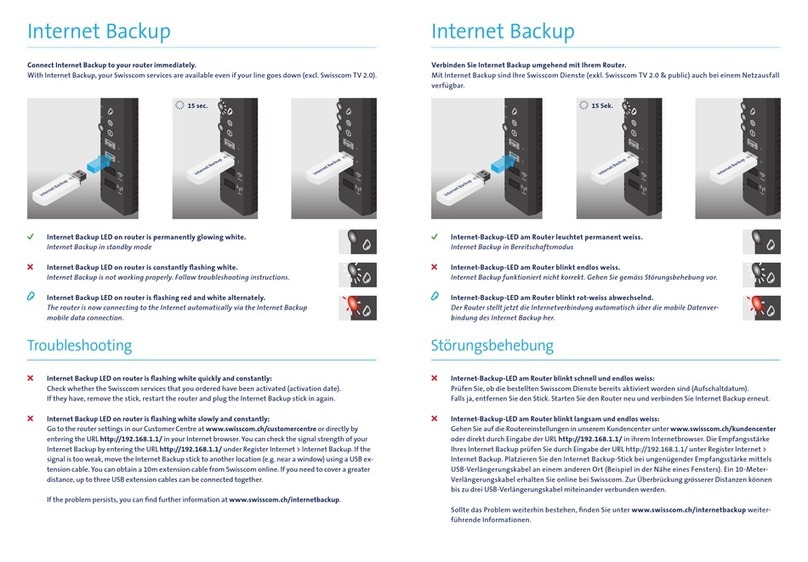
Swisscom Internet Backup manual

Swisscom

Swisscom Internet Backup manual

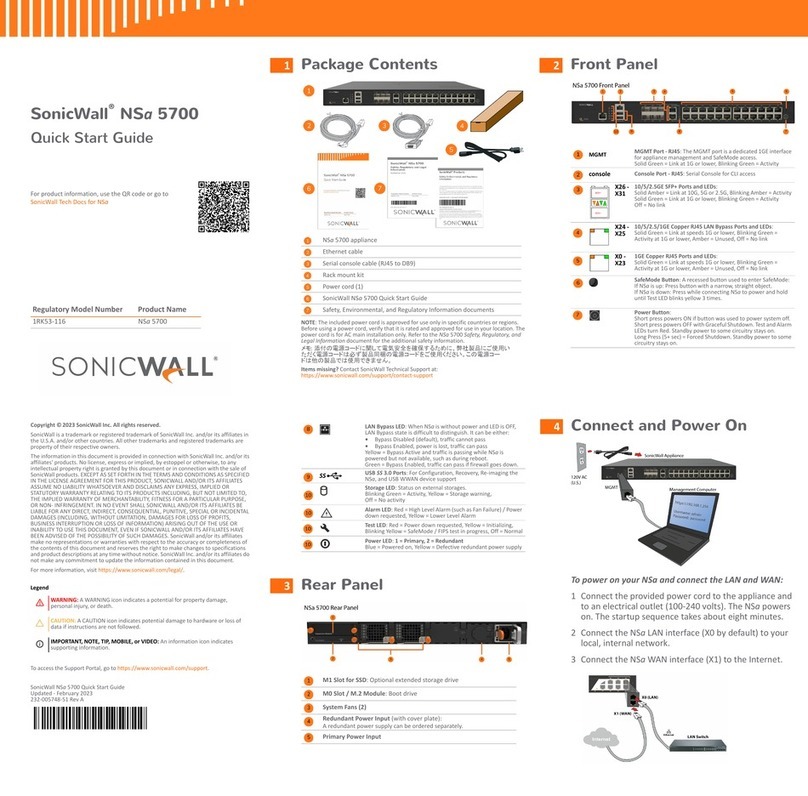
SonicWALL NSa 5700 quick start guide

SonicWALL

SonicWALL NSa 5700 quick start guide

DPtech FW1000 SERIES Maintenance manual

DPtech

DPtech FW1000 SERIES Maintenance manual

FEITIAN MultiPass FIDO product manual

FEITIAN

FEITIAN MultiPass FIDO product manual

Trend Micro Deep Edge quick start guide

Trend Micro

Trend Micro Deep Edge quick start guide

Smoothwall S10 Appliance Getting started guide

Smoothwall

Smoothwall S10 Appliance Getting started guide

manuals.online logo
manuals.online logoBrands
  • About & Mission
  • Contact us
  • Privacy Policy
  • Terms and Conditions

Copyright 2025 Manuals.Online. All Rights Reserved.

This document is uncontrolled pending incorporation in PDM
1 OVERVIEW
15
Security
The SVG2500 provides the following:
•A firewall to protect the SVG2500 LAN from undesired attacks over the Internet
•For wireless transmissions, data encryption and network access control
Network Address Translation (NAT) provides some security because the IP
addresses of SVG2500 LAN computers are not visible on the Internet.
This diagram does not necessarily correspond to the network cabling. A full
discussion of network security is beyond the scope of this document.
Figure 1-6 — SVG2500 Security Measures
This document is uncontrolled pending incorporation in PDM
1 OVERVIEW
16
Firewall
The SVG2500 firewall protects the SVG2500 LAN from undesired attacks and other
intrusions from the Internet. It provides an advanced, integrated stateful-inspection
firewall supporting intrusion detection, session tracking, and denial-of-service attack
prevention. The firewall:
•Maintains state data for every TCP/IP session on the OSI network and transport
layers
•Monitors all incoming and outgoing packets, applies the firewall policy to each
one, and screens for improper packets and intrusion attempts
•Provides comprehensive logging for all:
•User authentications
•Rejected internal and external connection requests
•Session creation and termination
•Outside attacks (intrusion detection)
You can configure the firewall filters to set rules for port usage. For information about
choosing a predefined firewall policy template, see Section 7, SVG2500 Firewall
Pages.
DMZ
A de-militarized zone (DMZ) is one or more computers logically located outside the
firewall between an SVG2500 LAN and the Internet. A DMZ prevents direct access
by outside users to private data.
For example, you can set up a web server on a DMZ computer to enable outside
users to access your website without exposing confidential data on your network.
A DMZ can also be useful to play interactive games that may have a problem running
through a firewall. You can leave a computer used for gaming only exposed to the
Internet while protecting the rest of your network. For more information, see Gaming
Configuration Guidelines.
Port Triggering
When you run an application that accesses the Internet, it typically initiates
communications with a computer on the Internet. For some applications, especially
gaming, the computer on the Internet also initiates communications with your
computer. Because NAT does not normally allow these incoming connections:
•The SVG2500 has preconfigured port triggers for common applications.
•If needed, you can configure additional port triggers on the Advanced Port
Triggers Page.
This document is uncontrolled pending incorporation in PDM
1 OVERVIEW
17
Wireless Security
Because WLAN data is transmitted using radio signals, it may be possible for an
unauthorized person to access your WLAN unless you prevent them from doing so.
To prevent unauthorized eavesdropping of data transmitted over your LAN, you must
enable wireless security. The default SVG2500 settings neither provide security for
transmitted data nor protect network data from unauthorized intrusions.
The SVG2500 provides the following wireless security measures, which are
described in Section 9, SVG2500 Wireless Pages.
To prevent unauthorized eavesdropping, you must encrypt data transmitted over the
wireless interface using one of the following:
•If all of your wireless clients support Wi-Fi®Protected Access (WPA) encryption,
Motorola recommends using WPA.Otherwise, configure a Wired Equivalency
Privacy (WEP) key on the SVG2500 and each WLAN client.
•To protect LAN data from unauthorized intrusions, you can restrict WLAN access
to computers having one or both of:
•Known MAC addresses
•The same unique network name (SSID) as the SVG2500
Restricting access to computers having the same network name is also called
“disabling SSID broadcasting” or “enabling closed network operation.”
Port Forwarding
The SVG2500 opens logical data ports when a computer on its LAN sends data,
such as e-mail messages or web data, to the Internet. A logical data port is different
from a physical port, such as an Ethernet port. Data from a protocol must go through
certain data ports.
Some applications, such as games and videoconferencing, require multiple data
ports. If you enable NAT, this can cause problems because NAT assumes that data
sent through one port will return to the same port. You may need to configure port
forwarding to run applications with special requirements.
To configure port forwarding, you must specify an inbound (source) port or range of
ports. The inbound port opens only when data is sent to the inbound port and closes
again after a specified time elapses with no data sent to it. You can configure up to
32 port forwarding entries using the Advanced Port Forwarding Page.
Virtual Private Networks
The SVG2500 supports multiple tunnel VPN pass-through operation to securely
connect remote computers over the Internet. The SVG2500:
•Is compatible with Point to Point Tunneling Protocol (PPTP) and Layer 2 Tunneling
Protocol (L2TP)
•Is fully interoperable with any IPSec client or gateway and ANX certified IPSec
stacks

This document is uncontrolled pending incorporation in PDM
19
2 INSTALLATION
The following topics provide information about installing the SVG2500 hardware:
•Before You Begin
•Precautions
•Signing Up for Service
•Computer System Requirements
•Installing the Battery
•Connecting the SVG2500 to the Cable System
•Cabling the LAN
•Installing USB Drivers
•Connecting a PC to the SVG2500 USB Port
•Obtaining an IP Address for Ethernet
•Configuring TCP/IP
•Installing the Telephone for VoIP
•Wall Mounting Your SVG2500
For information about WLAN setup, see Setting Up Your Wireless LAN.
Before You Begin
Before you begin the installation, check that the following items were included with
your Motorola SVG2500 Gateway:
Item Description
Power cord
Connects the SVG2500 to a power adapter that
connects to an AC electrical outlet
Telephone cable (RJ-11) Connects to a telephone outlet
Ethernet cable Connects to the Ethernet port
USB cable Connects to the USB port
SVG2500 Installation
CD-ROM
Contains this user guide and USB drivers
SVG2500 Quick
Installation Guide
Contains basic information for getting started with
the SVG2500
This document is uncontrolled pending incorporation in PDM
2 INSTALLATION
20
You must have the latest service packs and patches installed on your computer for
your operating system. You will need 75-ohm coaxial cable with F-type connectors to
connect the SVG2500 to the nearest cable outlet. If a TV is connected to the cable
outlet, you may need a 5 to 900 MHz RF splitter and two additional coaxial cables to
use both the TV and the SVG2500.
Determine the connection types you will make to the SVG2500. Check that you have
the required cables, adapters, and adapter software. You may need:
Wireless LAN Wireless adapter and driver software for each computer having a wireless
connection.
Wired Ethernet Ethernet cables and network interface cards (NICs) with accompanying
installation software
LAN To connect more than four computers to the SVG2500, one or more Ethernet
hubs or switches
USB A USB cable and the SVG2500 Installation CD-ROM containing the software
for USB installation
Coaxial cable, RF splitters, hubs, and switches are available at consumer electronic stores.
Precautions
Postpone SVG2500 installation until there is no risk of thunderstorm or lightning
activity in the area.
To avoid potential shock, always unplug the power cord from the wall outlet or other
power source before disconnecting it from the SVG2500 rear panel.
To prevent overheating the SVG2500, do not block the ventilation holes on the sides
of the unit. Do not open the unit. Refer all service to your Internet Service provider.
Wipe the unit with a clean, dry cloth. Never use cleaning fluid or similar chemicals.
Do not spray cleaners directly on the unit or use forced air to remove dust.
This document is uncontrolled pending incorporation in PDM
2 INSTALLATION
21
Signing Up for Service
You must sign up with an Internet Service provider to access the Internet and other
online services. To activate your service, call your local Internet Service provider.
You need to provide the MAC address marked HFC MAC ID printed on the Bottom
Label on the SVG2500. You can record it in the SVG2500 Quick Installation Guide.
You should ask your Internet Service provider the following questions:
•Do you have any special system requirements?
•When can I begin to use my SVG2500?
•Are there any files I need to download after connecting the SVG2500?
•Do I need a user name or password to access the Internet or use e-mail?
Computer System Requirements
You can connect Microsoft Windows, Macintosh, UNIX®, or Linux®computers to the
SVG2500 LAN using one of the following:
•Ethernet — 10Base-T or 10/100Base-T Ethernet adapter with proper driver
software installed.
•Wireless — Any IEEE 802.11g or IEEE 802.11b device. This includes any Wi-Fi
certified wireless device, such as a cellular telephone equipped with this feature.
In addition, your computer must meet the following requirements:
•PC with Pentium class or better processor
•Windows®2000, Windows®XP, Windows VistaTM, Macintosh, or Linux®
operating system with operating system CD-ROM available
•Minimum 16 MB RAM recommended
•10 MB available hard disk space
You can use any web browser such as Microsoft®Internet Explorer, Netscape
Navigator®, or Mozilla®Firefox®with the SVG2500.
The following operating systems are not supported by the SVG2500. Microsoft
support for these products has ended:
•Windows®95
•Windows®98
•Windows®98 SE
•Windows®Me
•Windows NT®
Note: UNIX, Linux, or Macintosh computers only use the Ethernet connection.
This document is uncontrolled pending incorporation in PDM
2 INSTALLATION
22
You can use the USB connection with any PC running Windows 2000, Windows XP,
or Windows Vista that has a USB interface. The USB connection requires special
USB driver software that is supplied on the SVG2500 Installation CD-ROM. You can
upgrade your USB drivers from the Motorola Downloads page:
http://broadband.motorola.com/consumers/support/default.asp
Installing the Battery
Before you begin the installation, you must first install the battery in your SVG2500.
Please read Safety Requirements for the SVG2500 Lithium-Ion Battery before
proceeding.
1. Place the SVG2500 on a soft surface to access the bottom of the unit.
2. Pull up on the battery cover tab.
3. Align the key pins in the SVG2500 with the key slots on the battery for proper
contact.
This document is uncontrolled pending incorporation in PDM
2 INSTALLATION
23
4. The battery connectors should mate with the connectors on the SVG2500. Make
sure the pull-tab is accessible and does not prevent the battery cover from
closing properly.
5. Reinstall the battery cover with the alignment tabs seated downward.
It may take up to 12 hours for the battery to reach full charge when:
•It is installed for the first time.
•It is replaced.
•It is fully discharged.
Battery back-up times may vary based on many factors, including the battery age,
charging state, storing conditions, and operating temperature, as well as by factors
such as data activity and length of active telephone calls.
This document is uncontrolled pending incorporation in PDM
2 INSTALLATION
24
Connecting the SVG2500 to the Cable System
Before starting, be sure the computer is turned on and the SVG2500 is unplugged.
1. Connect one end of the coaxial cable to the cable outlet or splitter.
2. Connect the other end of the coaxial cable to the cable connector on the
SVG2500. Hand-tighten the connectors to avoid damaging them.
3. Plug the power cord into the power connector on the SVG2500.
4. Plug the power cord into the electrical outlet. This turns the SVG2500 on. You do
not need to unplug it when not in use. The first time you plug in the SVG2500,
allow it 5 to 30 minutes to find and lock on the appropriate communications
channels.
5. Check that the lights on the front panel cycle through this sequence:
POWER Turns on when AC power is connected to the SVG2500.
Indicates that the power is connected properly.
ONLINE Flashes during SVG2500 registration and configuration.
Changes to solid green when the SVG2500 is registered.
DS Flashes while scanning for the downstream receive channel.
Changes to solid green when the receive channel is locked.
US Flashes while scanning for the upstream send channel.
Changes to solid green when the send channel is locked.