7
Frequently Asked Quest ons
Why are the projected mages always green us ng N ght V s on technology?
The human eye resolves detail best at the wavelength of green light.
How should I care for my N ght V s on dev ce?
Do not operate in lighted conditions; device is for use in the dark.
Do not drop the device. The internal intensifier tube is made of glass and is sensitive to impact.
Why do you focus both the front (Object ve lens) and Eyep ece (Ocular Lens)?
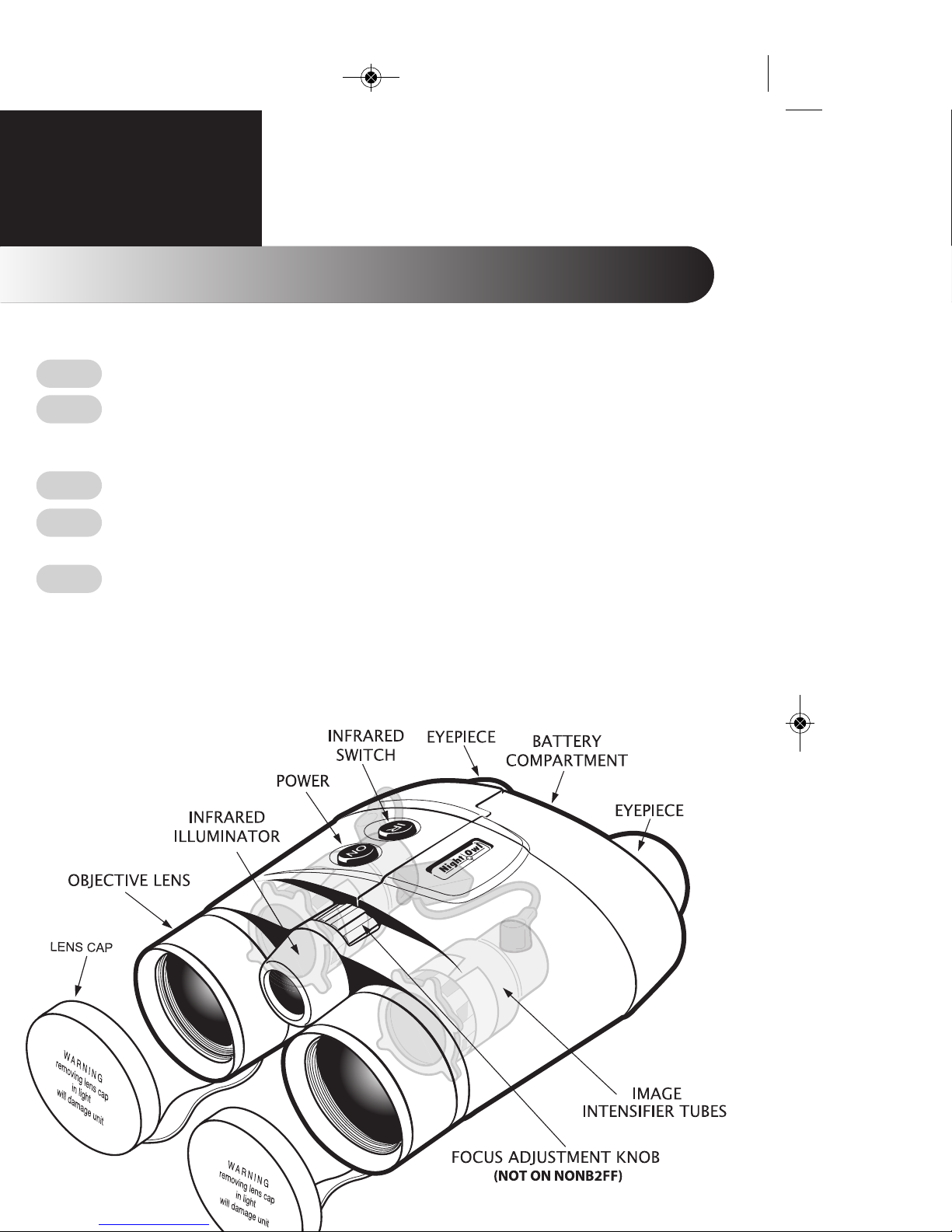
You do not see through the Night Vision device, like a day binocular. Rather you see the
phosphor screen on the back of the tube. The objective lens focuses the image on to the front
of the intensifier tube. That image is then converted into electrons. The electrons strike the
phosphorous screen converting electrical energy into a visible image. The eyepiece focuses
your vision on to the image on the phosphorous screen.
What s the effect ve range of N ght V s on?
The maximum viewing distance depends on the environmental conditions and the size of
the object being viewed. Overcast conditions, fog or rain will reduce the effective distance
you can see. The Infrared Illuminator will increase viewing range, especially in areas of
complete darkness where there is no ambient light.
What s the max mum effect ve d stance of the Infrared Illum nator?
75 to 125 yds. The farther the object, the less intense the infrared light will be on the target.
Are N ght V s on dev ces safe?
Night Vision products include shield-encased image intensifiers. The infrared illuminator
utilizes light emitting diodes (LED’s) operating in the near-infrared range and will not harm
your eyes like a laser.
CAUTION: Do not point Infrared Emitter directly into eye at close range.
The infrared Emitter emits a BRIGHT, although invisible, beam of light.
As with any bright light, do not point into the eye.
Recognize that the image produced on the phosphorous screen can be very bright. Staring into
a very bright light causes the pupil to constrict. Your eye needs time to adjust to ambient light.
When can I expose the un t to l ght?
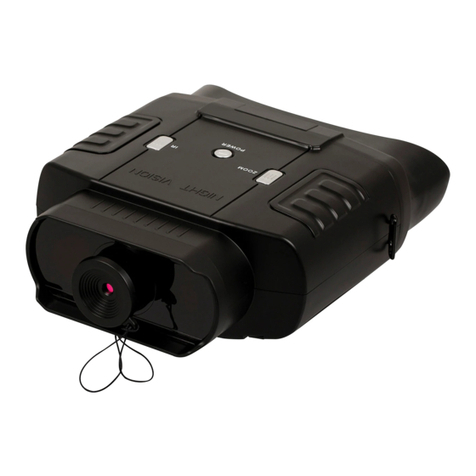
For demonstration purposes there is a pinhole in the lens cap, which enables you to power on
the unit in a lighted environment. The lens cap can be taken off during daylight, but the unit
has to be powered off.
What s Generat on 1? How does t d ffer from other Generat ons of N ght V s on dev ces?
Generation 1, 2, 3 and 4 all employ electron bombardment technology. All of these
technologies convert light into electrons and reproduce the image on a phosphorous screen.
Generation 1 produces a higher resolution image than Generation 2.
Generation 3 and 4 are used by the United States Military and are very expensive.
Generation 2, 3 and 4 use a fiber optic device and/or special chemicals to further amplify light.