Using the Classic CA
hat is a VCA?
The CA ( oltage controlled Amplifier) is a device used to control the level of one signal by
the application of another. Traditionally, the controlled input to the CA is called the INPUT,
whilst the controller input is called the C , or control voltage. A typical system will have the
input as the audio output from a filter or oscillator, and the C from an envelope generator.
As the envelope generator’s output voltage rises and falls, so the output of the CA becomes
louder and softer. The output of the CA is connected to the OUT A socket on the module.
It should be noted though that the C input can actually be an audio input, and that the
INPUT can be a control voltage. It is up to you what you put into the module. The
nomenclature refers only to the original and common usage of the input sockets on a CA
module.
The term amplifier is actually slightly different to the one you normally use too. It doesn't
always amplify in so far as it doesn't normally make the input signal bigger. The amplification,
or gain, actually varies from nearly zero, ie. the CA is closed or off, to about one, or 0dB.
When the gain is one then the output level is the same as the input voltage.
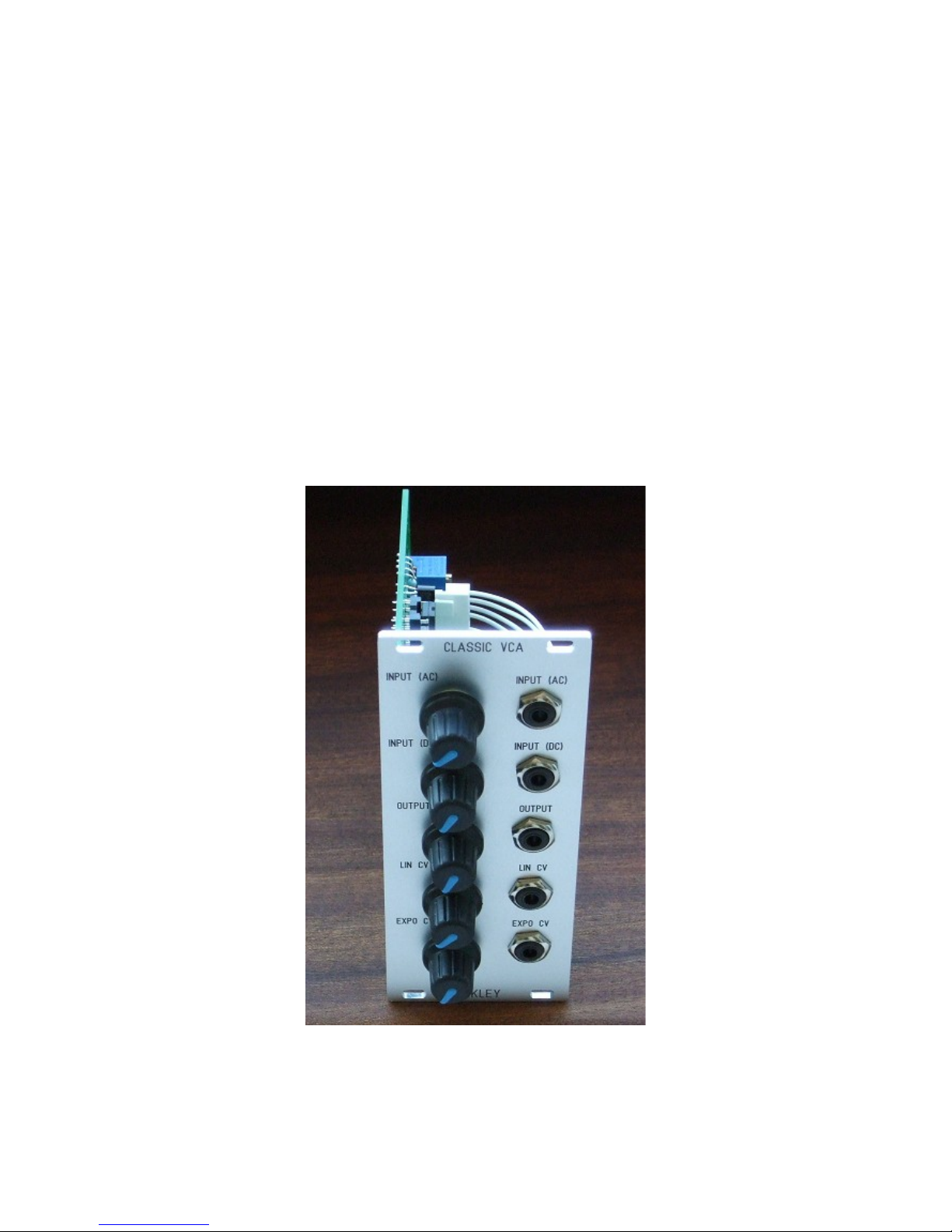
The Oakley Classic VCA
The Oakley Classic CA features two input signals, IN1 (DC) and IN2 (AC), and each has its
own level control. In this way, the Classic CA can be used to mix or sum two signals
together before they are processed by the CA core. One of the inputs, IN1 (DC), is directly
coupled to the CA core. All signals, C and audio, connected to this input can therefore be
controlled by the CA. The other input, IN2 (AC), goes via a capacitor and so is often called
'AC coupled'. The capacitor acts to block very low frequency signals and steady state
voltages. You can think of it as being a high pass filter with a very low cut-off frequency.
The GAIN pot controls the 'initial gain' of the module. This is used to partially open the CA,
even when there are no other signals applied to either of the two C inputs. If any positive
C is applied then this will open the CA further. While the addition of a negative C will
actually cause the CA to close.
Two control voltage inputs are provided, LIN C and EXP C . Each has its own level pot
which controls the depth of the effect.
The LIN C input has a linear response. This means that doubling the C will double the
output amplitude. In general this is the most useful response for general CA duties. With the
gain pot at its minimum, and the LIN C pot at its maximum, +5 at the LIN C input will
produce a gain of around one.
The EXP C input has an exponential response. This means that a rising C will produce a
proportional change in gain measured in decibels. In practice this means that the output signal
appears not to quickly increase in level until the input C is close to 5 . This affect tends to
produce wonderfully plucky sounds when used with a conventional ADSR as the C source.
5