H4EKO-D Instructions
3
1. INTRODUCTION
Dear Customer,
We appreciate that you have chosen a product from our product range and become one of our customers. We hope that you are
content with our product. We hope that our product serves you reliably and for a long time. All employees of our company
contribute to this. Please read the operating instructions thoroughly and please do not hesitate to ask any questions that you may
have, we will be happy to advise you on the boiler’s operation.
2. BOILER CHARACTERISTICS
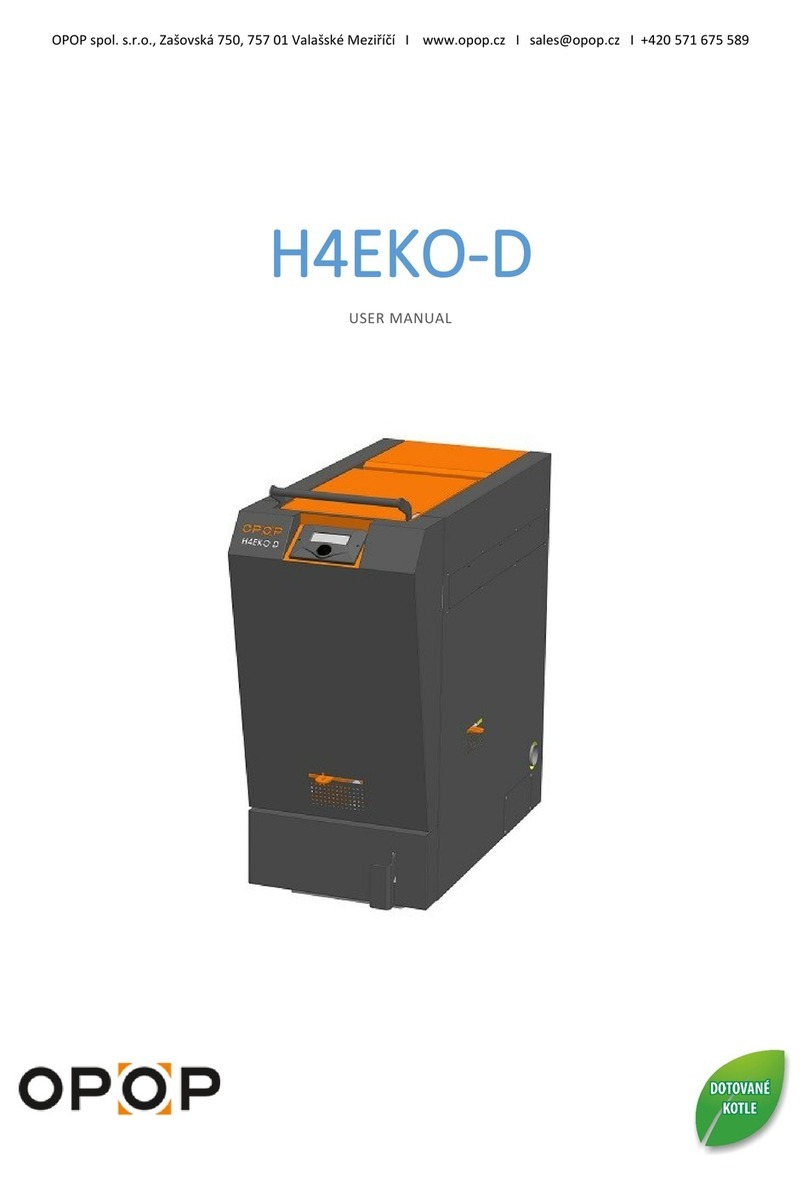
The H4xx EKO-D series steel hot water boiler is designed and surface-treated for floor and central heating of family houses or
suitable production plants with a maximum hydrostatic heating water height of 20 m. The H4xx EKO-D boiler is designed for solid
fuel combustion, i.e., pieces of wood. Combustion of other substances or materials is not permitted. The boiler must be connected
to a chimney corresponding to the boiler output and with the required minimum draft according to the operating instructions.
For proper boiler operation, in addition to expert installation, care must be taken to ensure that the boiler is properly serviced
and regularly cleaned, as described below in these Instructions. This boiler was certified by the Engineering Test Institute in Brno
according to ČSN EN 303-5 and meets the strictest criteria for solid fuel combustion as it is classified in the highest emission class
and also meets the Ecodesign standard. This means that it is possible to apply for subsidies for these boilers.
The boiler is operated at underpressure at the flue gas outlet thanks to an exhaust fan which sucks air through the primary and
secondary air dampers into the filling shaft, nozzle, heat exchanger and then into the flue gas path. The boiler operates under non-
condensing conditions so there are no flue gas path requirements from the operation that would require protection against air
condensation.
3. TECHNICAL DESCRIPTION
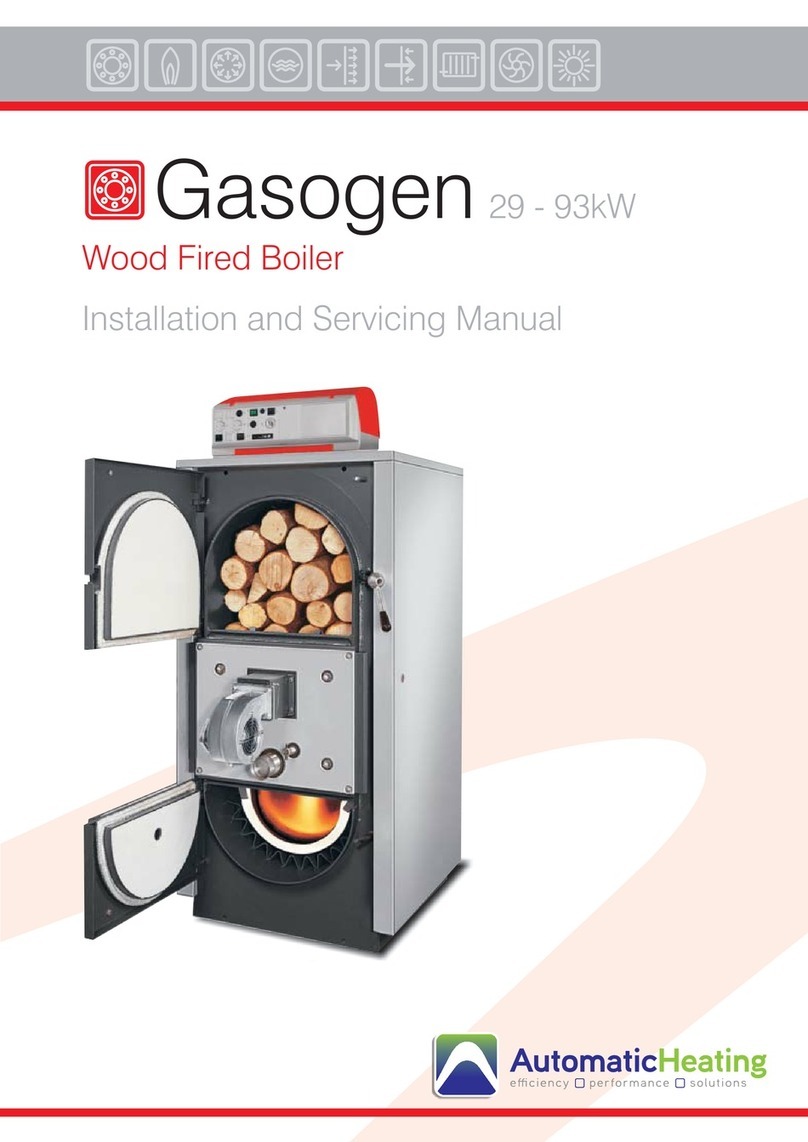
The H4xx EKO-D boilers are gasification boilers designed for wood burning. There is a refractory nozzle inside the boiler that
transmits the flame into the back of the boiler, the heat exchanger and then into the chimney. Exhaust fan is located at the outlet
of the boiler flue, ensuring ideal combustion under almost all conditions. This is controlled by a boiler control unit located in its
back section.
Combustion air supply is provided by primary flaps (on the left and right sides of the boiler) and secondary flap (front of the boiler).
The primary flaps ensure the correct boiler output and the secondary flap regulates the residual oxygen content in the boiler to
optimise combustion with the lowest carbon monoxide and nitrogen oxide emissions.
The filling and cleaning doors are on the front of the boiler. Make sure that they are closed tightly during the boiler’s operation.
Wood combustion in gasification boilers generates a large amount of smoke which accumulates in the filling chamber under the
filling door during the combustion process and gradually leaves through the nozzle into the heat exchanger. Do not open any of
the doors during the burning process until there is only a small burning layer of remaining wood in the boiler, on which you can
then refill the new fuel. More about heating in chapters ‘Igniting’, ‘Operation’, ‘Adding Fuel’, ‘Extinction’.
You will find a pull rod on the side of the boiler that controls the exhaust flap to ensure that the smoke is drawn from the hopper
so that no smoke escapes into the room when the door is opened. Do not open the door during the burning process, it is better
to wait until the wood is burned to the residual hot layer that does not smoke. Then simply open the door and add more fuel. See
‘Adding Fuel’for more information.
The filling chamber’s side walls are fitted with cover plates to protect the boiler walls from harmful substances created during
combustion. These cover plates are removable, but they must always be placed in the boiler during the burning.
There is a combustion chamber under the refractory nozzle. This is where the flame from the filling chamber goes down where
the entire combustion process is completed. The combustion chamber is lined with fireclay bricks that capture and burn residual
amount of dust particles that would otherwise end up in the air. The combustion chamber can be accessed by opening the lower
door. This way, you will also sweep the remaining ash out of the boiler.
All doors must be closed during boiler operation. If you leave any of the doors unsealed, flue gas leaks into the room,
which can cause damage to health or property.