FEATURES
Preamplifier section
The modular design of the SI 1000 makes service maintenance a mere formality. The volume
control stage is done in full domain to preserve the quality and integrity of the sound signal. All
channels are dual mono design and individual modules are used for left and right channels
respectively.
Individual and separated power supply section
Class “A” push-pull output stage
2 pairs of junction FET (J-FET)
2 pairs of bipolar transistors on the input differential circuit
Power Amplifier section
The SI 1000 uses four bipolar power transmissions for each channel of the power amplifier
section. The main circuit is designed to preserve and maintain the maximum quality of sound
reproduction and musical integrity.
Junction FET input
Proprietary feed-back circuit on the power transmissions for an improved low frequency
extension and control
Push-pull designed parallel output circuit
Main Signal Path
The main signal path uses exclusively discrete components for optimal performance. The use of
OP Amps is strictly prohibited at this level!
DC coupled signal path
Preamp output for Bi-Amping or Subwoofer application
Bypass function input for surround processor connection (activated as a 2 channel amp)
Caution! The SI 1000 is designed to operate at the following line voltages: 100,
120, 220, or 230. Only an authorized Oracle Audio dealer can make
changes to the voltage selection.
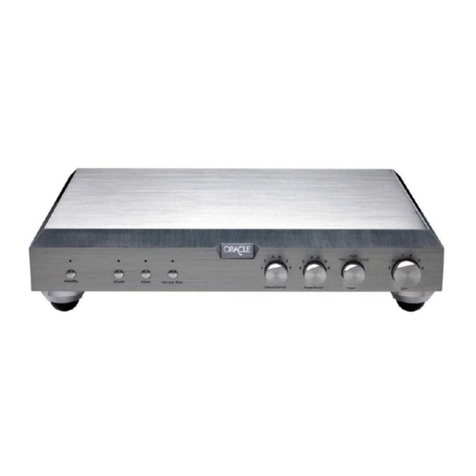
The Oracle Audio SI 1000 main power switch is located on the rear
panel. The standby switch is located on the front panel. During normal
daily operation use the STANDBY switch leaving the main line input
switch in the “ON “ position. The current draw in the standby mode is
very small while the internal circuitry is maintained at an optimal
operating temperature. However, it is recommended to turn the main
power switch “OFF” or unplug the AC power lead when you plan to leave
the house for an extended period of time.
Do not stack other devices on top; it is important to maintain proper
ventilation around the Oracle Audio SI 1000. Improper heat dissipation
from and around the SI 1000 could cause overheating related problems.