WARNING: 1
2
3
1
2
3
1
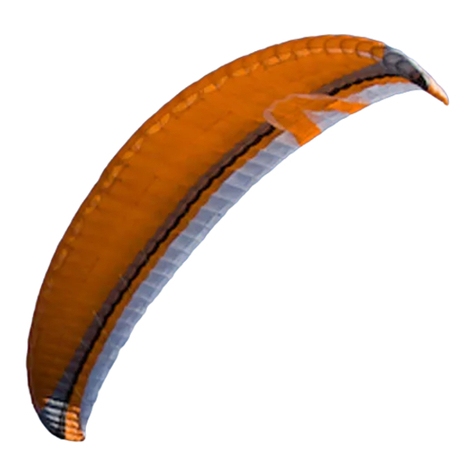
PARAJET VOLUTION 3 PARAMOTOR
OWNERS INSTRUCTION & SAFETY MANUAL
Chest Strap
The chest strap can be moved up and down
the shoulder straps. Adjust the position of
strap to fit across the upper part of your
chest. Then fasten the quick-release
buckle and adjust the length to take some
lateral tension off the shoulders.
Shoulder Straps
The optimum setting for the shoulder
straps depends on your height. Stand
upright with the chest and leg straps
fastened and symmetrically adjust the
shoulder straps using the handle loops
until the straps are a snug fit, but not over
tight. To confirm correct adjustment squat
down into the harness, the seatboard
should deploy automatically.
Lateral Comfort Straps
The lateral straps adjust to stabilize the
weight of the paramotor when not in the
seating position. Symmetrically adjust
the comfort straps using the handle loops
until the paramotor rests comfortably on
your torso.
Seatboard Straps
The seatboard straps change the depth
of the seat. Adjust to find a comfortable
position. Lengthening the straps helps
you to slide easily into the harness at take
off, while shortening the straps helps you
to be in the standing position for landing.
Fueling your paramotor
The Volution 3 paramotor uses a 2-stroke
petrol engine that requires a mixture of oil
and fuel in the ratio of 1:50. Therefore you
need to add 20cc (or ml) of synthetic oil
for each litre of fuel.
Your engine has been designed to use
regular unleaded gasoline with a pump
octane number [(R+M)/2] of 95 or higher.
We recommend the use of Castrol Power
1 Racing 2T and Mobil 1 Racing 2T or
equivalent fully synthetic 2-stroke oil.
NOTE: The nature of the carbon deposits
on the cylinder head, spark plug and
exhaust port give important information
about the fuel mixture burning in your
engine. Remember that mixes that contain
too much or too little oil do not extend the
engine’s life.
Gasoline and
gasoline vapors are extremely
flammable. To avoid fires and
explosions and to reduce the risk of
injury, never re-fuel while smoking,
or while in the vicinity of sparks,
open flames, or other sources
of ignition. Carry out re-fuelling
operations in a well ventilate place
and with the engine switched off.
Always make sure that the fuel cap
is properly fitted after re-fuelling.
Carburettor Settings
The engine utilises a carburettor which
atomises the fuel, controlling its mixture
with air, and regulating the intake of the
air-petrol mixture into the engine.
The carburettor can be effected by climatic
conditions causing it to behave differently
and therefore will require adjustment in
order to ensure a smooth running engine.
The engine is shipped with the carburettor
set to a default factory setting suitable
for general use and will ensure plenty of
fuel is entering the engine. If the engine is
performing well under this factory setting,
then it is possible you will not need to
make any adjustments.
NOTE: It is important to thoroughly read
and understand the carburettor settings
and adjustment, as outlined in the engine
manufacturer’s user manual.
Failure to understand these procedures
may lead to incorrect or dangerous
settings and can cause irreparable engine
damage and invalidates the engine and
paramotor warranty.
Prior to starting the engine
We recommend that you do not run your
Volution 3 paramotor while placed on the
ground without adequate support. Be sure
to choose a flat area of ground which is
well ventilated. Do not start the engine
indoors or in other poorly ventilated
areas. Experience has proven that it is
much safer to carry out all pre-flight
power checks with the paramotor firmly
strapped on your back.
Conduct a thorough pre-flight
inspection as outlined in the
“Harness to Hub Safety Checklist”
of this manual. Check you have
an adequate level of fuel for the
duration your flight.
Before starting the engine, check
immediate area near the propeller
for lines, ropes, clothing and
anything that could be caught in the
moving propeller or drive pulleys.
Always warn any persons nearby
before starting the engine; Make it a
habit to shout ‘Clear Prop’ in a loud
and clear voice.
Starting your paramotor
Priming the Engine
To start, the engine requires the
fuel system to be primed. Squeeze
the priming bulb to pull the fuel into
the system. To make this operation
easier push softly the diaphragm
nipple located on the carb.
Continually squeeze the priming
bulb, stopping immediately you
see the fuel reach the carburettor
inlet. Failure to stop will result in the
engine becoming flooded with fuel.
Squeeze the priming bulb one final
time to let a small amount of fuel
into the carburettor.
Pull Start Engines
Attach the hand control to your
right hand using the velcro strap.
Slide the hand control underneath
the chassis handle located at the
top of the backplate, wrapping your
fingers over the top.