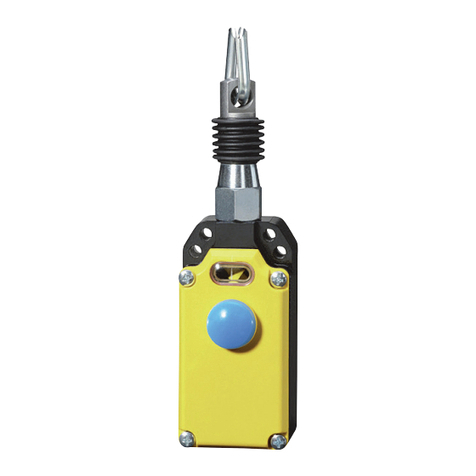
Cat No. 8501 Series Basic Switch
Cat No. 8502 Series with Key Lock
Cat No. 8503 Series with Alternator Field Disconnect
Cat No. 8504 Series with Lock and Field Disconnect
BATTERY SWITCHES
INSTALLATION AND OPERATING INSTRUCTIONS
For use with alternators and generators rated 6-50 V.D.C. switch rating: 250 amperes continuous, 360 intermittent.
Locate switch to keep battery cables short as possible.
All wiring to the switch shall be preformed by a QUALIFIED MARINE ELECTRICIAN, and in accordance with the “Fire Protection
Standard For Motor Craft”, N.F.P.A.* No. 302, The Standards of the American Boat and Yacht Council, Inc.*, and the U.S.C.G.*
Safety Standards for Boat Electrical Systems (33 CFR 183).
CAUTION: (1) Make sure connections at terminals No.1 and No. 2 are of the same polarity.
(2) Always STOP engines before switching to “OFF” position. Make-Before-Break feature allows switching between
1-all-2 positions with running engines.
Erratic operation, particularly after very long periods of idleness, can be cleared by rapidly switching back and forth briskly several
times with out any load connected.
NOTE: (1) Locate switch to keep battery cables short as possible.
(2) If switch is to be mounted in an area subject to corrosion, it is recommended that a liquid electrical coating be
applied to the terminal connections.
(3) Terminal stud size is 5/16 inch. Torque terminal nuts to 10 ft-lbs.
(4) Mounting screw size #10 pan head or round head. Do not over-tighten screws to prevent deforming the switch.
OPTIONAL ACCESSORIES
(1) Key Lock - Switch can be locked only in the “OFF” position. Key can be removed in either the locked or unlocked position.
(2) Alternator Field Disconnect - used to break the field current and protect the alternator diodes if the battery switch is
inadvertently turned to the “OFF” position with the engine running. Hook-up instructions and applicability are explained in
Diagram #4.
(3) Optional cable spacer (Dealer Pack: 0462DP0RED or Bulk Pack: 0462000RED) available for use with large or heavy-duty
cables, when additional space is required between terminals and mounting surface.
The following diagrams illustrate typical installations.
+
-
+
-
F1•
F2•
12
COM
F1•
F2•
12
COM
F1•
F2•
12
COM
Starter
Optional
Alternator Field Disconnect
See Diagram #4
DIAGRAM #1
Single Engine
2 Batteries
Switch Position
Indicates which battery
(#1, All, #2) is connected
to engine
Battery #1 Battery #2
Engine Ground
+
-
+
-
F1•
F2•
12
COM
Port
Starter
DIAGRAM #2
2 Batteries
2 Engines
2 Switches
This allows either engine to
be started by either battery.
Port switch indicates which
battery(#1, All, #2) is connect-
ed to port engine and star-
board switch indicates which
battery(#1, All, #2) is connect-
ed to starboard engine.
Battery #1 Battery #2
Engine
Ground
F1•
F2•
12
COM
STBD
Starter
Optional Alternator Field
Disconnect for Port
Engine See Diagram #4
Optional Alternator Field
Disconnect for Starboard
Engine See Diagram #4
+
-
+
-
+
-
Port
Battery
Engine
Ground
Starboard
Battery
Lighting
Battery
Port
Starter
STBD
Starter
DIAGRAM #3
2 Switches
2 Engines
2 Engine Batteries and separate
bank of lighting batteries
This allows both engines to be used
to charge lighting batteries.
Port switch indicates which battery
(Port only, Port Lighting only) is
connected to port engine and the
starboard switch indicates which
battery(Starboard only, Starboard
Lighting only) is connected to
starboard engine.
Optional Alternator Field
Disconnect for Port Engine
See Diagram #4
Optional Alternator Field
Disconnect for Starboard
Engine See Diagram #4
DIAGRAM #4
ALTERNATOR FIELD DISCONNECT
A. Use minimum 14 awg wire, suitable for use in marine engine compartments.
B. On systems with separate regulator, splice the field disconnect switch into the field wire “F” as
shown:
1. At the Regulator:
2. At the Alternator:
C. On unitized alternators with built-in regulator - a field disconnect cannot be installed.
REGULATOR
FBA
Do Not Disturb “B & A” Wires
To Alternator
F1 F2
To Field Disconnect Switch
Terminals F1 & F2
F R
Alternator
F1 F2
To Field Disconnect Switch
Terminals F1 & F2
Alternator
Output
DO NOT DISTURB
“F & R”
Marked on back of
alternator where
connector plugs in.
Do Not Disturb
“R” Wire
1. American Boat & Yacht Council, Inc. 2. U.S. Coast Guard 3. N.F.P.A.
613 Third Street, Suite 10 Washington, D.C. 20593 1 Batterymarch Park
Annapolis, MD 21403 (or your local C.G. office) Quincy, MA 02269