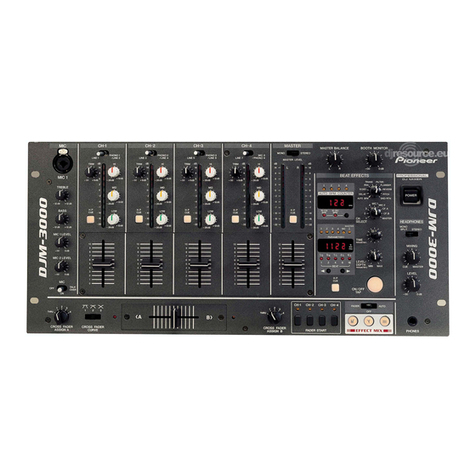
. BLOCK DIAGRAM EXPLANATIONS
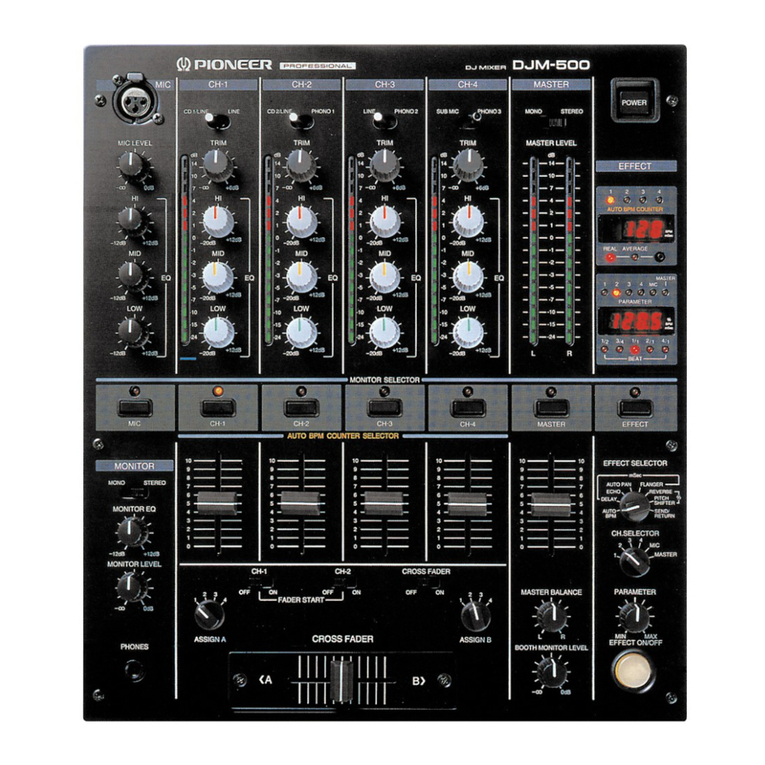
(1) Channel Amplifier Section
The input signal of each channel is sent to the ming part,
There are four channels, and each channel has input from
two systems,
The respective channels are matched to the connected
equipment, channell is CDILIN, chanel 2 is CDIPHONO,
chanel 3 is LINHONO, chanel 4 is MIC (sub)IPHONO,
and selection is made with the input selector switch.
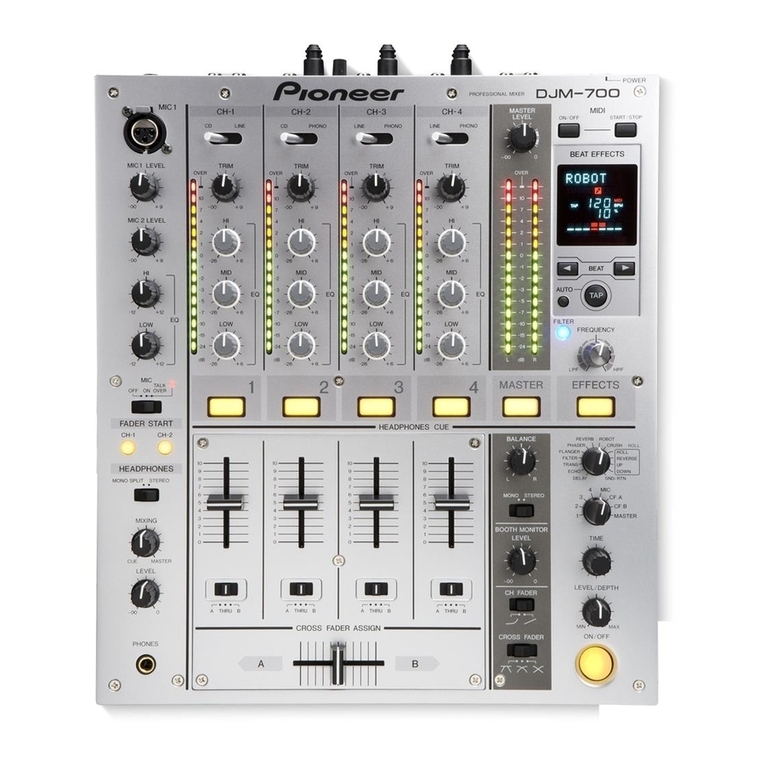
Each chanel is equippe with a 3-band equalzer permttig
independent control of trim for control of the input signal
level and fader volume for high, medium, and low range,
(2) Channel Assign and Mixing Section
T(~)ignal from the chanel amplifier is selected with the
C :)1': assign switch and is sent to both ends of the cross-fader,
The C,F.ldirect mixig switch is used to select mixing only
with the source alott to the cross-fader or mig only with
the cross-fader,
(3) Master Amplifier Section
The signal afr ming is processed.
The input signal passes balance adjustment and mai volume
adjustment and then is sent to the next stage,
(4) Monitor Amplifier Section
This is the source selection circuit for confirmation of the
signal of each chanel with headphones etc.
The input signal can be selected from channels 1 to 4, mie,
effector, and master. For channels 1 to 4, the signal before
each channel fader can be monitored, so that signal
confirmation is possible in case of trim adjustment and
r ming, Also, and adjustable equalizer is installed for
c pondence to cases where beat is diffcult to hear with
headphones,
(5) MIC Amplifier Section
There are two mike input systems, the phone type input
(submie) at the rear panel and the Canon typ input (mai
mike) at the control panel, and the main mike input is
equipped with an independent equalizer for high, medium,
and low range in addition to volume adjustment.
D.JM-500
(6) BMP Detection Section
The BMP (Beats Per Minute, a factor indicating the speed of
a title as the number of beats per minute) of the signal
selected with the monitor select switch are detected, and the
BMP value or the beat interval time is displayed.
The synchronization of the input signal by frequencies is
detected, the BMP of the most stable signal ar selected, and
the data are processed by the microcomputer part. The
detection modes are "real-time mode" with data display in
real time and "average mode" with display of stable
inormation for a cert tie, and the micromputer executes
output accordig to the indication,
The beat timing also can be indicated to the beat monitor of
the selected chaneL.
(7) Effector Section
Diverse effects ca be realized with the built-in DSP (Digita
Signal Processor),
The DSP operation ca be selected with the effector fuction
selection switch from pitch shifter, delay/flanger, pan!
reverberation/echo,
The applicable channels are channels 1 to 4, mike, and
master, For increased ease of use in combination with an
external equalizer a SENDIRETURN terminal which can
correspond to each channel is provided, and input level
adjustment is possible,
(8) CD Control Section
Wlen a CDJ-50/CDJ-500(G) is connected to channell or 2,
the CD player can be stared from this unit.
In the same way, when CDJ-500 II is connected, stop (back
cue) is possible in addition to CD player start. This is
executed using the relay start function of CDJ-50/CDJ-
500(G) and CDJ-500 II, and interlocked operation with
channel fader and cross-fader also is possible.
(9) Operation and Display Section
The part in regard to display and operation of the built-in
fader is executed by a microcomputer. BPM display and its
mode switching, control of effect parameters and built-in
fader, beat monitor, and level meter display, control, etc. are
executed by an 8-bit microcomputer.
8