4. CIRCUIT DESCRIPTIONS
GRAPHIC
EOUALIZER
SECTION
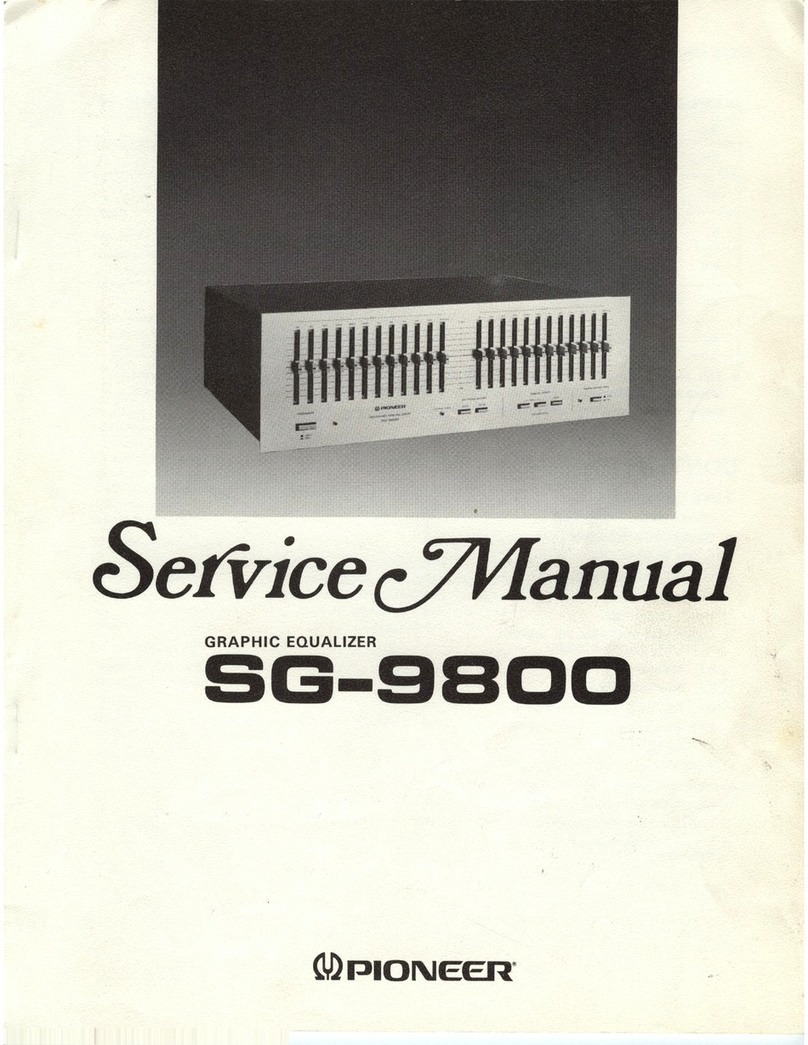
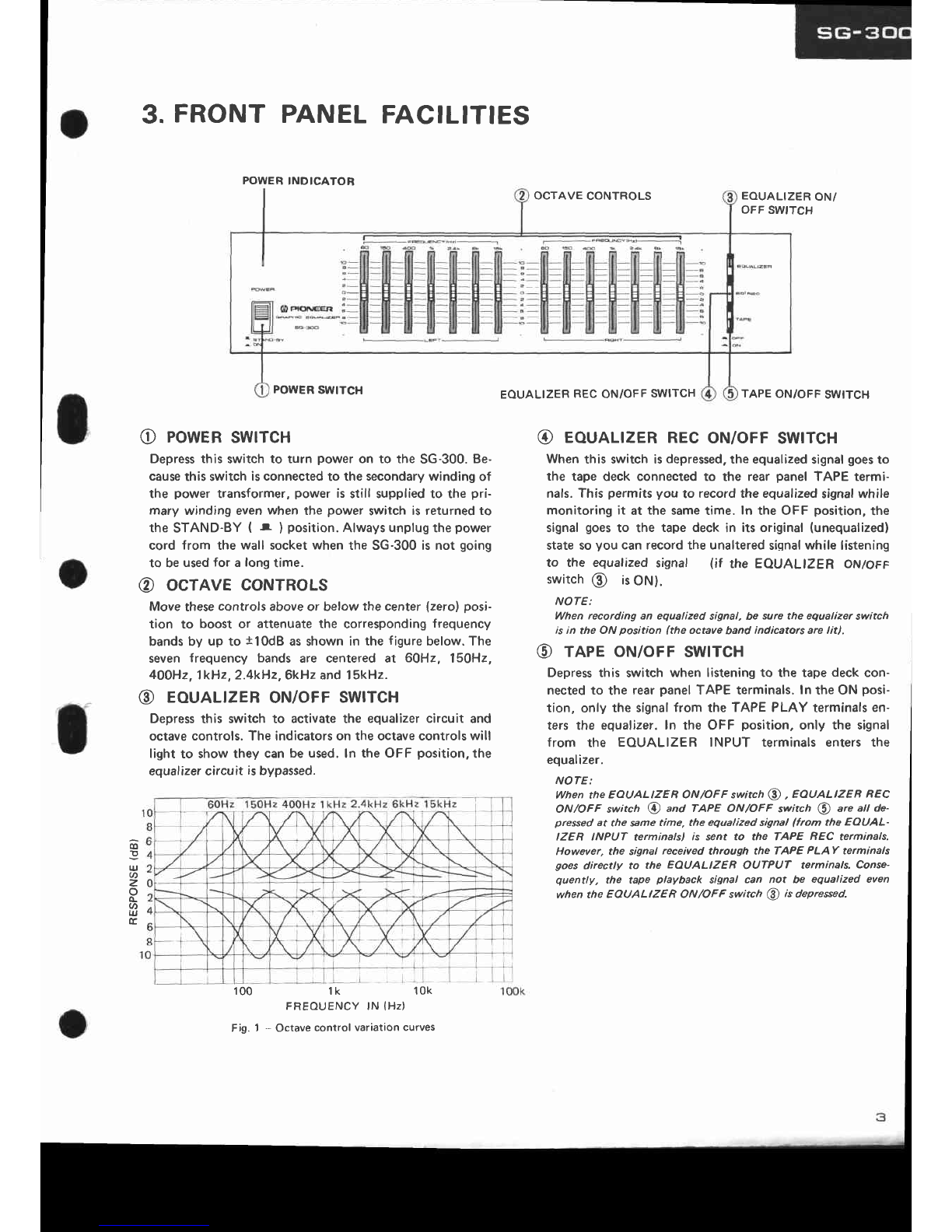
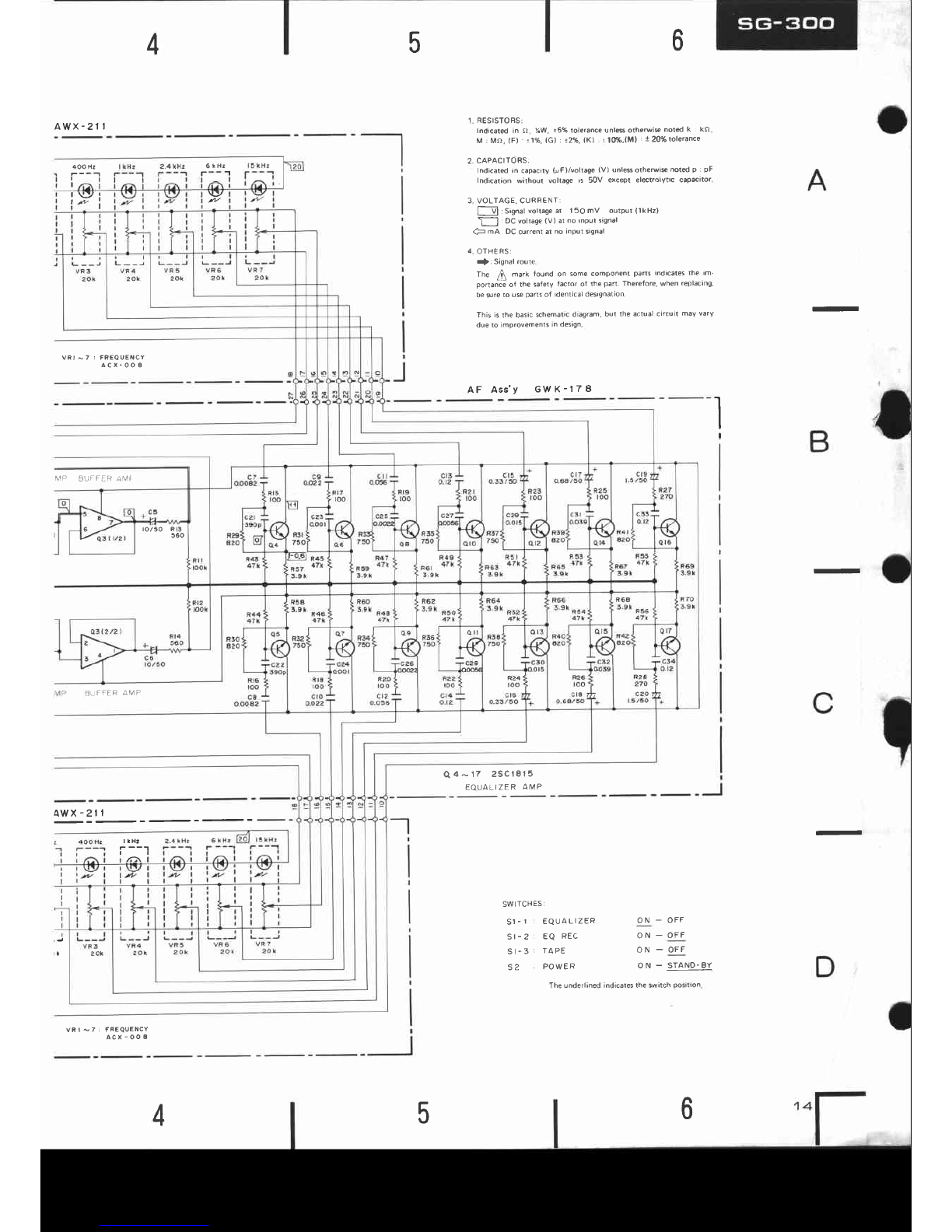
A graphic equalizer is a device which divides the
audio frequency band into severalsegments
called
octaves so that the level of each individual octave
can be increasedor reduced.The SG-300 divides
reproduced frequencies into 7 octaveswith center
frequencies of 60 Hz, 150 Hz, 4OO
Hz, 1 kHz,
2.4kHz, 6 kHz and 15 kHz. The level of each
octave can be varied throughout arange of t10 dB,
and the left channel and the right channel can be
adjusted independently.
Further, when the equalizer switch (EQ SW) is
ON, the LEDs built into the level controls (sliding
variable resistor knobs) light to allow the fre-
quency responseof each octave to be determined
visually. The equalizer element is an LC series
resonance circuit in which the active element is
an inductor equivalent. This resonance circuit is
connected to the variable resistor linking the
positive and negative input terminals. (SeeFigwe
4-L.',)
This causes the impedance of the resonance
circuit and the resistanceof the varirableresistorto
act as constants for the input circuit and the
feedback circuit. Further, buffer amplifiers are
located before and after the EQ AMP so that the
frequency response of the equalizer element are
not affected by the impedance of audio equipment
connectedto the SG-300.
Figure 4-1 shows the equivalent circuit for the
graphic equalizer section. In the area surrounded
by the dotted line, the circuit on the Q1 side of
point A is equivalent to an inductance and a
resistance connected in series. Any required re-
sonant frequency can be obtained by changingthe
inductance and capacitance of the seriesresonance
circuit by varying CL, C2, Rg and R4. \{ith the
SG-300, 7 equalizer elements $'ith different
resonance frequencies are included in one EQ
AMP, and each frequency segmentcan be adjusted
independently. The frequency response of each
octave is boosted when the slider of the variable
resistor is moved toward the minus input side(the
feedback input side)of EQ AMP ICl; conversely,
it is reducedwhen the slider is moved to the plus
side.
POWER
SUPPLY
CIRCUIT
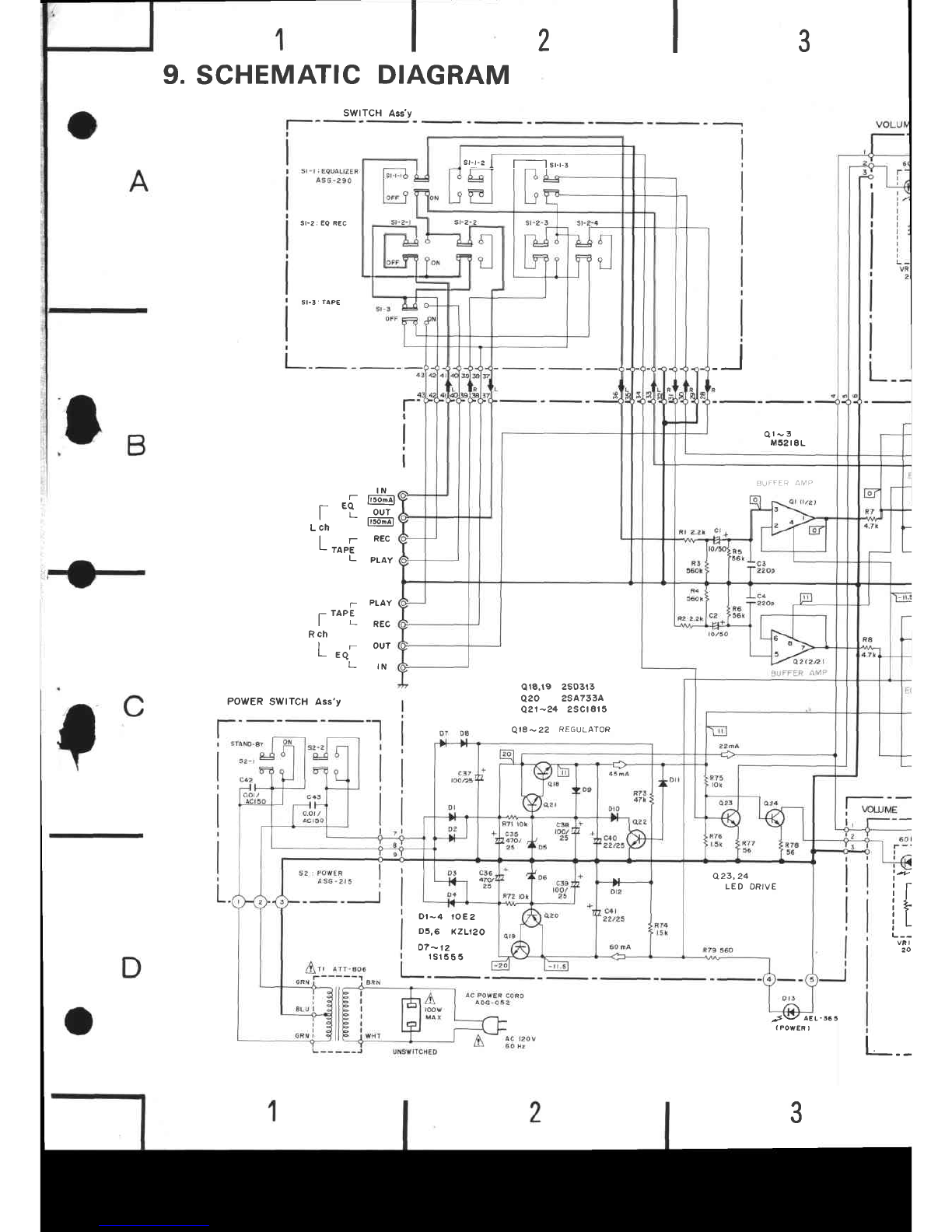
As is shown in Figure 4-2, two voltage(+11 V
and - 11.5 V) are supplied by the regulated
po\Mer
supply of the graphic equalizersection.The LED
set in the knob of eachsliding resistoris supplied
with stable cunent by Q23, so the light emitted
4,
by the LED is steady. Further, the load on Q18
and qzL is light because the LED current is
obtained after full waverectification. Q23 goes
ON
when the EQ switch is tumed ON to release
GND
on the base side, and the LED lights when Q23
goes
ON.
SWITCHSECTION
o TAPE switch
This switch selectsbetween aprogram sourceor
atape playback (or REC monitor) signal.
o EO RECsritch
Turning this switch on causes an equalized
program source signal to be output to the REC
terminals.
. EO suritch
This switch determines whether or not a signalis
to be equalized; when this switch is OFF, the
equalizing circuit is by-passed and the input
signal is connected directly to the output ter-
minals.
L----------_____J
Fig.
4-l Graphicequalizer
+llVqzs 3
FORSLIDE
VR KNOB
LED
5W
,{,
EQ
EQ AMP
Fig.4-2 Power
supply
circuit