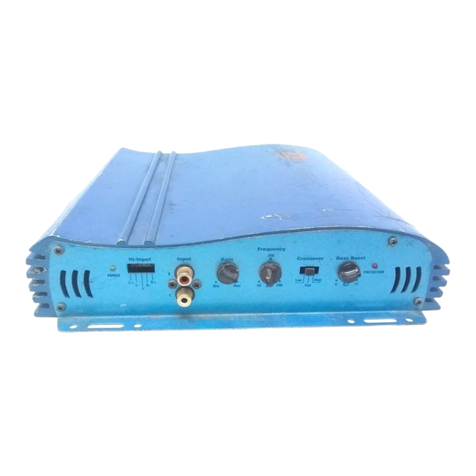
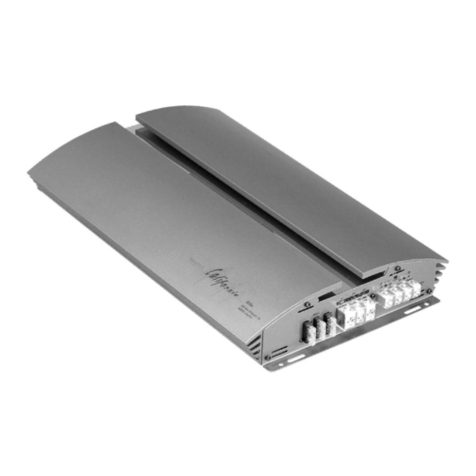
Profile Clarus CL440 Installation instructions

MOSFET POWER AMPLIFIERS
Installation Instructions / Owner's Manual
CL440 CL640 CL600M
CL300 CL400 CL600 CL800 CL1200

INTRODUCTION
Congratulations on your purchase of a Clarus state-of-the-art power amplifier. Your selection
of a Clarus car audio product indicates a true appreciation of fine musical reproduction.
Whether adding to an existing system or including your Clarus amplifier in a new system, you
are certain to notice immediate performance benefits.
KEEP YOUR SALES RECEIPT
Take this time to attach your sales receipt to the manual and put in a safe place. In case of any
unforeseen reason this product may need warranty service, your receipt will be necessary to
establish purchase date.
RECOMMENDATION
A power amplifier's performance is only as good as its installation. Proper installation will
maximize the system's overall performance. It is recommended that you have our product
installed by an authorized Profile retailer. However, if you decide to install it yourself, please
carefully read through this manual and take your time to do a quality installation.
WARNING!
Exposure to high power sound system can cause hearing loss or damage.
Listening to your system at loud levels while driving, will impair your ability to
hear traffic sounds and emergency vehicles. Use common sense when listening
to your system.
WARNING!
Exposure to high power sound system can cause hearing loss or damage.
Listening to your system at loud levels while driving, will impair your ability to
hear traffic sounds and emergency vehicles. Use common sense when listening
to your system.
IMPORTANT! Before making any connections, disconnect the car's battery
until the installation is completed to avoid possible damage to the electrical
system.
Serial # Model #
1

SAFETY PRECAUTIONS
Fuse amplifier's power wire at the battery.
Be sure to fuse the power wire within 12" of the car's battery. This will protect the car's
battery in case of a short circuit between the power amplifier and battery. THIS IS A MUST,
the amplifier's built-in fuse will only protect the power amplifier not the car's battery!
Use high grade wire connectors.
To ensure maximum power transfer and secure safe connections, it is recommended to use
high grade barrier spades (for connection at amplifier) and terminal rings (for connection at
battery).
Do not run any wires underneath vehicle.
Exposed wires have a chance of being cut or damaged. It is best to run all wires through the
vehicle under the carpet and/or side panels. This lends to a cleaner installation and less risk of
damage.
Use caution when mounting amplifier.
Remember there are many electrical wires, gas lines, vacuum lines, brake lines as well as a gas
tank in the automobile. Make sure you know where they are when mounting the amplifier to
avoid puncturing lines, shorting wires or drilling holes in the gas tank.
Run signal wires away from electrical wires.
To avoid possibility of induced noise from the car's electrical system (i.e. popping noises or
engine noise), run wires away from the car's electrical wiring.
Make all ground wires as short as possible and at the same point.
In order to reduce the chance of ground loops (i.e. engine noise), make the grounding wire as
short as possible to reduce the wire's resistance. Also, when using multiple components, make
sure all units are grounded at the same point.
Avoid sharp edges when running the wires.
To avoid the possibility of power, signal or speaker shorts, be careful not to allow the
amplifiers wires to come in contact with sharp edges. Use a grommet to protect the wire when
running through the fire wall .
2

FEATURES AND BENEFITS
DC Offset Protection
This circuit protects the output of the amplifier against DC voltage. If for some reason DC
voltage is detected at the output stage, the amplifier will shut down protecting the speakers
from direct current.
Short Circuit Protection
The circuit protects the amplifier from damage due to a short found in the speakers or wiring.
If one of the speakers or its wiring comes in contact with ground, the amplifier will shut down.
To resume normal operation, correct the problem and turn the head unit off, then back on. The
amplifier will reset and play again.
Thermal Protection
To protect the amplifier circuitry against damage caused by prolonged exposure to high
temperatures, a thermal protection circuit is activated if the amplifier reaches excessively
high operating temperature. Once the thermal circuit is activated, the amplifier will shut
down to cool off. The Amplifier will automatically turn back on once it cools down to a safe
operating temperature.
Protection Indicator
This red diagnostic L.E.D. indicates that the amplifier has gone into protection. Once on, the
amplifier will have no output. To resume normal operation, turn head unit off and back on again.
If the amplifier immediately goes back into protection, check for high temperature, short
circuits or low impedance.
Tri Mode Capable
If so desired the amplifier may be run in stereo and mono at the same time. For example, this
feature would allow you to run a pair of mid and tweeters in stereo and a sub-woofer mono.
Built-in Crossover
The Clarus amplifiers include a built-in variable **high and low pass crossovers. The crossover
features a variable frequency selection (40Hz ~ 500Hz) for precise high or low pass filtering.
**Except CL600M which has a 50 ~ 120Hz low pass filter.
3

Bass Boost
For added low frequency performance the amplifiers are equipped with a variable 0~18 dB
bass boost @ 45Hz.
Line Out
One set of full range line outputs have been provided for convenient connection to additional
amplifiers in the system.
Subsonic Filter (CL1200 & CL600M Only)
Power Fusing
This protects the amplifier against short circuits and excessive current.
Remote Turn-on
Automatically turns amplifier on when connected to the head unit's remote output. The
amplifier will turn on and off with the head unit to save current consumption. This control also
operates the reset circuit for the amplifier's protection. It must be connected with the head
unit in order to reset protection circuits.
Power and Speaker Distribution Blocks
Heavy gauge bare wire distribution blocks are provided for maximum power and signal
transfer with minimal resistance.
Adjustable Input Sensitivity
Allows you to fine-tune the level matching between your source and the power amplifier.
High Level Input
Allowing for integration with "Factory Sound Systems"
Stable To 2 Ohm Stereo Mode
Stability to 2 ohm in stereo mode, 4 ohms bridged.
A subsonic filter has been provided to filter out unwanted low bass frequencies below the
audible range. Once engaged this feature helps to improve the amplifiers overall performance
since power is not wasted reproducing frequencies beyond the audible range. This feature
works in conjunction with the Low-pass crossover to provide band-pass filtering.
4

MOUNTING LOCATION
Before you start the installation, it will be necessary to find a mounting location for the
amplifier. Find a location in which the amplifier will receive adequate ventilation in order to
dissipate the heat it develops during operation. Two popular mounting locations are in the
trunk or under the seat.
Select the location in which you wish to mount the amplifier. Use caution when mounting
amplifier, there are many wires, gas lines, vacuum lines, brake lines as well as a gas tank in
the automobile. Make sure you know where they are when mounting the amplifier to avoid
puncturing lines, shorting wires or drilling holes in the gas tank. Once you are ready, use a
pencil to mark the mounting holes in the bottom panel. After you have marked the locations of
the holes move amplifier out of the way and drill small starter holes to make the tapping
screws easier to install. Use provided screws to tighten down the amplifier.
5

Connect the amplifier to the car's battery.
At times, the amplifier will need to draw large levels of current that cannot be provided by any
circuit in the car's fuse box. We recommended using an 4 to 10 gauge power wire for your
connections depending on the amplifier and length of the wire. Strip one end of the wire to
connect to the terminal on the amplifier marked +12V. Loosen screw terminal and connect
bare wire and tighten. Use caution to make sure no stray wire stands come in contact with
surrounding terminals causing short circuits. Run the wire directly to the positive terminal of
the car's battery. Make sure to use an in-line fuse within 12" of the car's battery to protect
the electrical system and amplifier against short circuits and/or power surges.
Connect the ground terminal of the amplifier to the car's chassis.
For the ground connection, use an 4-10 gauge wire (black) to connect to the terminal marked
GND and then connect it to the car's chassis. Try to keep the length of the cable as short as
possible, preferably less than 6". Also make sure that the point on the car where the
connection is to be made is free of paint and dirt.
Connect the remote terminal of the amplifier to a switchable +12V source.
This connection allows the amplifier to be turned on and off with the power control of the
radio. If the radio has a REMOTE output terminal, connect it to the amplifier's terminal
marked REMOTE (using a 16 gauge wire or heavier). Now when the radio is turned on, the
amplifier will automatically turn on. This connection can also be made to the radio's Power
Antenna wire.
IMPORTANT! Before making any connections, disconnect the car's battery until the
installation is completed to avoid possible damage to the electrical system.
6
POWER CONNECTIONS
CAR BATTERY
+12V
CAR BATTERY
+12V
--
++
94.794.7
RADIO'S REMOTE
TURN-ON OUTPUT
RADIO'S REMOTE
TURN-ON OUTPUT

7
Connect the RCA output of the head unit (AM/FM cassette player, CD, or DAT)
to the RCA input terminals of the amplifier.
To make these connections, we recommend high quality RCA cables, which are available at your
local car audio retailer. Run signal wires away from electrical wires to avoid possibility of
induced noise from the car's electrical system (i.e. popping noises or engine noise). Please note
that when making these connections the signal inputs correspond with the speaker outputs.
For example: If you connect the radios front right RCA to "CH 1" .......then speaker output
"CH 1" will operate the front right speaker.
SIGNAL CONNECTIONS

8
High Level inputs have been included to connect the amplifier to a radio without low-level
outputs (i.e. factory radio). This connection will allow you to connect directly to the speaker
output of the radio with out the need of an external adapter.
Determine the type of radio you have and make one of the following connections.
HIGH LEVEL CONNECTIONS (OPTIONAL)
CAUTION! Before making any connections determine the type of radio to avoid possible
damage to amplifier and/or radio.

9
This manual suits for next models
7
Table of contents
Other Profile Amplifier manuals