04
THE INSTALLATION AND USE OF THIS
PROFESSIONAL EQUIPMENT MUST BE DONE
BY COMPETENT AND TRAINED PERSONNEL
WITH APPROPRIATE TECHNICAL KNOWLEDGE
AND UNDERSTANDING OF APPLICABLE SAFETY
STANDARDS. BEFORE USING THIS EQUIPMENT
IT IS NECESSARY TO CONDUCT THE FOLLOWING
STEPS:
1. Water connection (tap with hose holder); the steam generator can be con-
nected to the tap with hose holder labelled WATER INLET (fig. 5 #1), placed
on the Boiler, via a rubber tube which must have a pressure capacity of at
least 100 lbs. This rubber tube must be fixed tightly with 2 hose clamps.
(NOTE: before inserting the rubber tube into the water inlet, you must flush a
few litres of water in order to clean the conduit).
2. Protected electrical plug, suitable to the power voltage of the
steam generator.
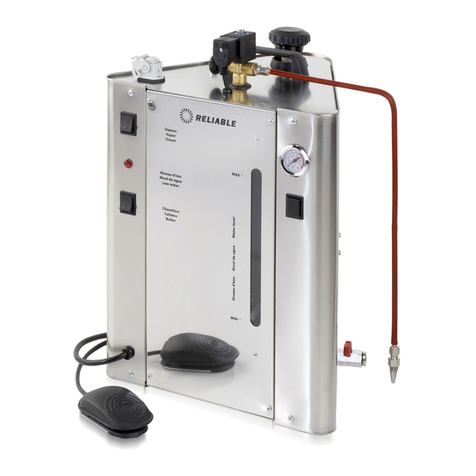
3. 8000CJ - Screw the nozzle into the steam fitting and plug in the 4-pin
receptacle for the electronic foot pedal. 8000CD - Connect the steam gun or
steam brush the same way using the quick disconnect steam hose.
4. 8000IS - Insert the two-piece wand into the flange on top of the boiler,
tighten with the side screw and attach the spring on the iron hose to the coil
end of the wand.
PACKAGE OPENING
1. Remove the Boiler from the box, affix the wands, connect iron sockets and
steam tubes, fix the iron cable to cable/steam wand support hook.
CONNECTION TO WATER PIPE AND STARTING
1. Connect the rubber tube to the tube holder called WATER INLET placed on
the steam generator and turn the water tap on.
2. Connect the power supply cable to a protected plug with a grounded switch,
and a voltage suitable to the steam generator voltage.
3. After switching on the Boiler (A) and the irons and the steam switch (B),
wait for the Boiler green pilot light to switch off (C) and for the pressure
gauge to indicate 50-60 lbs. At this point press the steam button 3 or 4
times, so that the steam comes out: this must be carried out in order to
heat up the hose that delivers steam to the iron steam wand/nozzle. This
prevents water leakage (the steam iron must always be held in such a way
as not to harm the operator.