Most modern designed products are marketed on price then features with performance
reduced to what can be acceptable to the public. This is not the State of the Art and
should never be considered as such. After all a mass produced car is never considered
to be racing car.
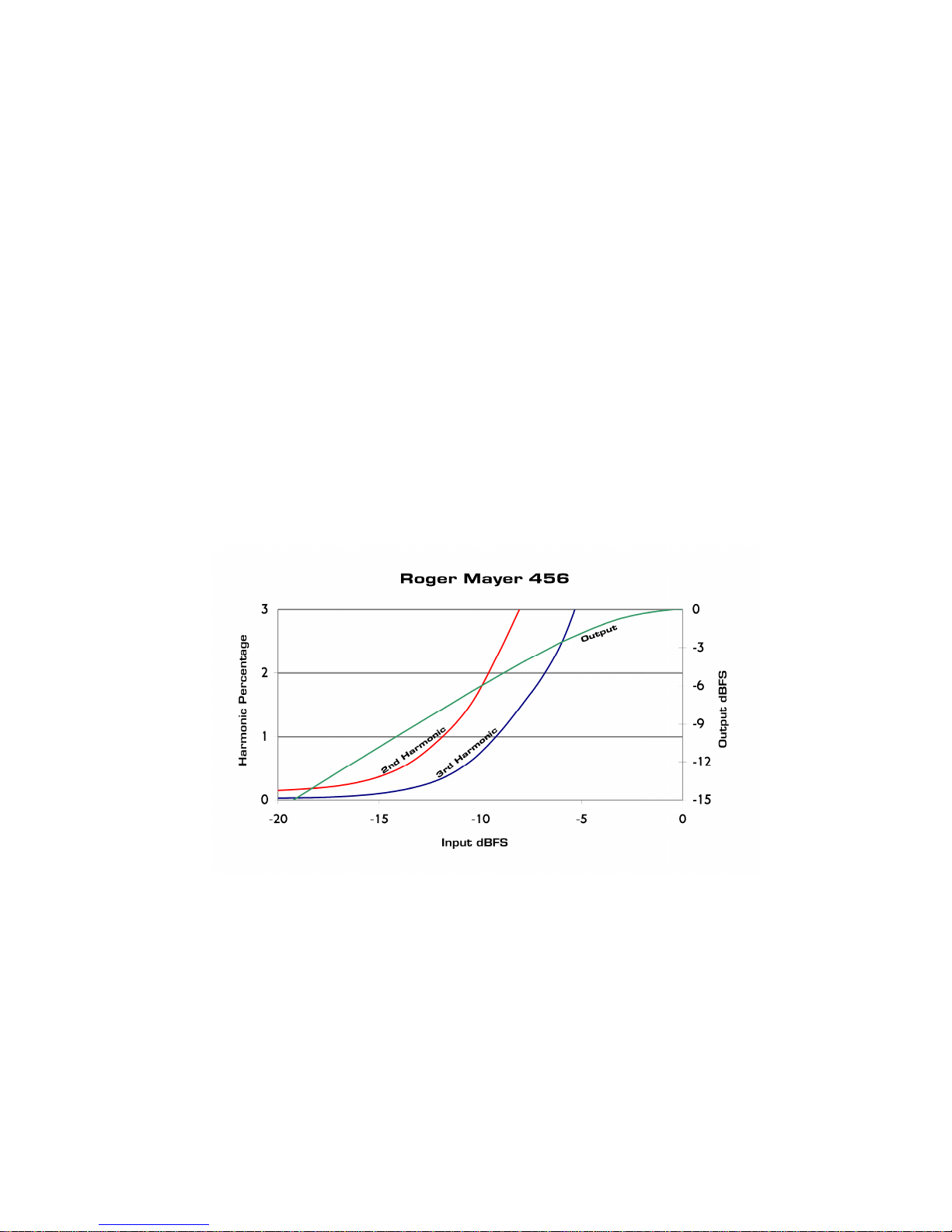
The 456 Microphone Pre-Amplifier uses the expensive discrete approach to audio
performance without any ICs in the Audio Path and sets the current State of the Art
performance using today’s highest quality parts and techniques all evolved from the
ground breaking and pioneering techniques we developed back then.
The detail, phase and frequency response from our direct approach has to be heard and
compared to other pre-amplifiers.
CHANNEL TECHNICAL INFORMATION:
The following details apply for every channel of the 456 and the 2 Channel model can
easily be upgraded to the 4 Channel model. Each channel has its own multistage
onboard power supply circuits providing the required voltages and also providing signal
isolation from the other channels to minimise crosstalk. A single 48V World Power
Supply Desktop Adaptor is supplied and is conforms to the latest ECO and Safety
Regulations.
TRANSFORMER BALANCED INPUTS AND OUTPUTS
We manufacture in house our own custom transformers using Ferrite Cores with wide
bandwidth material specification to ensure ultimate high frequency, phase response and
hum rejection. There is no better way to connect a microphone into an amplifier than by
using a high bandwidth quality transformer. Perfect isolation and safety can be obtained
in the most demanding situations with no chance of destroying your microphone pre-amp
by plugging a microphone in. Phantom Powering can be left on as traditionally always
was done without damage to the microphones whether they are Ribbon, Dynamic or
Condenser. Just make sure your microphone cables are correctly wired and of the
highest quality. The modern myths about turning the phantom on and off have been
discussed and dismissed and began with the introduction of electronically balanced input
circuits with phantom power issues.
Electronically balancing an input with a multiple IC configuration is cheaper for sure but
then you have introduced a convoluted signal path right before you start to amplify it.
Also be aware that audio signals are not symmetrical about the zero axis and also differ
with every 180° so electronic balancing will always introduce input errors.
So it makes sense to have a direct balanced transformer path to the pre-amplifier.
MICROPHONE INPUT TRANSFORMER: This has been especially designed to
interface and accommodate high output condenser capsules as well as low output ribbon
types. SPL levels of 150dB from an AKG 414 will not overload it.
PHANTOM POWERING: is from carefully matched pairs of 6K8 resistors with a
tolerance typically. 0.02%. Each channel provides a 4-stage filter network producing
175dB of noise reduction. Virtual DC operation to the microphone is thus ensured.
LINE INPUT TRANSFORMER: The transformer is capable of accepting high levels in
excess of +35dBu.
OUTPUT TRANSFORMER: This has an electronic specification that is perfectly matched
to DAW input specifications. The headroom provided is at least 24dB above nominal
operating conditions.