67
When electrofisher is switched on the frequency is set on optimum level
(50 Hz) and the duration on minimum.
J - the consumed current by electrofisher ( Amperes) from battery . After
the point we can see decimals of Ampere.
P - Power (watts). When the steering button is not pressed - off (START)
the consumed power is in the idle mode. When the START is pressed (ON) the
output power appears on the panel on the right side.
Digits separated by a blinking colon show the time of electrofishing.
When the password is inserted the time is counting automatically and it is
displayed on the panel at once. The given function is not marked by any sign and
is recognised by the blinking colon.
H hours the number of consumed Ampere-hours during electrofishing.
If the battery was full loaded and during electrofishing it was unloaded then we
can see the real capacity of Ampere-hours, which a given battery has. After the
point we can see decimals of Ampere-hours. In fact capacity showed is lower
than on the battery as the power source is not always fully unloaded.
General operating time and Ampere-hours consumed by the
electrofisher. When the power supply is turned off the indicator of Ampere-hours
and time of electrofishing is resetable to zeroes. However, during operation time
the data are saved and summed up in the memory. Looking at them is possible by
pressing the button “LGT/MOD” for a few seconds. To zero the given counter is
possible by pressing the button “FREQ” once.
If, on the display panel, the sign (-) appears in the middle this means that
battery voltage decreased below permissible level ( 10,3 V). If it goes while the
button START is pressed it is advised to lower the power of fishing in order to
catch for some time yet. If the (-) is lighting constantly then you should stop
electrofishing and change or charge the battery. The sign (+) at the right side of
the counter of time shows that the battery is appropriately loaded and has enough
capacity for electrofishing.
At the right of the sign (+) while the button START is pressed the small
arrow “ ” appears which indicates the state of steering cable.
The electrofisher SAMUS-725G has an overload protection, which
prevents the device from damages caused by high surges, that switches on when
the power exceeds 650 watts. When it works the display shows ATTENTION!
OVERLOADING! for 5 seconds.
As it is possible to overheat transistors then in such case the device
automatically blocks itself for 5 seconds from further operating ( in case of
pressing the button START) - that time is necessary to cool the transistors. In the
moment of blocking all regulations keep going without influence on indication.
After 5 second period the warning ATTENTION! OVERLOADING! disappears
and the electrofisher is ready for electrofishing again.
ELECTROFISHING WITH SAMUS-725G
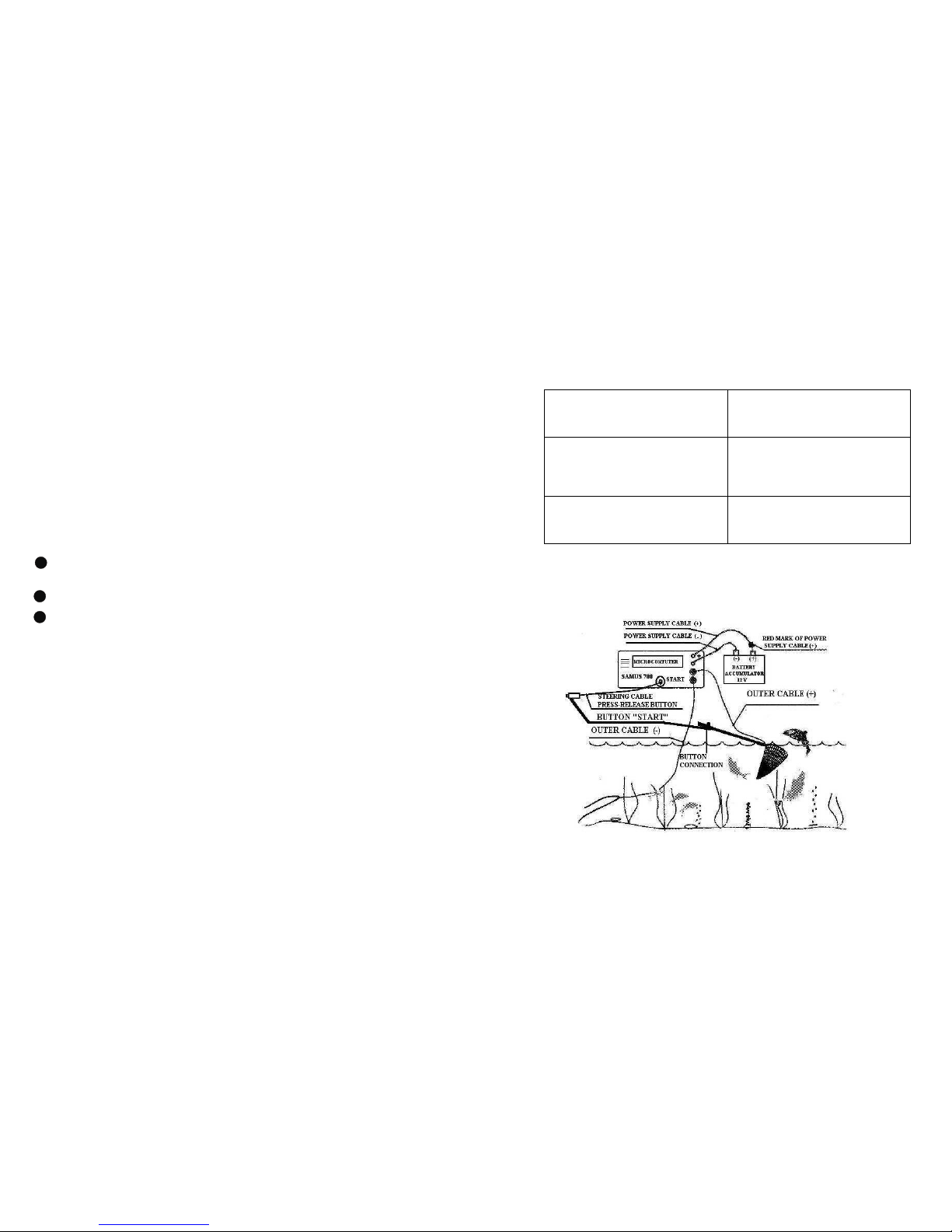
When electrofisher is correctly connected we can start fishing dipping
the landing net in water and pressing press-release button. The (-) minus cable
with metal wire at the end must ALSO be dipped into the water. Fishing takes
place by periodic/short pressing the button START on landing net while it is
under water surface. The (-) minus cable with metal wire at the end and the
cable (+) plus must be in the distance of 3 meters and in case of catfishing it can
be greater even 20 meters. In this moment flow of electric current follows
between electrodes and executes the fishing. You should hear silent noise and
blinking red lamp on the device as well as display showing operating
parameters- J (current), P (power), time.
In the course of electrofishing negative (-) electrode is placed in water
"freely" and positive electrode (anode)(+) serves to active fishing. Intensity of
current field is the greatest at positive electrode and quickly diminishes with the
distance from it. In regard with this fishes become paralysed in the radius not
greater than 2-5 metres from anode. Inertly flowing fishes we should pick up
quickly because in the course of several seconds they recover equilibrium and
escape at random.
When we catch wading in a river cathode cable we pull near behind so
that space out between electrodes must be not greater than 2-3 metres.
You should be interested in two parameters at the first try- J or P. For
instance J should be regulated by increasing duration (L) of going out impulses
until the consumed current will reach 6-20 Ampere. Approximately, it will be
your nominal POWER for electrofishing and fishes should be caught in that
power range accordingly.
Switching the device by pressing START should be no longer than for
10 seconds. If the consumed current is lower than 10 A you can hold on the
START button longer and in case of 5 A you can keep it very long.
It is not advised to turn the electrofisher very often as fishes are shy,
especially large, and will escape from big distance if they are outside of the
catching zone. You should turn the device every 5-10 meters from last fishing
place. Boating should be silent and careful in order not to frighten fish.
Fishermen should also watch out not to close cathode and anode and
simultaneously to switch on the device because it may cause its overload and
damage, but it should not happen in most cases as the electrofisher has built-in
protection from overloads and display will show ATTENTION!
OVERLOADING!