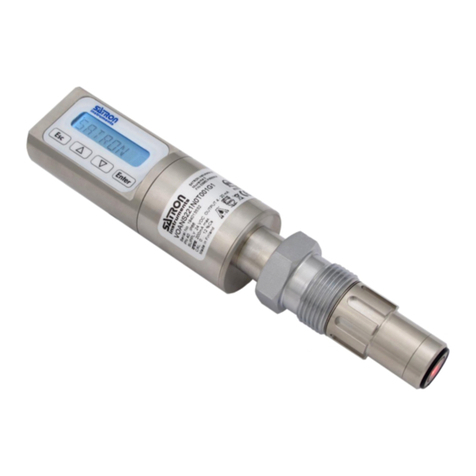
SATRON VO Installation and Setting-Up Instructions Manual
5
Satron Instruments Inc., FI-33960 Pirkkala, Finland
Tel. +358 207 464 800, www.satron.com
1.1.3 Instructions and spare parts that are according and within the EHEDG and 3‑A appliance
46 ‑ 04
FOR EHEDG CERTIFIED INSTALLATIONS.
Only the Satron VO Turbidity transmitter, models VOM
and VOA with G1 connection and EPDM seal are EHEDG
certied for EL Class I and are optimized for CIP (Clean
In Place) cleaning. Therefore cleaning of the sensor
can be done in place together with the pipeline or tank
cleaning of the process.
Install the sensors according to the directions given in
EHEDG documents 8, 10 and 37.
E.g. mount the sensor in a self-draining orientation, which
means that the angles will be chosen in such a way that
uids can be drained completely by gravity alone. When
applied in tanks, the cleaning device must be positioned
in such a way that the sensor is perfectly cleaned.
Welding the G1 M548101A coupling is described here as
an example.
To allow self draining, place the coupling in the mounting
hole as shown in Fig. 1-2.1. Make sure the leakage
detection port is down. Then weld with several runs so
to prevent the coupling’s oval distortion and tightness
problems. The inside welding must be cleaned, and
polished with an end result of Ra <0,8. The adapters
must be TIG welded. Directions for welding are given in
EHEDG documents 9 and 35.
Make sure the leakage detection port is facing down to
allow self draining for all Couplings and Adapters.
Preferably do not mount on a T-piece because of dead
end. If mounting on a T-piece is unavoidable then respect
the EHEDG installation directions for mounting on a
T-piece; (see EHEDG position paper).
In case the sensor is applied in a tank wall, the surface
must be ush nished with an end result of Ra <0,8..
Suitable pipe couplings and process connections
(including FDA gaskets/seals) must be applied.
These shall be according to the most recent version of
the EHEDG Position Paper (for EHEDG applications;
see the EHEDG website www.ehedg.org). Applied seals
must be approved for food contact. E.g. they shall have
an applicable FDA approval. The sensors are suitable for
cleaning-in-place (CIP) and sterilization-in-place (SIP)
The maximum allowable temperatures are: Ambient: -30
to +80 °C Process: -30 to +125 °C 0 to +200 °C (temp.
code H)
FOR INSTALLATIONS ACCORDING 3A
All couplings that are according the 3-A appliance
listed in the bottom of this page.
These instructions apply to hygienic welded couplings;
welding the G1 M548101A coupling is described here
as an example.
• Place the coupling in the mounting hole as shown
in Fig. 1-2.1. Make sure the leakage detection port is
down. Then weld with several runs so to prevent the
coupling’s oval distortion and tightness problems. The
inside welding must be cleaned, and polished with an
end result of Ra <0,8
• The analyzer must be out of the coupling while
the coupling is welded.You can use the shut-o plug
shown in to shut the coupling.
The plug protects the coupling’s sealing face and
permits the starting of the process without the
transmitter.
• It is always recommendable to use the welding
assistant (M1050450) while welding the coupling
to prevent any distortions due to heat.
• Do not make weld grounding via the analyzer's
body!
Couplings in combindation with 3A:
38/G1" Welding adapter M1050577A
45/G1" Welding adapter M548101A
Tuchenhagen / Varivent DN25 M1050090A
Tuchenhagen / Varivent DN50 M1050091A
Tuchenhagen / Varivent DN65,5 M1050092A
Tri-clover 25/38 ISO2852 M1050206A
Tri-clover 40/51 ISO2852 M1050222A
Tri-clover 63.5 ISO2852 M1050224A
Welding assistant M1050420
Welding Sequence Polished Ra <0,8
Figure 1‑2.1
Leakage port