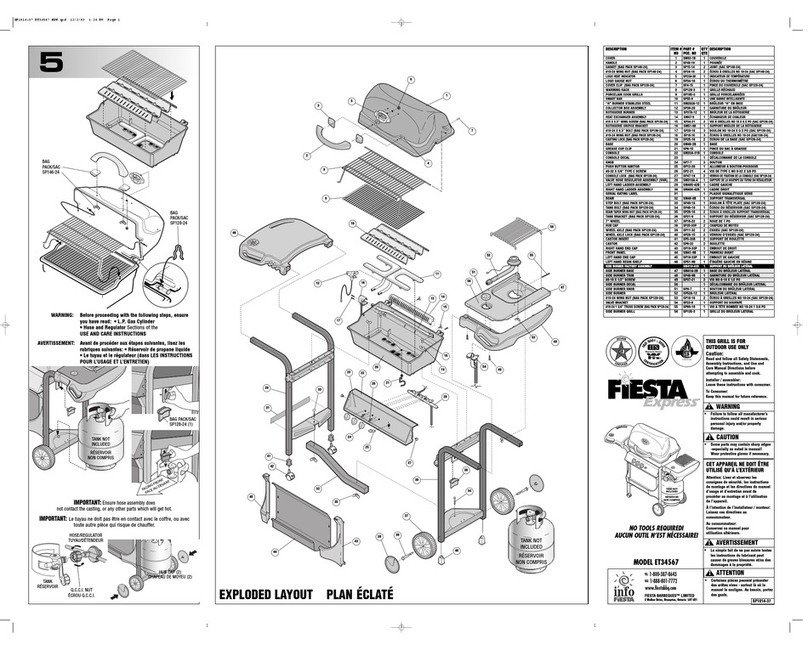
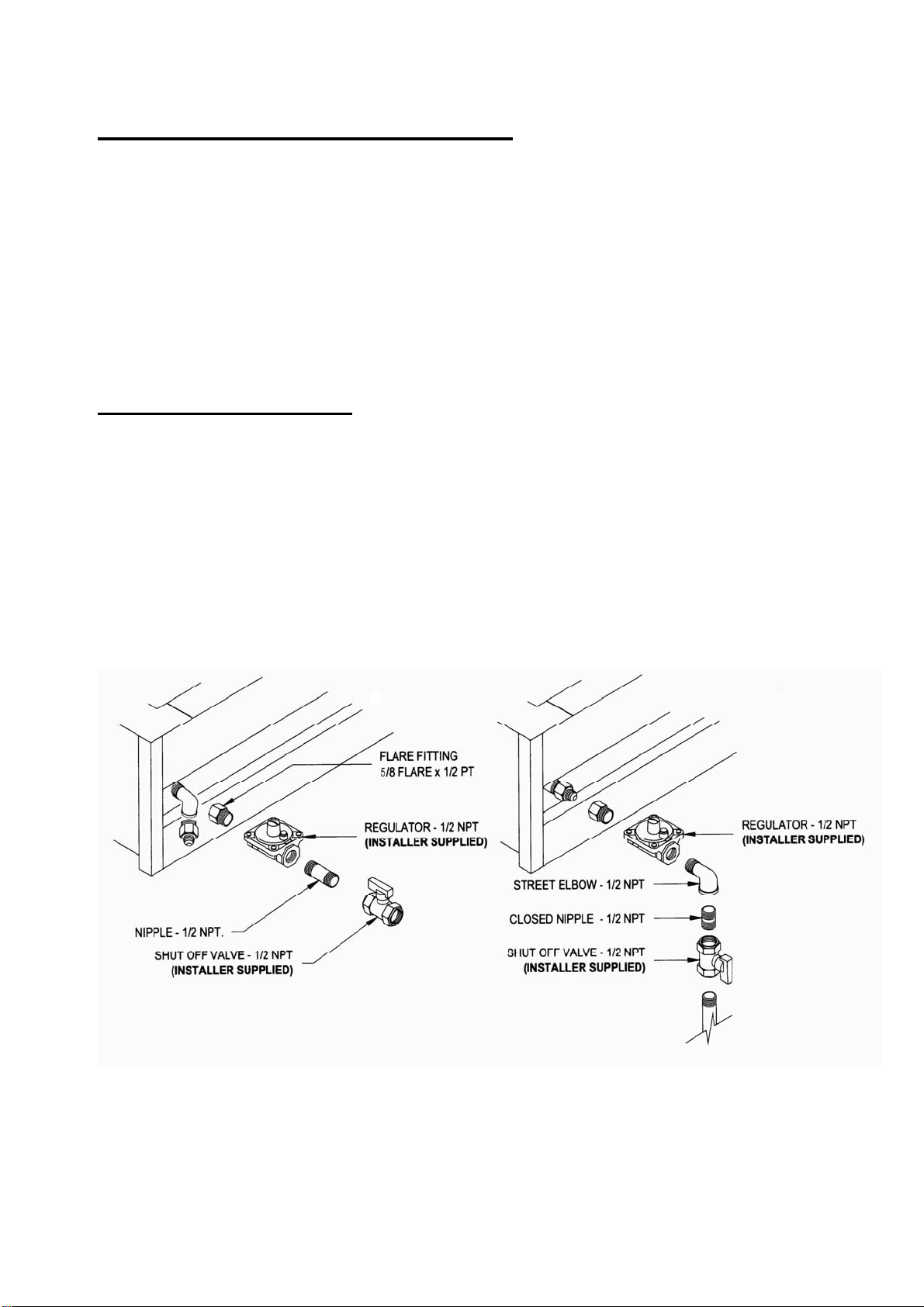
To connect, insert the regulator inlet into the tank valve and turn the black coupler
clockwise until the coupler tightens up. DO NOT OVER TIGHTEN THE COUPLER.
To disconnect, turn the tank valve off. Hold the coupler sleeve and turn counter clockwise.
The inlet line will be disengaged.
If the appliance is not in use, the gas must be turned off at the supply cylinder. Cylinder
must be stored outdoors out of reach of children and must not be stored in a building,
garage or any other enclosed area.
A dented, rusty or damaged propane cylinder must be replaced immediately.
Check for leaks every time the cylinder is replaced or
reconnected. All leaks must be corrected immediately.
Never use an open flame to check for leaks.
(see illustration on p.12)
LP Tank Requirements:
The L.P. gas cylinder must be constructed and marked in accordance with the
specifications for L.P. gas cylinders of the U.S. Department of Transportation (DOT) and
designed for use with a QCC-1 quick disconnect system only.
The cylinder must be provided with a shut-off valve terminating in an L.P. gas supply
cylinder valve outlet specified, as applicable, for connection No. QCC-1.
The cylinder must be provided with a listed overfilling prevention device.
The pressure regulator and hose assembly supplied with the outdoor cooking gas appliance
must be used. Replacement of pressure regulators and hose assemblies can be
purchased from authorized dealers.
The cylinder supply system must be arranged for vapor withdrawal. Make sure the LP
cylinder has a collar to protect the cylinder valve.
(a) Do not store a spare LP gas cylinder under on near this appliance.
(b) Never fill the cylinder beyond 80 percent full.
(c) If the information in (a) and (b) are not strictly followed, a death-causing fire or
serious injury may occur.
9