Instruction Manual
PAL/NTSC Encoder 50/60Hz real-time software switchable
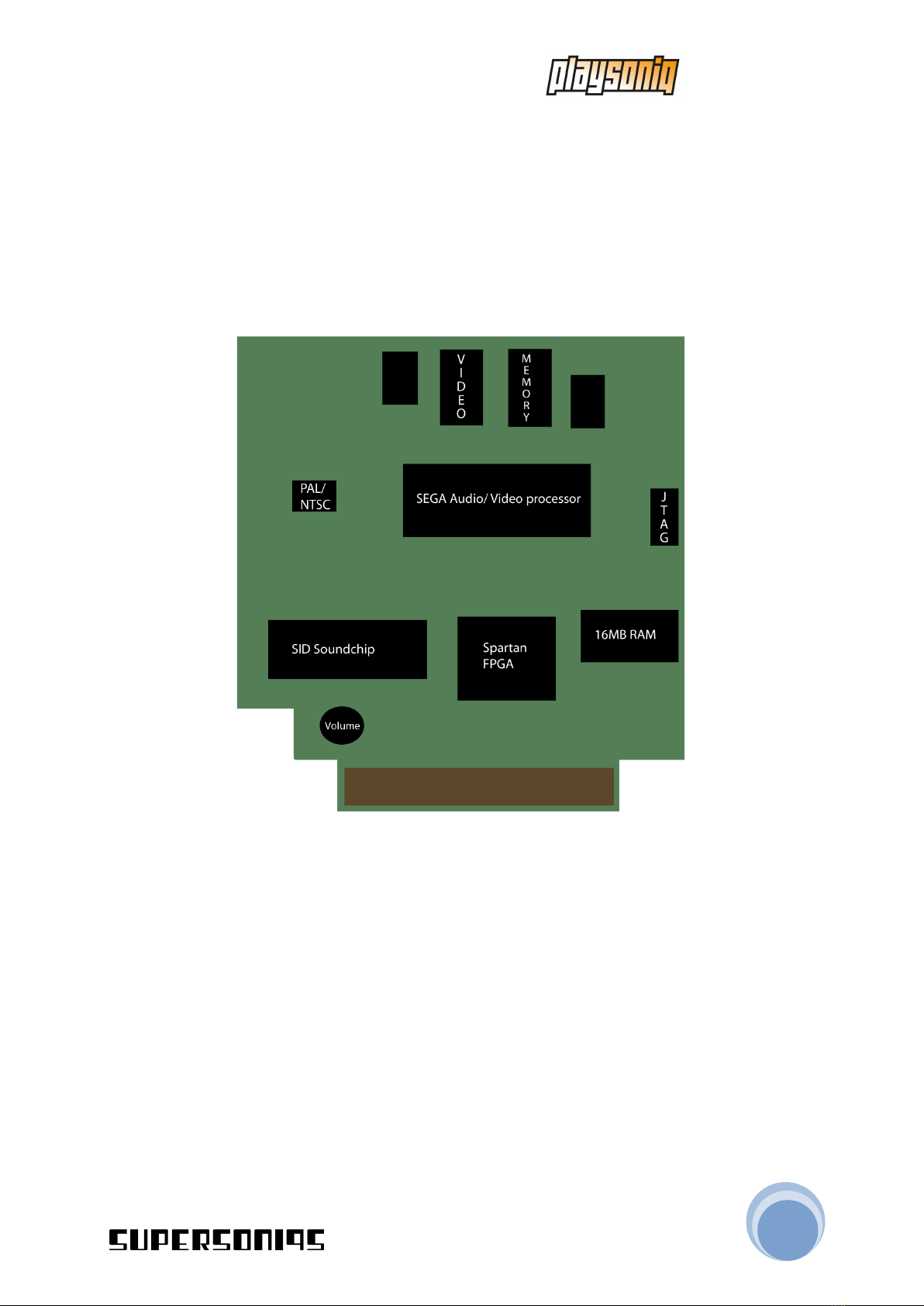
The Advanced Devices AD724 PAL / NTSC Encoder does what it says: it creates the color carrier and
video signals for RGB and composite (CVBS) output. The PlaySoniq has its own PAL crystal onboard
but as your MSX by default also gives the NTSC clock signal we have made it so that you can actually
switch between NTSC and PAL encoding, and also choose between a 50hz or 60Hz refresh frequency.
This eliminated building different versions of the PlaySoniq for us, and you can play your favorite
Japanese games in 60Hz on your European displays (or the other way around) when your TV or
monitor supports this.
MOS Technology 6581 or 8580 Sound Interface Device (SID)
Included in the PlaySoniq is a MOS Technology Sound Interface Device (SID). The SID was created in
1981 by engineer Robert Yannes and has been used in different Commodore models such as the
Commodore 64 and 128 range of home computers. It has a few features that gives the SID its own
unique sound and has a lot of users, even today. For example devices like the SIDstation or HardSID
exist that are custom made synthesizers and need to be supplied with one or multiple real SID’s.
Its main specifications as used on our expander:
three separately programmable independent audio oscillators (8 octave range, approx. 16 -
4000 Hz)
four different waveforms per audio oscillator (saw-tooth, triangle, pulse, noise)
one multi-mode filter featuring low-pass, high-pass and band-pass outputs with 6 dB / octave
(band-pass) or 12 dB / octave (low-pass / high-pass) roll-off. The different filter-modes are
sometimes combined to produce additional timbres, for instance a notch-reject filter
three attack / decay / sustain / release (ADSR) volume controls, one for each audio oscillator
three ring modulators
oscillator sync for each audio oscillator
Three different versions of the SID exist, the 6581, the 6582 (not commonly used) and the 8580. Our
expander supports the 6581 and the 8580. Due to shortage of SIDS, we use the 8580 or the 6581,
depending on which are available during the manufacturing process. Please note that replacing one
type with another type also needs some technical modifications on your expander because both
types use a different voltage and filter.
Connecting the SID to MSX has been a long term wish for some of us. But challenges had to be
overcome. The SID needs a clock speed of around 1MHz, as opposed to the clock speed of MSX
(standard about 3.57Mhz). Buffers had to be implemented so that writing to the SID from a MSX
would not result in stuttering sound. Furthermore, PAL and NTSC versions of Commodore computers
also have slightly different internal clock speeds, and we also needed to support those. The FPGA
processor creates and can switch between those clock speeds.
128 Megabit (16Megabyte) addressable memory
The MSX has four sub-slots for memory banks and each can address a maximum of 4 Megabytes. The
PlaySoniq contains a memory chip and programmed logic to support the maximum of 16 Megabytes
your MSX can handle. The memory mapping system that handles the addressing of the memory can