Version: Leo 15 GTa_GB
8/38
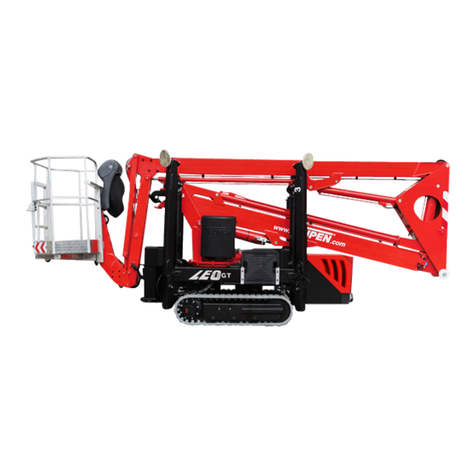
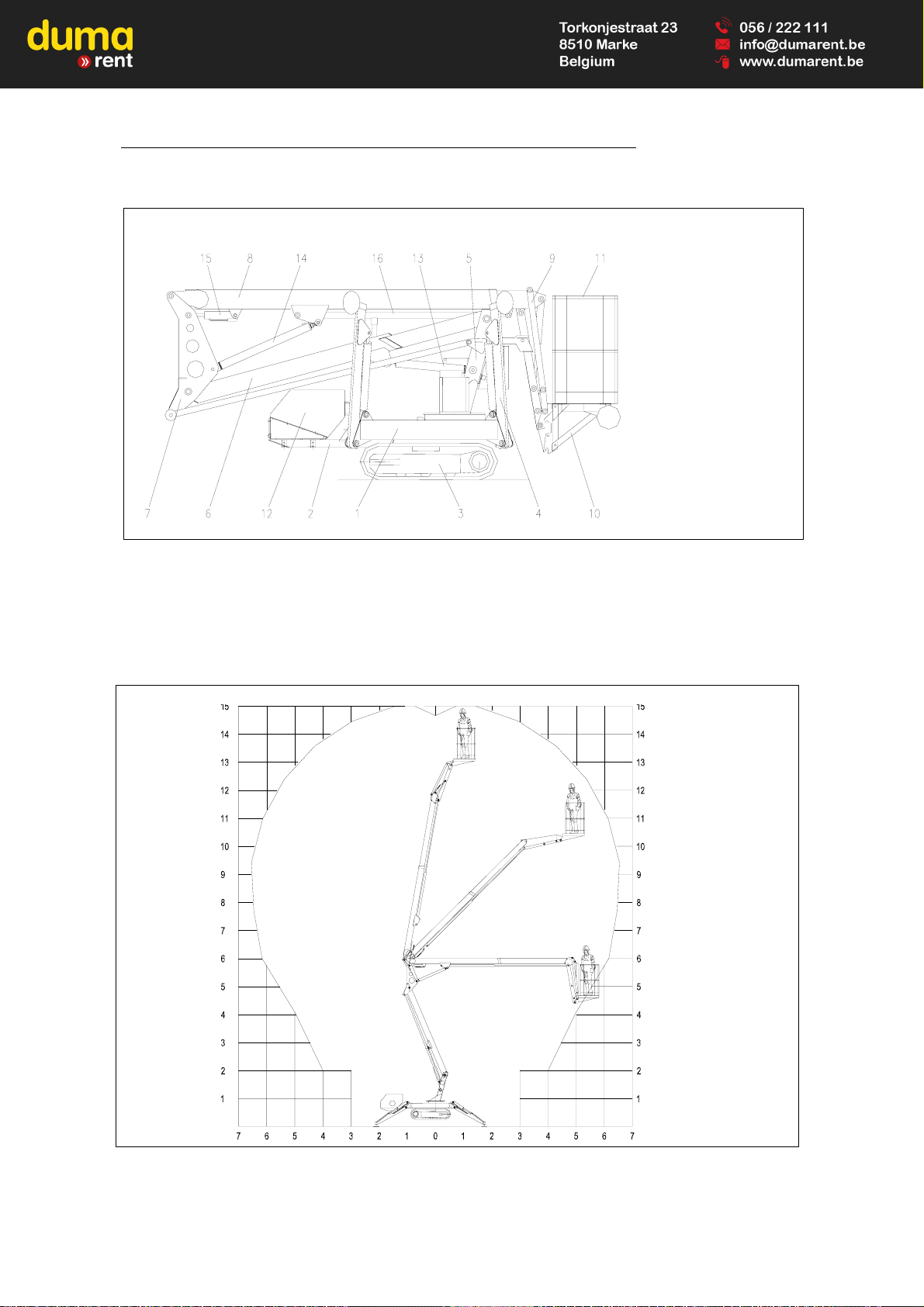
1.3.4 Working cage
The serial equipment is the demountable cage.
The working area / basket / is a welded structure from aluminum profiles and
plates. The entering to the cage can be by a turning down aluminum stairs. An
automatically closing door and the two joining eyelet for tightening the safety
belt serve the safe work.
In the cage is located a tool holder tray to ensure proper storage of the
necessary tools.
The elevating machine has a demountable cage, because of the reducing of the trans-
porting length and it is able to go through narrow opening. In case of the demountable
cage, the superstructure will not operate, only self-propelling movements are possible.
The weight of the aluminum cage is 34 kg.
1.3.5. Controlling of the elevating machine
−The outriggers can be actuated by the manual directional control valve which are
placed on the lifting arm support.
The actuating of the rubber caterpillar tracks can be done by the manual direc-
tional control valve which are placed on the lifting arm support or optionally by the
cord control system (3m).
−The moving of the working basket can be done from the basket control panel
which is before the working basket /cage/ by the joysticks and the turning of the
buttons.
1.3.6. Rubber caterpillar track running gear
This is a special bogie is able to assure the self-powered of the machine on the extreme
ground too. The outside wide of the caterpillar track can be changed between 0.78-
0.98m by mechanically.
The drive of the caterpillar tracks is hydraulic one and the movement of those can be
controlled:
-By hand hydraulic arms which are located on the lifting arm support.
In that case, the maximum speed is 1.5 km/h, which one can be controlled propor-
tionally by the removing of the arms.
-By electrical cable /about 3m /, which cable must be connected to the socket on
the lifting arm support. The required directions can be changed by the turning
switches. In that case, the maximum speed is 0.5 km/h
The caterpillar tracks only can be actuated hydraulically.
Therefore the machine must not be towed in order to avoid the damage of the
hydraulic motors.