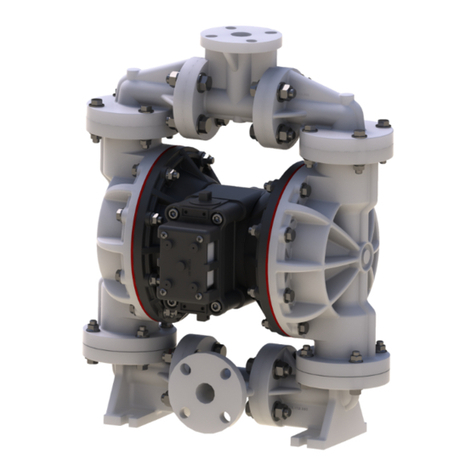
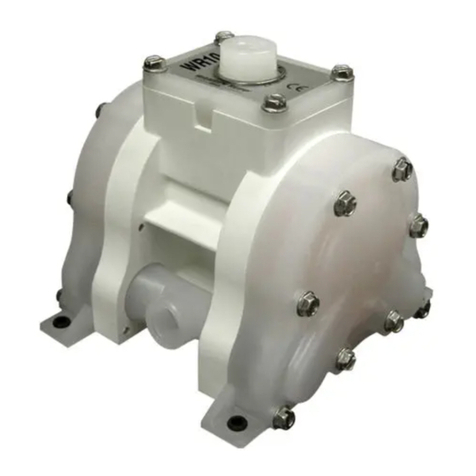
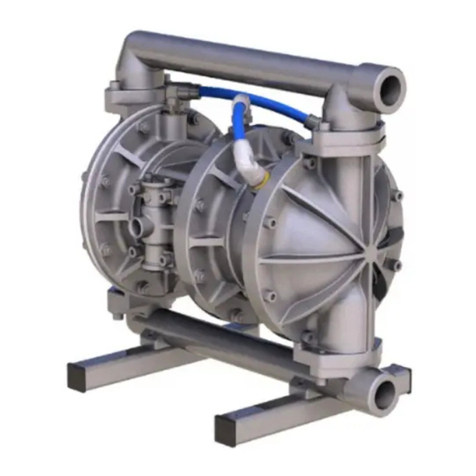
520-193-000 9/02 Model S15 Non-Metallic Design Level 2 Page 8
PRINCIPLE OF PUMP OPERATION
This ball type check valve pump is
powered by compressed air and is a 1:1
ratio desi n. The inner side of one
diaphra m chamber is alternately
pressurized while simultaneously
exhaustin the other inner chamber. This
causes the diaphra ms, which are
connected by a common rod secured
by plates to the centers of the
diaphra ms, to move in a reciprocatin
action. (As one diaphra m performs the
dischar e stroke the other diaphra m
is pulled to perform the suction stroke
in the opposite chamber.) Air pressure
is applied over the entire inner surface
of the diaphra m while liquid is
dischar ed from the opposite side of the
diaphra m. The diaphra m operates in
a balanced condition durin the
dischar e stroke which allows the pump
to be operated at dischar e heads over
200 feet (61 meters) of water.
For maximum diaphra m life, keep
the pump as close to the liquid bein
pumped as possible. Positive suction
head in excess of 10 feet of liquid (3.048
meters) may require a back pressure
re ulatin device to maximize
diaphra m life.
Alternate pressurizin and
exhaustin of the diaphra m chamber
is performed by an externally mounted,
pilot operated, four way spool type air
distribution valve. When the spool shifts
to one end of the valve body, inlet
pressure is applied to one diaphra m
chamber and the other diaphra m
chamber exhausts. When the spool
shifts to the opposite end of the valve
body, the pressure to the chambers is
reversed. The air distribution valve spool
is moved by a internal pilot valve which
alternately pressurizes one end of the
air distribution valve spool while
exhaustin the other end. The pilot valve
is shifted at each end of the diaphra m
stroke when a actuator plun er is
contacted by the diaphra m plate. This
actuator plun er then pushes the end of
the pilot valve spool into position to
activate the air distribution valve.
The chambers are connected with
manifolds with a suction and dischar e
check valve for each chamber,
maintainin flow in one direction throu h
the pump.
INSTALLATION ANDSTART-UP
Locate the pump as close to the
product bein pumped as possible. Keep
the suction line len th and number of
fittin s to a minimum. Do not reduce the
suction line diameter.
For installations of ri id pipin , short
sections of flexible hose should be
installed between the pump and the
pipin . The flexible hose reduces
vibration and strain to the pumpin
system. A sur e suppressor is
recommended to further reduce
pulsation in flow.
AIR SUPPLY
Air supply pressure cannot exceed
100 psi (7 bar). Connect the pump air
inlet to an air supply of sufficient capacity
and pressure required for desired
performance. When the air supply line
is solid pipin , use a short len th of
flexible hose not less than ½" (13mm)
in diameter between the pump and the
pipin to reduce strain to the pipin . The
wei ht of the air supply line, re ulators
and filters must be supported by some
means other than the air inlet cap. Failure
to provide support for the pipin may
result in dama e to the pump. A pressure
re ulatin valve should be installed to
insure air supply pressure does not
exceed recommended limits.
AIRVALVE LUBRICATION
The air distribution valve and the pilot
valve are desi ned to operate WITHOUT
lubrication. This is the preferred mode of
operation. There may be instances of
personal preference or poor quality air
supplies when lubrication of the
compressed air supply is required. The
pump air system will operate with
properly lubricated compressed air
supply. Proper lubrication requires the
use of an air line lubricator (available from
Warren Rupp) set to deliver one drop of
SAE 10 non-deter ent oil for every 20
SCFM (9.4 liters/sec.) of air the pump
consumes at the point of operation.
Consult the pumps published
Performance Curve to determine this.
AIR LINE MOISTURE
Water in the compressed air supply
can create problems such as icin or
freezin of the exhaust air, causin the
pump to cycle erratically or stop
operatin . Water in the air supply can
be reduced by usin a point-of-use air
dryer to supplement the users air dryin
equipment. This device removes water
from the compressed air supply and
alleviates the icin or freezin problems.
AIR INLET AND PRIMING
To start the pump, open the air valve
approximately ½ to ¾ turn. After the
pump primes, the air valve can be opened
to increase air flow as desired. If openin
the valve increases cyclin rate, but does
not increase the rate of flow, cavitation
has occurred. The valve should be closed
sli htly to obtain the most efficient air
flow to pump flow ratio.
BETWEEN USES
When the pump is used for materials
that tend to settle out or solidify when
not in motion, the pump should be flushed
after each use to prevent dama e.
(Product remainin in the pump between
uses could dry out or settle out. This
could cause problems with the
diaphra ms and check valves at restart.)
In freezin temperatures the pump must
be completely drained between uses in
all cases.